Last fact-checked: August 19, 2026. This guide reflects the International Tourist Tax rate in effect for departures from Japan on or after July 1, 2026.
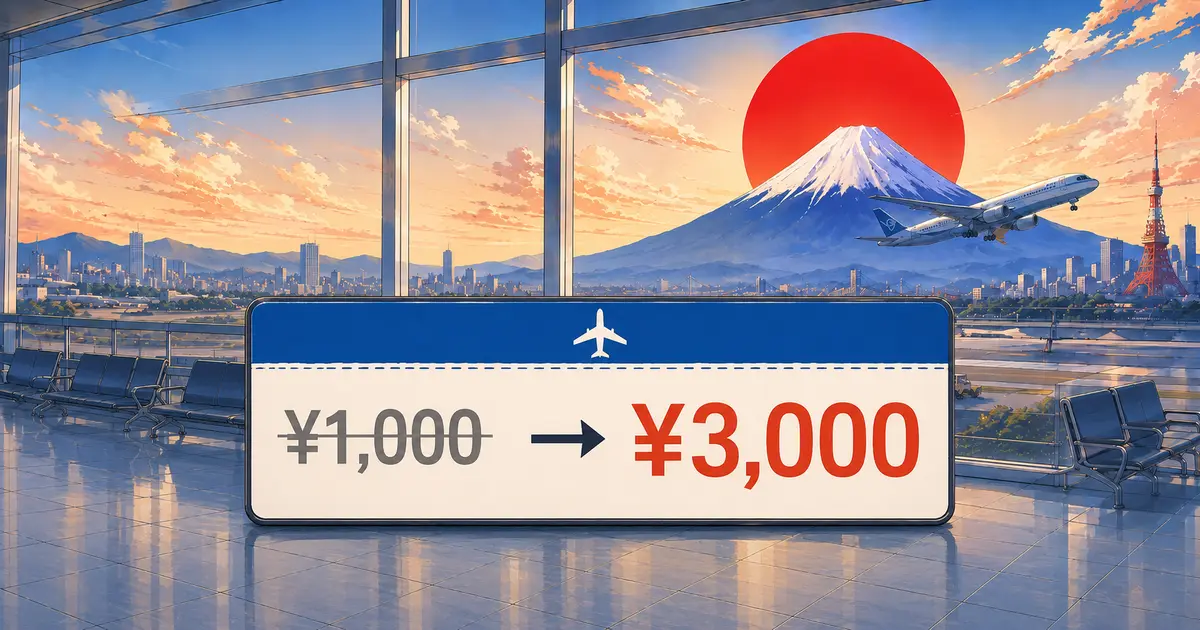
Quick answer: Japan’s International Tourist Tax—often called the Japan departure tax or “sayonara tax”—increased from JPY 1,000 to JPY 3,000 per departure on July 1, 2026. For most travelers flying home to the United States, the airline includes the tax in the ticket price. You normally do not need to find a separate airport counter or pay it in cash before boarding.
The important distinction: This is a nationwide departure tax, not a visa fee, hotel tax, or tax-free shopping charge. It generally applies when a passenger leaves Japan by international aircraft or ship.
- What changed in July 2026?
- Who has to pay Japan’s departure tax?
- How do travelers pay the tax?
- Does the tax apply to tickets booked before July 1, 2026?
- Who is exempt?
- How much should a family budget?
- Is the tax charged once per trip?
- Do award tickets and airline miles avoid the tax?
- How is this different from other taxes in Japan?
- Where does the money go?
- Frequently asked questions
- Is Japan charging U.S. citizens a special tourist fee?
- Do I pay JPY 3,000 when I arrive in Japan?
- Do I have to pay cash at the airport?
- Is the fee JPY 3,000 per family?
- Are children exempt?
- What if I only connect through Japan?
- Can I get the tax refunded if I cancel my flight?
- Will the tax appear separately on my receipt?
- What U.S. travelers should do
- Official sources
What changed in July 2026?
Japan introduced the International Tourist Tax in 2019. The rate was JPY 1,000 per departure until the 2026 increase, which is summarized in the Japan National Tourism Organization’s official traveler notice.
| Departure from Japan | General tax rate |
|---|---|
| Through June 30, 2026 | JPY 1,000 per departure |
| On or after July 1, 2026 | JPY 3,000 per departure |
The official rate is fixed in Japanese yen. If an airline collects the tax in U.S. dollars or another currency, the converted amount can vary because operators may use a reasonable exchange rate reflecting the market at the time of collection.
There are transitional rules for some transportation contracts concluded before July 1, 2026. Those rules are explained later in this guide.
Who has to pay Japan’s departure tax?
The tax is broader than its official English name may suggest. It is not limited to vacationers and it is not based on nationality.
In general, passengers departing Japan on an international commercial flight or ship are subject to the tax. That includes:
- Foreign visitors returning home after a vacation
- Japanese citizens traveling overseas
- Business travelers
- People leaving Japan for work, study, medical treatment, or other reasons
- Cruise passengers departing Japan for a foreign port
For a typical U.S. visitor flying from Tokyo, Osaka, Nagoya, Fukuoka, Sapporo, or another Japanese airport to the United States, the practical assumption should be that the JPY 3,000 tax applies unless the passenger falls within a specific exemption.
How do travelers pay the tax?
For most commercial flights and cruises, the carrier collects the tax. In practice, it is usually included in the total ticket price along with other taxes and fees.
This means most travelers do not need to:
- Buy a separate tax stamp
- Visit a payment kiosk at the airport
- Prepare exactly JPY 3,000 in cash
- Pay the tax again at immigration
Check the tax-and-fee breakdown on your airline, cruise line, or travel agency receipt if you want to confirm the charge. The wording may vary by booking system, so ask the carrier if the International Tourist Tax is not clear.
Different procedures apply to private jets and other departures not covered by collection through an international passenger carrier. In those cases, the traveler may need to pay the government through Customs before boarding.
Does the tax apply to tickets booked before July 1, 2026?
The answer depends on the transportation contract—not only the date of the flight.
Under the National Tax Agency’s transition rules, a qualifying contract of carriage concluded before July 1, 2026, with a departure date already fixed before that date may remain subject to the old JPY 1,000 rate.
However, the new JPY 3,000 rate can still apply to a pre-July contract when:
- The departure date was not fixed before July 1 and was selected afterward
- The departure date was changed on or after July 1
- The contract provides that the International Tourist Tax will be collected separately from the fare
The National Tax Agency also notes that the date of the contract between the traveler and carrier may differ from the date of an arrangement made with a travel agency. If you bought or changed a ticket around the effective date, the safest approach is to check the final ticket receipt or contact the airline.
Who is exempt?
The National Tax Agency’s April 2026 English Q&A lists several non-taxable and exempt categories. The most relevant ones for ordinary travelers are:
- Children under 2: The tax is not levied on a child who is under 2 under the applicable age rule.
- Certain transit passengers: Qualifying passengers traveling through Japan by air and scheduled to depart within 24 hours of entry may be non-taxable when the itinerary meets the official single-ticket requirements.
- Emergency diversions: Certain passengers whose aircraft or ship stops in Japan because of bad weather or another unavoidable reason may be non-taxable.
Other categories include ship and aircraft crew, people leaving on qualifying official ships or aircraft, certain diplomats and state guests, and eligible U.S. or U.N. armed forces personnel traveling for official duties.
Do not assume that every short stopover is automatically exempt. The 24-hour transit rule has itinerary and ticket conditions. If your connection requires entering Japan, changing airports, using separate tickets, or staying close to 24 hours, ask the operating airline how the tax is handled.
How much should a family budget?
The tax is charged per liable traveler, per departure—not per booking.
| Example group | Travelers subject to tax | Total tax |
|---|---|---|
| Solo traveler | 1 | JPY 3,000 |
| Two adults | 2 | JPY 6,000 |
| Two adults and two children age 2 or older | 4 | JPY 12,000 |
| Two adults, one 5-year-old, and one child under 2 | 3 | JPY 9,000 |
These examples assume the new rate applies and no other exemption is involved. Because the charge is usually already inside the ticket total, it may not appear as a new expense during the trip itself.
For broader trip-budget planning—including cash, credit cards, ATMs, and IC cards—see our Cash vs Card in Japan guide.
Is the tax charged once per trip?
It is charged once for each taxable departure from Japan.
For a normal U.S.–Japan round trip, that usually means one charge when leaving Japan. The flight from the United States to Japan does not trigger Japan’s departure tax.
An itinerary involving more than one departure from Japan can generate more than one charge. The National Tax Agency gives the example of a cruise passenger who leaves Japan, visits a foreign port, returns to Japan, and later leaves Japan again. In that situation, the tax can apply to both departures.
Buying an extra airline seat for an instrument or additional space does not create a second tax for the same traveler. The tax follows the number of people departing, not the number of seats purchased.
Do award tickets and airline miles avoid the tax?
No—not automatically. A free or mileage-funded ticket does not remove the traveler’s tax liability.
The National Tax Agency allows mileage to be used as part of the settlement mechanism when the tax is collected with the ticket, but the exact booking and payment display depends on the airline. Review the taxes and fees shown before confirming an award reservation.
How is this different from other taxes in Japan?
Travelers can encounter several unrelated charges that are easy to confuse:
| Charge or system | When it applies | How it works |
|---|---|---|
| International Tourist Tax | When leaving Japan internationally | JPY 3,000 per taxable departure, usually included in the ticket |
| Local accommodation tax | When staying in certain cities or prefectures | Varies by destination, room rate, and number of nights |
| Consumption tax | When buying many goods and services in Japan | Usually included in displayed or checkout prices |
| Tax-free shopping | Eligible purchases by qualifying non-residents | A separate consumption-tax exemption and refund system |
The July 2026 departure-tax increase is separate from Japan’s major tax-free shopping change scheduled for November 1, 2026. If you plan to shop during your trip, read our guide to Japan’s new tax-free shopping refund rules.
Where does the money go?
According to the Japan Tourism Agency and National Tax Agency, the revenue supports tourism-related measures, including:
- Reducing congestion and strengthening measures against overtourism
- Improving airport and tourist-site infrastructure
- Making travel information easier to access
- Protecting and improving cultural, natural, and regional tourism resources
- Encouraging visitors to explore regional destinations beyond the busiest routes
For travelers, the important practical point is that the tax is a national departure charge. Paying it does not replace local hotel taxes, attraction fees, or other charges that may apply during a trip.
Frequently asked questions
Is Japan charging U.S. citizens a special tourist fee?
No. The tax is not specific to Americans or foreign nationals. It generally applies to passengers leaving Japan internationally, including Japanese citizens, unless an exemption applies.
Do I pay JPY 3,000 when I arrive in Japan?
No. It is a departure tax. For a normal commercial flight, it is generally collected through the international ticket rather than at immigration on arrival.
Do I have to pay cash at the airport?
Usually not. Airlines and other international passenger carriers normally collect the tax with the ticket. Private-jet and other exceptional departures can follow different payment procedures.
Is the fee JPY 3,000 per family?
No. It is JPY 3,000 per taxable passenger, per departure.
Are children exempt?
Children under 2 are non-taxable under the official rules. Children age 2 or older are generally subject to the tax unless another exemption applies.
What if I only connect through Japan?
Certain air passengers traveling through Japan and scheduled to depart within 24 hours can be non-taxable, but the official rule requires a qualifying itinerary and single-ticket arrangement. Confirm your specific booking with the operating airline, especially when using separate tickets or changing airports.
Can I get the tax refunded if I cancel my flight?
Cancellation and refund handling is administered by the airline, cruise line, or ticket seller. Ask the seller whether the collected tax will be returned under its cancellation procedure.
Will the tax appear separately on my receipt?
Often it appears within the taxes-and-fees breakdown, but labels and presentation vary by booking system. Contact the airline or seller if you cannot identify it.
What U.S. travelers should do
- Budget JPY 3,000 per liable traveler for each departure from Japan.
- Check the taxes-and-fees section before finalizing your international ticket.
- Do not plan a separate airport payment unless your carrier specifically instructs you to do so.
- Ask the airline about transit eligibility when using separate tickets or entering Japan during a short connection.
- Keep the final ticket receipt if the booking was made or changed around July 1, 2026.
- Remember that local accommodation taxes and the tax-free shopping system are separate.
Bottom line: For most U.S. travelers, Japan’s 2026 departure-tax increase changes the ticket total—not the airport routine. Expect JPY 3,000 per taxable passenger, check that it is included in your fare, and avoid paying it a second time unless your carrier gives specific instructions.
Official sources
- National Tax Agency: International Tourist Tax overview
- National Tax Agency: Q&A about the International Tourist Tax, revised April 2026
- Japan Tourism Agency: International Tourist Tax rate and use of revenue
- Japan National Tourism Organization: Japan’s International Tourist Tax is Increasing
Airline display names, exchange rates, and refund procedures can vary. Confirm the final taxes and fees with the carrier or ticket seller for your specific itinerary.