Quick answer: To navigate Japanese train stations, check four things in order: the railway line, the train’s direction, the platform, and your destination exit. A station name alone is not enough. Before boarding, match the departure display to the specific service in your route plan.
A busy station can feel like a shopping mall that happens to contain several railways. You do not need to understand the entire building. You only need to identify your next step—and leave enough time to do it without running.
This guide focuses on finding your way through stations, with Tokyo Metro and JR examples. Signs, ticket rules, and station layouts differ between operators. For choosing and setting up a transit card, use our separate Suica guide for tourists.
Official guidance checked September 11, 2026. Follow current station displays and staff instructions when routes, platforms, or facilities change.
- Start with this station checklist
- Station numbers, platform numbers, and exit numbers are different
- 1. Plan to the actual building, not just the station
- 2. Find the correct railway entrance and ticket gate
- 3. Match the train’s direction, not just its line color
- 4. Understand local, rapid, express, and limited express
- 5. Handle transfers one step at a time
- 6. Find the correct exit before going outside
- 7. Plan separately for suitcases, strollers, and step-free access
- What to do when you make a mistake
- Japanese phrases for asking station staff
- Small habits that make station travel easier
- Frequently asked questions
- Your final check before boarding
Start with this station checklist
- Before leaving: save your destination’s exact address and the full train route.
- Outside the station: find the entrance for the operator and line you need.
- Before entering the gates: confirm that your ticket or transit card covers the intended journey.
- At the platform: match the line, direction, service type, and stopping stations.
- When changing trains: follow signs for the next line, checking whether a gate crossing is required.
- At your destination: choose the correct exit before heading outside.
My practical recommendation is to plan your first journey around clarity. One straightforward ride and a slightly longer walk may suit you better than a tightly timed route with several unfamiliar transfers.
Station numbers, platform numbers, and exit numbers are different
Several kinds of numbers can appear in one journey. They answer different questions.
| Information | What it identifies | How to use it |
|---|---|---|
| Line name or symbol | The railway service to follow | Find matching signs before entering the gates. |
| Station code | A stop on a particular line | Check your boarding, transfer, and destination stations. |
| Platform number | The place where you board | Confirm it on the station’s departure display. |
| Car number | A carriage within a train | Use it for a reservation or an optional boarding-position suggestion. |
| Exit number or name | A route toward the surrounding streets | Match it to your hotel or attraction’s access directions. |
Tokyo Metro uses a line letter and station number inside a colored circle. The letter identifies the line; the number identifies the station on that line. Its official map and numbering guide explain the system.
A platform labeled “2” does not mean station number 2. An exit labeled “A2” is another identifier entirely. When asking for help, show the whole route rather than pointing to a number without context.
1. Plan to the actual building, not just the station
Enter your hotel, restaurant, or attraction as the destination in your route planner. If you stop planning at the station, you still have to solve the last part of the journey after arrival.
Check that you selected the correct branch of a hotel or business. Save its address in Japanese as well as English. A screenshot of the building entrance can also be useful when several properties have similar names.
Before starting, make yourself a short journey note:
- Board at: station and line.
- Travel toward: the direction shown for your chosen service.
- Change at: station and next line, if needed.
- Get off at: destination station.
- Leave through: the recommended exit or accessible route.
This is a planning template, not a live itinerary. Fill it using a route search for your actual travel date and departure time. A route saved last night may no longer describe the next departure this morning.
How to read Google Maps without following it blindly
Expand the transit journey and read each leg. Look for the operator, line, destination direction, departure time, and any walking connection. Platform and exit details may be available, but do not assume every route includes them.
Google explains that some departures use real-time information while others show a timetable. Treat an app as your route plan and station displays as an essential check on the service you are about to board. See Google’s transit departure guidance.
If you miss the suggested departure, search again. The next train from the same platform may have a different destination or stopping pattern. For your first unfamiliar transfer, I suggest allowing an extra 10–15 minutes where practical; this is a planning cushion, not an official minimum.
2. Find the correct railway entrance and ticket gate
Large station complexes can contain multiple operators. “I am at the right station” does not necessarily mean “I am at the right gate.” Follow the railway and line named in your itinerary before tapping in.
For example, a route using a JR line and a route using Tokyo Metro are not interchangeable simply because both pass through the same neighborhood. Avoid entering the first gate you see while assuming the correct platform will be somewhere inside.
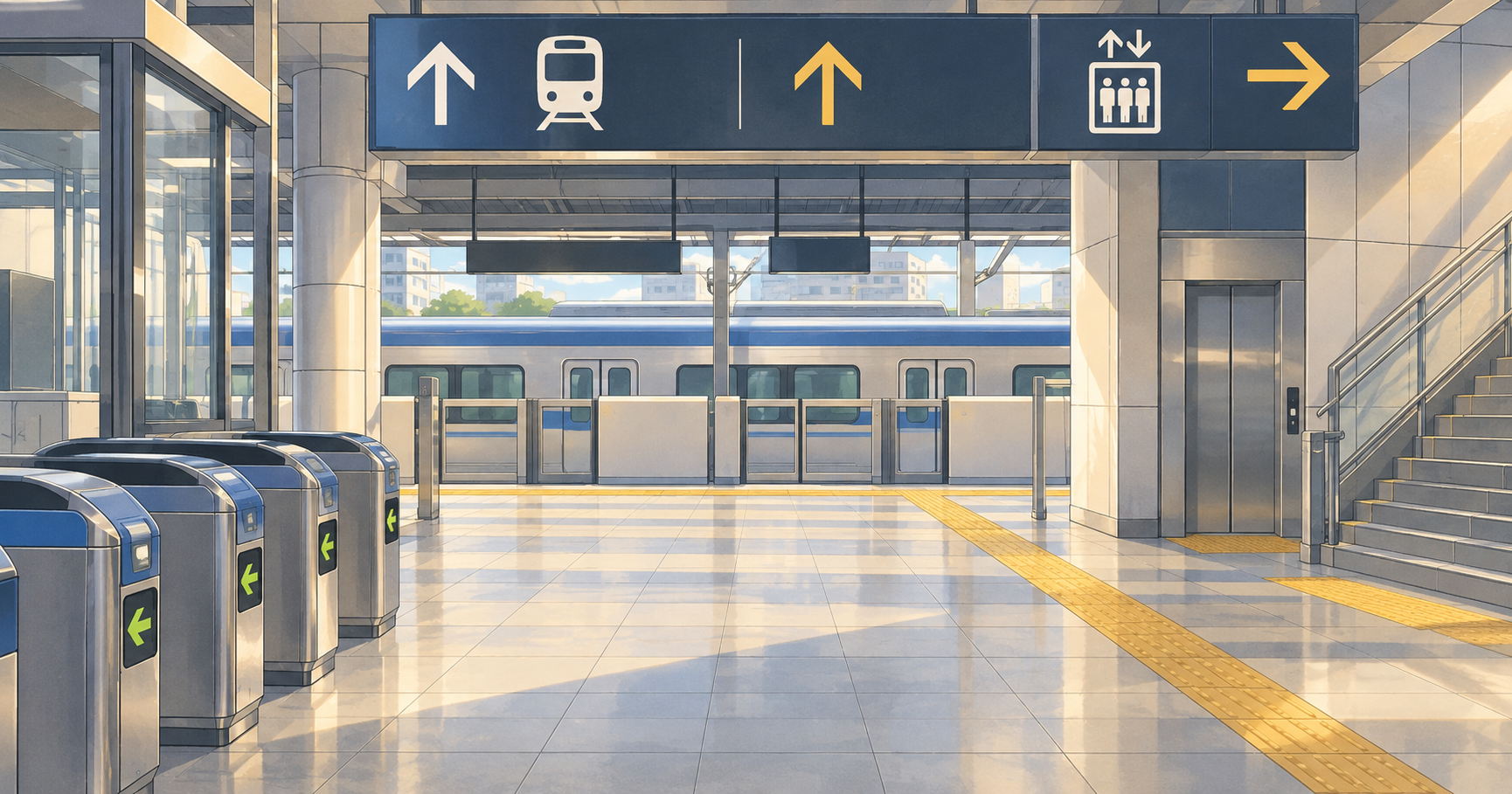
Tokyo Metro’s boarding guide recommends using line symbols and overhead arrows to find the gate, then checking direction and platform information. It describes blue transfer guidance and yellow exit guidance on its own network. Use those colors as a Tokyo Metro aid, not a rule for every station in Japan.
Also distinguish a transit IC card from a contactless bank card. Tokyo Metro offers Tap to Ride with eligible bank cards, but that service does not extend to every railway, including JR East. Check your whole route before choosing how to enter.
What if the ticket gate rejects your card?
Step aside and ask station staff. Show where you boarded and where you want to go. Do not follow another passenger through, repeatedly change payment methods, or assume a closed gate means you should try a different railway.
For balance, entry-record, and device problems, see the troubleshooting section in our Suica guide. Keeping payment troubleshooting there leaves this guide focused on finding your way.
3. Match the train’s direction, not just its line color
A line usually serves more than one direction, and some services branch or end before your destination. The destination displayed on a train may be farther away than the stop you need. That alone does not make it the wrong train.
Compare the departure board with your route’s direction and stopping pattern. If your destination is not obvious, check the line diagram or ask whether that particular train stops there.
A useful hypothetical example: your journey is to “Museum Station,” but the train display says “River Terminal.” It can still be correct if Museum Station is an intermediate stop. The question is not whether both names match; it is whether your station is served by that departure.
On the platform, keep these checks together: right line, right direction, right service, right stop. Do not reduce the decision to “the train is the same color as the one in my app.”
4. Understand local, rapid, express, and limited express
Service names tell you something about stopping patterns, but fare rules are operator-specific. Before taking a faster train, confirm both that it stops at your station and that you have the required ticket.
| Label | Typical meaning | Your check |
|---|---|---|
| Local — 普通 / 各駅停車 | A service stopping at each station on its operating section | Does it travel far enough in your direction? |
| Rapid — 快速 | A service skipping some stops | Is your station on its stopping pattern? |
| Express — 急行 | A faster stopping pattern, defined by the railway | Check the operator’s stops and ticket requirements. |
| Limited Express — 特急 | A service with fewer stops; ticket rules vary | Do you need a supplement or reservation? |
For JR Central’s Shinkansen and limited express services, the company explains the need for the relevant express ticket in addition to the basic fare. Digital products may package or link these components. See JR Central’s ticket types.
JR East also separates ordinary local/rapid travel from limited express and Shinkansen ticket arrangements in its ticket overview. A successful tap through a gate is not proof that every train or premium car beyond it is included.
For a short city trip, avoiding an unfamiliar premium service can remove an unnecessary decision. For a reserved long-distance journey, check the train name, departure, car, and seat against your booking instead.
5. Handle transfers one step at a time
After getting off, pause clear of the doors and identify the next line. Follow its transfer signs. A route that says “change here” may involve a nearby platform, a long corridor, another floor, or leaving one paid area and entering another.
Do not assume that every transfer stays behind the gates—or that walking outside always means you have made a mistake.
Transfers that require leaving the gates
Tokyo Metro identifies certain transfers that require passing through gates. Its English guidance specifies designated orange transfer gates and a 60-minute transfer window for these arrangements. This is an operator-specific rule, not permission to leave any station for an hour and resume the same fare. Follow the instructions for your ticket and connection. See Tokyo Metro’s transfer and exit guide.
If you are uncertain, ask before passing through. Show staff your next line and your ticket or IC card so they can explain the correct gate procedure.
When the route says to stay on the train
A through service can continue onto another line. A change of line name in your itinerary does not always require changing trains. Read the instruction for your specific departure: “stay on the train” and “transfer” are different actions.
If an announcement or display conflicts with your saved route, ask staff or recheck the journey. Do not stay aboard solely because an earlier screenshot said there would be no transfer.
6. Find the correct exit before going outside
Keep the destination’s access instructions open as you approach the end of your trip. “West Exit,” a named ticket gate, and a numbered street exit may describe different stages of the walk.
JR East publishes station maps for major stations. Use the relevant map to understand where your platform, gate, and street access sit relative to one another.
For a hotel arrival, I recommend checking its own access page alongside your map app. Write down the exit and one visible landmark. “Meet at the station” is also a weak plan for a group; choose a named gate or a specific location outside the paid area.
If you reach the wrong side of a station, stop and calculate a walking route from where you actually are. Do not automatically tap back into the paid area just to cross the building. Ask whether there is a public passage if the route is unclear.
7. Plan separately for suitcases, strollers, and step-free access
The shortest walking route is not necessarily the easiest route with luggage. A nearby exit may involve stairs, while an elevator route may emerge on a different street.
Before committing to an entrance, check the station map for the full path from street to gate to platform. Finding one elevator does not by itself tell you that the entire transfer is step-free. If accessibility is essential, confirm the connection with the operator and allow time for assistance.
My suggestion for travelers with heavy bags is to compare journeys by the number of changes and the amount of carrying, not only by the arrival time. A few minutes saved on paper can disappear when you have to move several bags between levels.
For a sightseeing stop between hotels, read our coin locker guide. If you use a locker, photograph its location, identifying number, and nearby exit sign before walking away. “Somewhere inside the station” is not a useful collection plan.
Large bags on a bullet train involve separate route-specific rules. Check our Shinkansen luggage guide before booking.
What to do when you make a mistake
You board in the wrong direction
Get off at the next suitable scheduled stop, then check the correct return route. Before leaving a paid area, ask staff about your ticket or IC journey. Fare treatment depends on the operator and what happened; do not assume every accidental detour is free.
You miss your stop
Check the next stopping station and your onward options. A fast service may not stop again immediately. If you are aboard a reserved or long-distance train, speak to the crew when possible rather than inventing a return journey using the same ticket.
You miss a connection
Refresh the route from your present station and current time. Recheck any later reservation or last connection. For a booked service, consult its ticket conditions or staff; the replacement arrangement is not universal.
You lose mobile data
Use saved route notes and station signs to reach an information point. Screenshots help with names and addresses, but they cannot report a service change. Keep your hotel’s address and contact details available independently of your route app.
You become separated from your group
Stop in a safe place and message a specific meeting point. Agree in advance that nobody should hold doors or rush onto a departing train to keep the group together. A missed train is easier to solve than an injury.
Japanese phrases for asking station staff
Show your destination on your screen while asking. One short, specific question is easier to answer than a long explanation of your entire day.
| English | Japanese | Pronunciation |
|---|---|---|
| Which platform for trains to ___? | ___行きは何番線ですか? | ___ yuki wa nan-bansen desu ka? |
| Does this train stop at ___? | この電車は___駅に止まりますか? | Kono densha wa ___ eki ni tomarimasu ka? |
| Do I need to change trains? | 乗り換えが必要ですか? | Norikae ga hitsuyō desu ka? |
| Which exit should I use? | どの出口から出ればいいですか? | Dono deguchi kara dereba ii desu ka? |
| Where is the elevator? | エレベーターはどこですか? | Erebētā wa doko desu ka? |
| I took the wrong train. | 電車を間違えました。 | Densha o machigaemashita. |
Small habits that make station travel easier
- Step out of the walking flow before checking your phone.
- Keep ticket gates, tactile paving, stairs, and elevator doors clear.
- Let passengers leave the train before boarding.
- Do not hold train doors or run for a closing departure.
- Keep suitcases under control and avoid blocking aisles.
- Check signs for reserved, premium, or restricted cars before boarding.
You are allowed to take a moment to understand the station. Choose a safe place to pause, identify your next sign, and continue when you are ready.
Frequently asked questions
Is a station number the same as a platform number?
No. A station code identifies a stop on a line. A platform number identifies where you board within the station. Keep both in your route notes if available.
Can I use the same platform for every train on a line?
Do not assume so. Check the current display for your direction and specific service. Your app’s platform suggestion is useful, but it still needs confirmation at the station.
Is the first train that arrives always the right one?
No. Check its destination and stopping pattern. Different services can use the same platform, and a faster departure may skip the stop you need.
Should I leave the ticket gates when transferring?
Only when the indicated connection requires it. Follow the operator’s transfer signs and ask staff if uncertain, especially when traveling with paper tickets or passes.
Does this guide also help outside Tokyo?
The planning sequence—line, direction, service, platform, exit—is useful elsewhere. Tokyo Metro’s sign colors and transfer rules should not be applied automatically to Osaka, Kyoto, rural stations, or another railway.
Your final check before boarding
Right line? Right direction? Does this service stop where you need it? Correct ticket? Once those are confirmed, board calmly and keep your transfer or exit information ready for arrival.
Written by Sho, a Japanese-born lodging facility manager in Tokyo, to help visitors handle everyday travel decisions with more confidence.