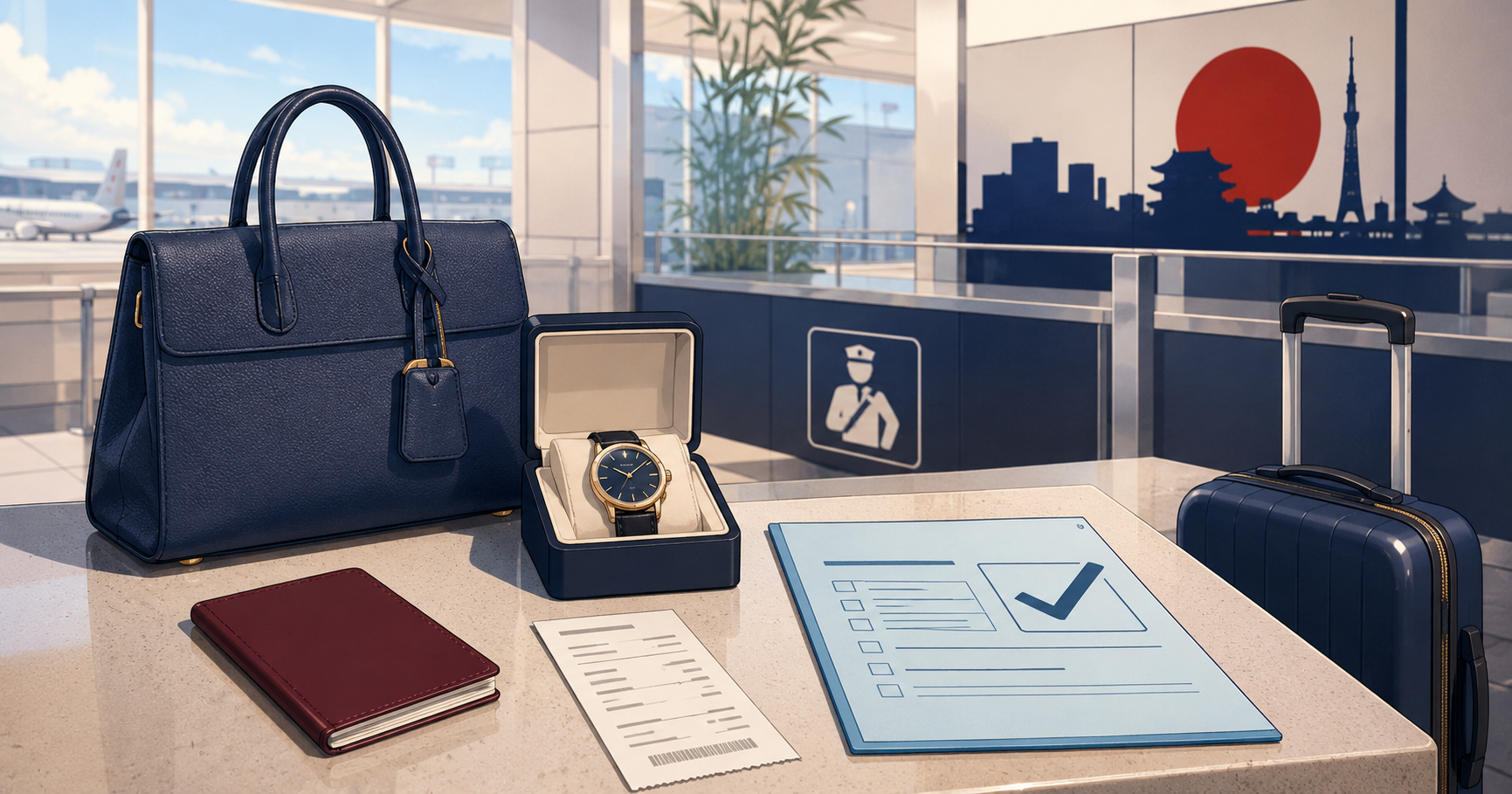
Quick answer: Do you have to declare luxury goods bought in Japan? Yes. U.S. residents must declare bags, watches, jewelry, clothing, and other items acquired abroad when returning to the United States. You may qualify for tax-free shopping in Japan and the usual U.S. $800 personal exemption, but “tax-free in Japan” does not mean “no U.S. declaration or customs duty.”
For many eligible U.S. travelers, the usual personal exemption is $800. This is an exemption from duty—not a threshold below which you can skip the declaration. Value above the exemption may be subject to duty. The exact amount depends on the product, its country of origin, current tariff rules, and the CBP officer’s determination—not simply the fact that you bought it in Japan.
Last fact-checked: September 16, 2026. Japan’s tax-free shopping system changes for purchases made on or after November 1, 2026. U.S. customs rules and tariff measures can also change, so check the official sources before making an expensive purchase.
- Luxury shopping in Japan: the rules at a glance
- Two separate tax systems are involved
- Can tourists buy luxury goods tax-free in Japan?
- What changes on November 1, 2026?
- Do you have to declare luxury goods bought in Japan?
- How does the U.S. 0 personal exemption work?
- The country of purchase is not always the country of origin
- Can families combine their exemptions?
- What paperwork should you keep?
- Should you wear the watch or use the bag before flying home?
- Can you mail the luxury item home?
- How to handle the airport procedures
- Is luxury shopping in Japan still worth it?
- A practical note from Sho
- Frequently asked questions
- If I buy a tax-free handbag in Japan, do I declare it in the U.S.?
- How much can I bring back from Japan duty-free to the U.S.?
- Do I pay customs duty on a Louis Vuitton bag bought in Japan?
- Is the first 0 always free of U.S. duty?
- Will I pay only 3% on an expensive watch?
- Does removing the box mean I do not have to declare the item?
- Does a used or vintage luxury item count?
- Do I need to declare gifts?
- Can the store tell me my exact U.S. duty?
- Final checklist
- Official sources
Luxury shopping in Japan: the rules at a glance
| Question | Short answer |
|---|---|
| Can tourists buy luxury goods tax-free in Japan? | Yes, when the traveler, store, purchase amount, and goods meet Japan’s rules. |
| Do I declare the item when returning to the U.S.? | Yes. Declare all items acquired abroad, including tax-free purchases and gifts. |
| Is the first $800 automatically declaration-free? | No. Eligible travelers may receive a duty exemption, but the goods must still be declared. |
| What happens above the exemption? | Duty may apply. When eligible for flat-rate treatment, the next $1,000 may be assessed at 3%; other value depends on classification, origin, and current rules. |
| What changes in Japan on November 1, 2026? | You pay the tax-inclusive price first and receive the tax equivalent only after the required departure confirmation. |
Two separate tax systems are involved
Luxury shopping on a Japan trip involves two different borders and two different sets of rules.
| Stage | Authority | Main question |
|---|---|---|
| Buying and leaving Japan | Japan’s tax-free shopping and Customs system | Do you qualify to buy without Japanese consumption tax or receive a refund? |
| Returning to the United States | U.S. Customs and Border Protection (CBP) | Must the item be declared, and is any U.S. duty due? |
The systems do not cancel each other out. A handbag can qualify for Japan’s tourist tax-free program and still need to be declared to CBP in the United States.
Can tourists buy luxury goods tax-free in Japan?
Yes, if both the traveler and the purchase qualify.
Under the system in effect through October 31, 2026, eligible visitors can generally buy qualifying items at a participating tax-free shop without paying Japanese consumption tax at checkout. The Japan Tourism Agency says a typical eligible foreign visitor must have entered Japan within the previous six months and present the required passport or entry documentation.
For general goods such as watches, handbags, clothing, and electronics, purchases at the same store on the same day must total at least JPY 5,000 excluding tax. The shop itself must be authorized to handle tax-free sales.
Japan’s standard consumption tax rate is 10% for most luxury goods. Be careful with the phrase “10% off,” though. Removing 10% tax from a tax-inclusive sticker price does not equal a 10% discount from that final sticker price. Stores or refund providers may also have their own handling arrangements.
For the full eligibility rules and airport procedure, read our Japan Tax-Free Shopping Changes in 2026 guide.
What changes on November 1, 2026?
Japan is moving from an at-purchase exemption system to a departure-based refund system for purchases made on or after November 1, 2026.
| Purchase date | What happens at the store | What happens when leaving Japan |
|---|---|---|
| Through October 31, 2026 | Eligible purchases are generally sold at a tax-exclusive price. | Customs may ask to see the goods and your passport. |
| From November 1, 2026 | You pay the tax-inclusive price. | The consumption-tax equivalent is refunded only after the required departure confirmation. |
Under the new system, you must complete the tax-free departure procedure within 90 days of purchase. The Japan Tourism Agency says the procedure takes place before baggage check-in, because all purchased tax-free items must be available if Customs requests an inspection.
This matters for a luxury item packed deep inside a checked suitcase. If you check the bag first, you cannot retrieve it simply to complete the tax-free procedure.
Do you have to declare luxury goods bought in Japan?
Yes. CBP’s declaration instructions tell U.S. residents to declare all articles acquired abroad and brought into the United States. That includes:
- Handbags and wallets
- Watches
- Jewelry
- Designer clothing and shoes
- Cameras and electronics
- New and pre-owned luxury goods
- Items received as gifts
- Items bought at a Japanese tax-free shop or airport duty-free shop
“Duty-free store” describes how a purchase is treated at that store or under the country of departure’s rules. It is not a promise that the item will enter the United States without duty.
Declare the purchase price you actually paid and keep the receipt. If you received a Japanese consumption-tax exemption or refund, keep the tax-free documents as well.
How does the U.S. 0 personal exemption work?
A returning U.S. resident is commonly eligible for an $800 personal exemption for accompanying goods when the trip and traveler meet the applicable conditions. CBP’s current guidance describes eligibility generally as returning after at least 48 hours abroad and not having used the exemption during the preceding 30 days—in other words, normally once every 31 days.
The items must generally be for personal or household use or intended as gifts. Merchandise intended for resale is not the same as personal travel shopping and may require commercial import procedures.
If your eligible purchases total no more than the exemption, you normally will not owe duty, but you must still declare them.
What happens above 0?
CBP says that, when the flat-rate treatment applies, the next $1,000 above a traveler’s personal exemption may be assessed at a flat 3% rate. Value beyond that is generally assessed under the duty rate applicable to the product.
Do not use this as a guaranteed calculator for an expensive handbag, watch, or piece of jewelry. Exceptions, current trade measures, the item’s tariff classification, and its country of origin can change the result. CBP makes the final assessment.
For a high-value purchase, the safest budget is:
- Assume you must declare the full purchase.
- Do not spend the expected Japanese tax saving before clearing U.S. Customs.
- Keep extra room in your budget for possible U.S. duty.
- Ask CBP directly before the trip if the possible duty materially affects your decision.
The country of purchase is not always the country of origin
This is one of the most important details for luxury shoppers.
A French-brand bag purchased in Tokyo may have been manufactured in France, Italy, Spain, or another country. A Swiss-brand watch may have Switzerland as its origin even though you bought it in Japan. CBP explains that the country of origin is not necessarily the country where an item was purchased.
The origin and tariff classification can affect the applicable duty. Look for origin information on the item, packaging, warranty documents, or invoice. If the receipt does not show it, ask the retailer before leaving Japan.
Can families combine their exemptions?
CBP allows qualifying family members who live in the same household and return together to combine their personal exemptions in some circumstances. However, do not assume that every high-value item can be divided across several travelers exactly as you wish.
List the goods accurately and let CBP apply the family exemption. If one traveler is returning separately, or a family member is not eligible for the normal exemption, the outcome may be different.
What paperwork should you keep?
Keep the following together until you have cleared both Japanese and U.S. Customs:
- The original itemized receipt
- The tax-free receipt or refund registration details
- Your credit-card receipt or other proof of payment
- The item’s model or serial number, if applicable
- The country-of-origin information
- Warranty and authenticity documents
- Photos of the item and receipts stored securely on your phone
For a pre-owned watch or bag, ask for documentation that clearly identifies the item and price. “Vintage” does not mean “invisible to Customs.”
Should you wear the watch or use the bag before flying home?
Using an item does not erase the fact that you acquired it abroad. A watch on your wrist or a handbag on your shoulder still needs to be declared when returning to the United States.
If you purchased the item under Japan’s current tax-free rules, follow the shop’s instructions. Under the system through October 2026, general goods and consumables have different conditions. Under the refund method from November 2026, all tax-free goods must be available for the departure confirmation, and consumed items are not eligible for the refund.
Do not remove labels, discard the receipt, or hide packaging because you believe it will avoid duty. Accurate declaration is the much safer plan.
Can you mail the luxury item home?
Mailing an item does not automatically avoid U.S. import duty. A shipment is processed under import rules that differ from the personal exemption for accompanied baggage.
Japan’s tourist tax-free rules are also important here. Since April 1, 2025, travelers can no longer rely on a delivery slip to prove eligibility after personally mailing tax-free goods overseas. The Japan Tourism Agency says travelers must be able to present the tax-free goods to Customs if requested.
For purchases made under the new system from November 1, 2026, the eligible quantity is limited to goods the traveler can personally carry and take out of Japan. Do not arrange your own international shipment and assume the airport refund will still work.
How to handle the airport procedures
When leaving Japan
- Keep your passport, receipts, and tax-free goods accessible.
- Do not check a suitcase containing tax-free goods before completing any required Customs procedure.
- Follow the process that applies to the purchase date.
- From November 1, 2026, use the designated tax-free procedure terminal or available Visit Japan Web process at your final airport or seaport of departure.
- If the system requests inspection, take the goods to the designated Customs area.
- Confirm how and when the retailer or its provider will issue the refund.
When arriving in the United States
- Declare every item acquired in Japan.
- State the price actually paid and present the receipt if requested.
- Answer questions about the item’s use, origin, and who owns it truthfully.
- Let CBP calculate any exemption and duty.
- Pay the assessed amount using the method instructed by CBP.
Mobile Passport Control, Global Entry, or another expedited process does not remove your obligation to declare purchases.
Is luxury shopping in Japan still worth it?
It can be. A purchase may still offer value because of:
- The Japanese retail price
- The exchange rate
- Japan’s tax-free benefit
- Good condition and careful presentation in the pre-owned market
- Models or colors that are difficult to find at home
But compare the final landed cost, not only the Japanese shelf price:
- Purchase price after any Japanese tax benefit
- Foreign transaction or currency-conversion fees
- Possible U.S. customs duty
- Warranty coverage in the United States
- Insurance and safe transportation
- Return limitations
For card fees and choosing between yen and dollars at checkout, see our cash versus card guide for Japan.
A practical note from Sho
Japanese service can make a major purchase feel wonderfully smooth. The wrapping is beautiful, the paperwork looks organized, and the staff may handle the tax-free procedure with impressive speed. That is the shop side of the journey, though—not the end of the tax story.
Before paying, ask three simple questions: What is the final price? What documents will I receive? What must I do at the airport? Then keep enough money available for possible U.S. duty. A luxury purchase should become a good memory, not a surprise conversation at Customs.
Frequently asked questions
If I buy a tax-free handbag in Japan, do I declare it in the U.S.?
Yes. Japanese tax-free treatment does not remove the U.S. declaration requirement. Declare the price paid and keep the receipt.
How much can I bring back from Japan duty-free to the U.S.?
Many eligible returning U.S. residents have an $800 personal exemption for accompanying goods. Conditions apply, and all purchases must still be declared. If your total is above the exemption, CBP determines whether duty is due and how much.
Do I pay customs duty on a Louis Vuitton bag bought in Japan?
You must declare the bag. Whether you owe duty depends on your available personal exemption, the purchase value, the bag’s country of origin, its tariff classification, and current U.S. rules. Buying a French-brand bag in Japan does not necessarily make Japan its country of origin.
Is the first 0 always free of U.S. duty?
The $800 exemption is the common allowance for eligible returning U.S. residents, but conditions apply, including trip length and how recently you used an exemption. Certain products and circumstances have special rules.
Will I pay only 3% on an expensive watch?
Not necessarily. The 3% flat rate may apply to a limited amount above the personal exemption when the purchase qualifies for that treatment. Remaining value can be assessed according to the item’s classification, origin, and current tariff rules.
Does removing the box mean I do not have to declare the item?
No. Packaging does not determine whether the item must be declared. The key fact is that you acquired it abroad and are bringing it into the United States.
Does a used or vintage luxury item count?
Yes. A pre-owned item acquired abroad is still an article acquired abroad. Keep a receipt showing the amount paid and identifying the item.
Do I need to declare gifts?
Yes. CBP says gifts acquired abroad must be declared. Eligible gifts may be included in your personal exemption, but they are not excluded from the declaration.
Can the store tell me my exact U.S. duty?
The store can provide the price, product details, and country-of-origin information, but it cannot guarantee CBP’s final assessment. For a large purchase, contact CBP before traveling or ask the officer upon arrival.
Final checklist
- Confirm that you and the store qualify for Japan’s tax-free program.
- Check whether your purchase falls before or after the November 1, 2026 system change.
- Ask for an itemized receipt and origin information.
- Keep the goods accessible before leaving Japan.
- Complete the Japanese Customs procedure before checking baggage when required.
- Declare the full purchase when entering the United States.
- Do not assume “tax-free” means no U.S. duty.
- Budget for card fees and possible customs duty.
Bottom line: Japan’s tax-free shopping program can reduce the Japanese purchase cost, but it does not replace the U.S. customs process. Declare your luxury purchase, keep the paperwork, and let CBP determine the exemption and duty. That is far safer than guessing—especially when the item is expensive enough to deserve its own seat on the flight home.
Official sources
- Japan Tourism Agency: Current Tax-Free Shopping Rules
- Japan Tourism Agency: Refund Method from November 1, 2026
- National Tax Agency: Japan Consumption Tax
- U.S. Customs and Border Protection: Know Before You Go
- U.S. Customs and Border Protection: Shopping Abroad
- U.S. Customs and Border Protection: Customs Duty Information
- U.S. Customs and Border Protection: Country of Origin and Imported Purchases
This article provides general travel information and is not legal, tax, or customs advice. CBP officers and the relevant authorities make the final determination in each case.