Fact-checked: August 25, 2026
Yes, many travelers can bring prescription medication to Japan for personal use. But Japan does not decide this only by whether a U.S. doctor prescribed it. The active ingredient, drug category, dosage form, and quantity all matter.
For an ordinary prescription drug, Japan generally allows up to a one-month supply without an Import Confirmation. That rule does not override the separate restrictions on narcotics, stimulants, stimulant raw materials, psychotropics, cannabis, opium, or prohibited substances.
Quick answer: Check the generic active ingredient—not just the brand name—on Japan’s official controlled-substance list. If the medicine is ordinary and you carry no more than a one-month supply, an Import Confirmation is usually not required. If it is controlled, prohibited, injectable, or more than the allowed quantity, extra rules apply.
This guide provides general travel information, not medical or legal advice. Do not stop, replace, or change a prescribed medicine without speaking to your clinician. When in doubt, confirm your exact active ingredient and quantity with Japan’s Ministry of Health, Labour and Welfare before traveling.
- The three checks to make before packing medicine
- Japan’s basic quantity rules
- The one-month rule is not blanket permission
- Controlled substances: when advance permission may be required
- When you need an Import Confirmation
- How to apply for a narcotic or stimulant-raw-material permit
- How to pack prescription medication for Japan
- What to do at Japanese customs
- Can you refill a U.S. prescription in Japan?
- A practical pre-trip checklist
- Frequently asked questions
- Official sources
The three checks to make before packing medicine
Do these checks before you focus on forms. It is much easier to solve a medication question at home than at an airport counter after a long flight.
- Find the active ingredient. Japan’s official controlled-substance list does not list every brand name. Ask your pharmacist or prescriber for the generic ingredient, strength, and dosage form.
- Count the total supply. Use the prescribed daily dose and the total number of tablets, capsules, pens, vials, or syringes—not merely the number of boxes.
- Identify the Japanese legal category. An ordinary prescription medicine, a psychotropic, a narcotic, a stimulant raw material, and a prohibited stimulant can require completely different action.
Japan’s basic quantity rules
The following is a practical summary of the Ministry of Health, Labour and Welfare’s personal-import rules. These quantity exemptions apply only when the product is for your own use and is not otherwise prohibited or controlled.
| What you are carrying | Amount generally exempt from Import Confirmation | Important exception |
|---|---|---|
| Prescription medicine | Up to a one-month supply | Controlled and prohibited substances follow separate rules |
| Other drugs and quasi-drugs | Up to a two-month supply | Ingredient restrictions can still apply |
| Injectable medicine and its syringe | Up to a one-month supply | Limited to a pre-filled syringe or self-injection kit; other restrictions may apply |
| Non-prescription medicine for external use | Up to 24 per item | This exemption excludes poison, deadly poison, and prescription products |
If you exceed the applicable amount, you generally need an Import Confirmation, formerly commonly called a Yunyu Kakunin-sho, before departure. Japan now provides an online application system.
The one-month rule is not blanket permission
This is the part worth reading twice. A one-month supply of an ordinary prescription drug may be exempt from the general Import Confirmation procedure. It does not make a prohibited drug legal, and it does not replace the advance-permission process for certain controlled substances.
A valid U.S. prescription also does not automatically settle the issue. Japanese law applies when you enter Japan. The safest question is not simply, “Is this prescribed?” It is, “How is this active ingredient classified in Japan?”
Controlled substances: when advance permission may be required
Japan’s Narcotics Control Department divides controlled substances into categories including narcotics, psychotropics, stimulants, stimulant raw materials, cannabis, and opium. The required procedure depends on the category.
Examples listed by the department include:
- Narcotics: morphine, fentanyl, oxycodone, codeine, tapentadol, and GHB.
- Stimulant raw materials: lisdexamfetamine and pseudoephedrine.
- Psychotropics: examples include methylphenidate, zolpidem, alprazolam, clonazepam, diazepam, and buprenorphine.
This is not a complete list, and brand names can differ by country. Use the official list and verify the ingredient with your prescriber.
Adderall and Vyvanse are treated differently
This is a useful example of why brand-level assumptions are risky.
- Adderall: Japan’s Narcotics Control Department says it cannot be brought into Japan because its amphetamine ingredient is prohibited, even when it is prescribed for treatment.
- Vyvanse: its active ingredient, lisdexamfetamine, is treated as a stimulant raw material. The department says it may be brought in only after obtaining advance permission.
Do not substitute or discontinue either medicine based on a travel article. Discuss alternatives and timing with your doctor, then confirm the Japanese entry rules with the responsible authority.
Psychotropic medicines have quantity thresholds
For psychotropics listed in Japan’s official threshold table, a traveler carrying no more than the stated amount in a non-injectable form generally does not need permission under the Narcotics and Psychotropics Control Law or a doctor’s certificate. Above the listed threshold—or when carrying an injectable form—a doctor’s certificate is required.
The threshold is ingredient-specific. Do not assume that every anxiety medicine, sleep medicine, or ADHD medicine shares the same limit. If the total amount is more than a one-month supply, the Narcotics Control Department also directs travelers to contact the Ministry of Health, Labour and Welfare about the general import procedure.
Some substances are prohibited for individual travelers
The current official guidance says individual travelers cannot import medicines containing heroin, opium powder, methamphetamine, amphetamine—including dexamphetamine and levamfetamine—or methaqualone, even when prescribed abroad.
When you need an Import Confirmation
For ordinary medicines and medical products, an Import Confirmation is generally needed when the personal quantity exceeds the exemption. The online process allows you to create an account, submit a form and supporting files, receive the decision, and download the issued certificate.
Basic online process
- Confirm that your medicine is not prohibited and determine whether a separate controlled-drug permit is required.
- Create an account on Japan’s official Import Confirmation website.
- Enter the medicine, quantity, trip, and arrival information requested by the system.
- Attach the required supporting documents.
- Download the certificate after approval and have it available for customs clearance.
The Import Confirmation and a controlled-substance permit are not interchangeable. Depending on the ingredient, quantity, and form, a traveler may need to follow a different procedure or contact more than one office.
How to apply for a narcotic or stimulant-raw-material permit
Japan’s Narcotics Control Department advises travelers to apply at least 14 days before travel. Last-minute handling is not guaranteed, and the Tokyo office specifically warns that it cannot accept last-minute applications for any reason.
The official application guidance calls for documents including:
- an import application form;
- an export application form if you will leave Japan with medication remaining;
- a medical certificate from the prescribing doctor, issued within the previous three months;
- the patient’s name and current address;
- the specific medical reason the medicine is needed;
- the medicine name, dose, and strength;
- the doctor’s signature and issue date; and
- photos of the package or other documents showing the medicine accurately.
Submit the application to the office responsible for your arrival airport. If you plan to depart with leftover controlled medicine, read the export instructions as well.
How to pack prescription medication for Japan
For an ordinary medicine within the exemption, the government does not say that every traveler must carry the same set of supporting papers. Still, clear documentation can make questions much easier to answer.
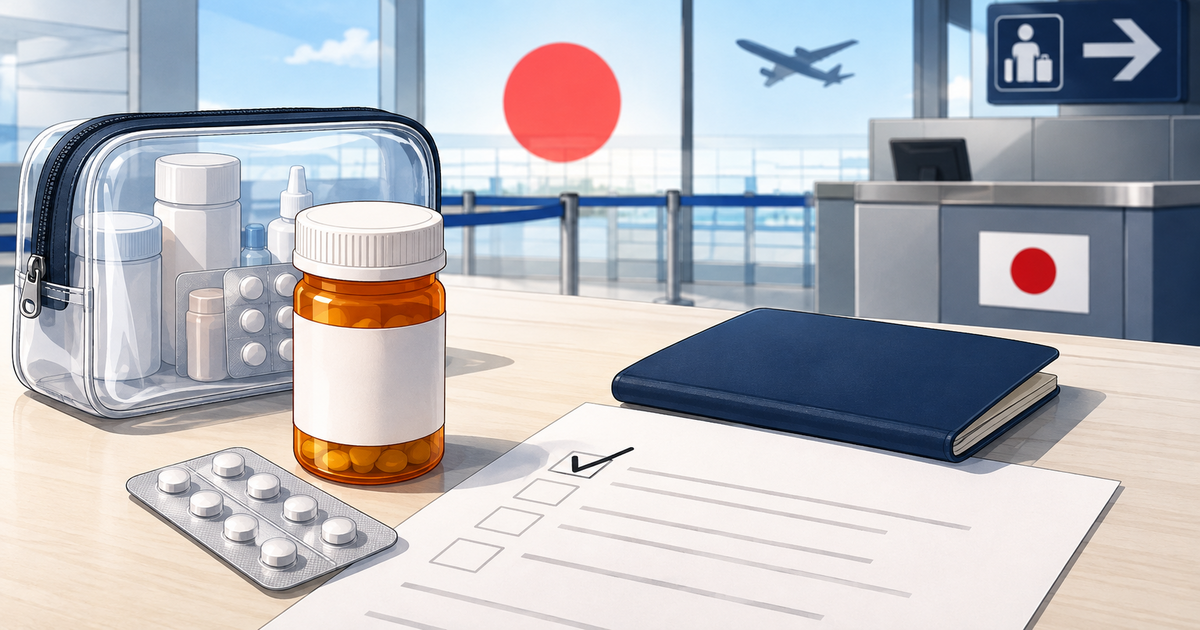
- Keep the medicine in its original labeled container when practical.
- Carry a copy of the prescription or a doctor’s letter showing the generic ingredient, strength, dose, and medical need.
- Bring only a reasonable personal-use quantity for the trip plus a small delay allowance that remains within the applicable limit.
- Keep digital and printed copies of any Import Confirmation or controlled-substance certificate.
- Carry essential medicine in your cabin baggage, subject to airline and security rules.
- Do not place essential medication in a suitcase being sent separately.
Japan’s controlled-substance guidance says the traveler must carry the medicine personally; it cannot be mailed or entrusted to another person. Even for ordinary medication, keeping it with you also protects against delayed checked luggage. If you plan to send suitcases between hotels, read our Japan luggage forwarding guide first.
What to do at Japanese customs
If you obtained an Import Confirmation or an import/export certificate, have it ready to show the customs officer. Keep the medicine and its documents together so you are not unpacking half your suitcase at the counter—airport floors are not ideal filing cabinets.
Answer questions honestly and use the generic ingredient name. A translation app can help with simple communication, but it cannot replace an official permit. If language worries you elsewhere during the trip, our guide to traveling in Japan without speaking Japanese has practical phrases and tools.
Can you refill a U.S. prescription in Japan?
Do not assume a Japanese pharmacy can refill a foreign prescription. Availability, approval status, dosage, and prescribing rules can differ. Some medicines sold under a familiar brand abroad may have a different formula in Japan or may not be approved at all.
If you may need medical care during your stay, check your travel insurance and ask your prescriber how to document your treatment. For a longer stay, contact an appropriate Japanese medical provider in advance rather than waiting until your last dose.
A practical pre-trip checklist
- Write down every active ingredient, strength, dosage form, and total quantity.
- Check the Ministry of Health, Labour and Welfare’s general personal-import rules.
- Check the Narcotics Control Department’s controlled-substance list and FAQ.
- Confirm whether you need an Import Confirmation, a controlled-substance permit, a doctor’s certificate, or no additional procedure.
- Start controlled-substance applications at least 14 days before travel—earlier is better.
- Ask about export permission if controlled medicine will leave Japan with you.
- Pack the medicine and documents in your carry-on.
- Recheck the official pages shortly before departure because rules and lists can change.
Sho’s practical note
Working with international guests has taught me that paperwork problems rarely become more charming when you postpone them. Check the ingredient first, keep the documents together, and do not rely on “someone online brought it once.” Official confirmation is the boring answer—and, here, boring is good.
Frequently asked questions
Can I bring a 30-day prescription to Japan?
Usually, an ordinary prescription drug of up to a one-month supply is exempt from the Import Confirmation requirement. However, controlled or prohibited substances are not covered by that simple exemption.
Is a doctor’s letter enough?
Not always. A letter may support your explanation, but it does not legalize a prohibited ingredient or replace a required government certificate or permit.
Should I check the brand name or generic name?
Check the generic active ingredient. Japan’s controlled-substance list does not include every brand name, and the same brand family may contain different ingredients in different countries.
Can I mail medication to my hotel in Japan?
Do not assume that you can. Japan’s controlled-substance guidance explicitly says controlled medication must be carried by the traveler and cannot be mailed or entrusted to someone else. Mailing ordinary medication is also a separate import process, so confirm the rules before sending anything.
Can I put medicine in luggage forwarding?
Essential medicine should stay with you. Controlled medicines that require permission must be personally carried, and forwarding an essential prescription also creates an unnecessary risk if the bag is delayed.
What if I am still unsure?
Contact the authority responsible for the relevant category before travel. For ordinary pharmaceuticals and Import Confirmation questions, use the Ministry of Health, Labour and Welfare contact information. For controlled substances, use the Narcotics Control Department guidance and the office responsible for your arrival airport.
Official sources
- Ministry of Health, Labour and Welfare: Bringing medicines for personal use into Japan
- Narcotics Control Department: Application guidance for travelers carrying controlled substances
- Official online Application for Import Confirmation
- U.S. Embassy & Consulates in Japan: Importing medication
Bottom line: Most travelers with ordinary prescriptions can prepare without drama, but “prescribed in the United States” is not the same as “automatically permitted in Japan.” Check the active ingredient, quantity, and Japanese category before you pack.