Last fact-checked: September 4, 2026. Admission prices, business hours, amenities, tattoo policies, sauna charges, and rules for children can vary by location and may change. Check the exact bathhouse before visiting.
Quick answer: A sento is a Japanese public bath, usually found in an ordinary neighborhood rather than a hot-spring resort. Remove your shoes at the entrance, pay admission, enter the correct changing room, undress completely, wash and rinse your body at a shower station, and only then soak in the shared bath. Do not wear a swimsuit, place a towel in the bathwater, swim, take photos, or use your phone in the changing or bathing areas.
Most first visits feel more complicated before the door than after it. Once you understand the sequence—shoes, payment, clothes, shower, bath—the experience is surprisingly simple.
My simple recommendation: Choose a sento with a current official page or social account, check its opening hours and tattoo policy, bring a small towel and a larger towel, carry some yen, and arrive with enough time to avoid rushing. Nobody expects a visitor to look like a lifelong bathhouse professional. They do expect you to wash before entering the tub.
This guide is about neighborhood public baths. If you are visiting a natural hot spring at a ryokan or resort, read our separate Japan onsen etiquette guide.
- Sento vs Onsen vs Super Sento
- How Much Does a Japanese Sento Cost?
- What to Bring to a Sento
- Are Tattoos Allowed at a Sento?
- How to Use a Japanese Sento: Step by Step
- 1. Confirm the hours and entrance
- 2. Remove your shoes
- 3. Pay at the front desk or ticket machine
- 4. Enter the correct changing room
- 5. Undress completely and store your belongings
- 6. Rinse or wash before entering the bath
- 7. Enter the bath slowly
- 8. Try other baths only when you understand them
- 9. Dry yourself before returning to the changing room
- 10. Cool down and hydrate
- The Essential Sento Etiquette Rules
- Can You Wear a Swimsuit or Underwear?
- Children and Mixed-Gender Bathing
- What About Transgender and Nonbinary Travelers?
- Health and Safety in a Hot Bath
- Can You Visit a Sento With Luggage?
- How to Find a Sento That Is Easy for Visitors
- A Note From Sho
- Common Sento Mistakes to Avoid
- Frequently Asked Questions
- What is a sento in Japan?
- Do I have to be naked at a Japanese sento?
- Do I shower before using the bath?
- Can foreigners use a sento?
- Are tattoos allowed in Japanese public baths?
- How much is a sento in Tokyo in 2026?
- Are towels and shampoo provided?
- Can I take my phone into the sento?
- Can I go to a sento if I am shy about nudity?
- Can children enter with a parent of another gender?
- What is the difference between a sento and an onsen?
- Final Checklist
- Official Sources
Sento vs Onsen vs Super Sento
English travel information sometimes uses “public bath” for several different facilities. They share much of the same bathing etiquette, but their water, price, scale, and tattoo rules may differ.
| Facility | What it usually means | What travelers should expect |
|---|---|---|
| Sento | A local public bathhouse. The bath may use heated tap water rather than natural hot-spring water. | Simple neighborhood atmosphere, regulated basic admission in many prefectures, and facilities ranging from historic to newly renovated |
| Onsen | A hot spring or facility using water that meets Japan’s legal hot-spring definition. | Common at ryokan and resorts; admission, amenities, and tattoo policies vary widely |
| Super sento | A larger commercial bathing and leisure facility, often with multiple baths, food, relaxation areas, and saunas. | Higher and facility-specific pricing; more extensive services; tattoo restrictions may be stricter than at an ordinary sento |
| Hotel public bath | A shared bath provided for hotel guests. | Not automatically an onsen; rules, hours, access, and amenities depend on the property |
The most important distinction is not whether the building looks traditional. A beautifully tiled neighborhood sento may use ordinary heated water, while a modern building may use qualifying hot-spring water. Read the facility description instead of judging from the architecture.
How Much Does a Japanese Sento Cost?
There is no single nationwide sento price. Basic admission to certain ordinary public baths is controlled at the prefectural level, so the amount changes by region and over time. Larger commercial baths and extra services set their own prices.
As a current example, the Tokyo Metropolitan Government set the following maximum admission prices for price-controlled public bathhouses from August 1, 2026:
- Adults age 12 and older: ¥600
- Children age 6 to 11: ¥200
- Children under age 6: ¥100
Those are Tokyo figures, not a national price list. A sauna, rental towel, soap set, drink, premium area, or other optional service may cost extra. A super sento can have completely different pricing, including weekday, weekend, or late-night variations.
Some bathhouses accept cards or mobile payments, while others remain cash-based. Bring yen and check the entrance before assuming your U.S. card or phone will work. Our guides explain cash and card payments in Japan and how to withdraw yen from a Japanese ATM.
What to Bring to a Sento
A small neighborhood bath may provide less than a hotel spa. Pack the basics unless the facility clearly lists them.
Useful items
- Small wash towel: Used while washing and for modest coverage when walking between the shower and bath. Keep it out of the bathwater.
- Larger bath towel: Used in the changing room after bathing.
- Soap, shampoo, and conditioner: Some sento provide them, some sell small sets, and some expect you to bring your own.
- Hair tie or shower cap: Essential if your hair is long enough to touch the water.
- Cash: Useful for admission, a shoe locker, a drink, or toiletries when cashless payment is unavailable.
- Clean clothes: Optional, but extremely satisfying after a bath.
- A small bag: Helpful for separating wet towels from the rest of your belongings.
Many sento sell or rent towels and sell toiletries at the front desk. Do not depend on that without checking. If you arrive empty-handed, you can ask:
Taoru wa arimasu ka? — Do you have towels?
Shanpū wa arimasu ka? — Do you have shampoo?
Are Tattoos Allowed at a Sento?
Tattoo rules are one of the biggest differences between an ordinary sento and many hot springs or large commercial baths. The Japan National Sento Association states that most ordinary sento allow tattooed customers. It also notes that many super sento and hot-spring facilities do not.
That is encouraging, but it is not permission for every bathhouse in Japan. Check the exact facility’s website, social account, entrance notice, or contact information. Do not assume that a place called “spa,” “onsen,” or “super sento” follows the same policy as a neighborhood sento.
If the policy is unclear, ask:
Tattoo ga arimasu. Daijōbu desu ka? — I have a tattoo. Is that okay?
Do not hide a prohibited tattoo and hope nobody notices. A cover seal is only useful when the facility specifically permits one. If admission is refused, remain polite and choose another bathhouse or a private bathing option. Our onsen guide explains the stricter range of policies commonly encountered at hot-spring facilities.
How to Use a Japanese Sento: Step by Step
1. Confirm the hours and entrance
Bathhouses may open in the afternoon or evening rather than in the morning, and many have one regular closing day each week. Final admission may be earlier than the posted closing time. Check the latest schedule on the facility’s official page, especially around national holidays and New Year.
At the entrance, look for the character ゆ, a common symbol for a bathhouse. Traditional buildings may have a fabric curtain called a noren. Modern sento may look more like a small spa or cafe from outside.
2. Remove your shoes
Do not walk into the changing area wearing outdoor shoes. Use the shoe locker, cabinet, or entrance shelf. Some lockers require a coin that is returned when you reopen them; others use a wooden key. Keep the key with you according to the bathhouse’s instructions.
3. Pay at the front desk or ticket machine
You may pay a staff member at a front counter, at a traditional raised attendant’s desk called a bandai, or at a ticket machine. Tell the staff whether you also want a sauna, towel rental, or toiletries. Sauna access may require a separate key, wristband, towel, or ticket.
If a ticket machine has no English, look for 入浴 or 入浴券, meaning bathing or bathing ticket. When uncertain, ask the staff before pressing several buttons and accidentally buying the world’s most confusing combination of sauna upgrades.
4. Enter the correct changing room
Men’s and women’s areas are normally separate. Look for these signs:
| Japanese | Reading | Meaning |
|---|---|---|
| 男 / 男湯 | otoko / otoko-yu | Men / men’s bath |
| 女 / 女湯 | onna / onna-yu | Women / women’s bath |
| 脱衣所 | datsuijo | Changing room |
| サウナ | sauna | Sauna |
| 水風呂 | mizu-buro | Cold-water bath |
| 露天風呂 | roten-buro | Open-air bath |
Curtain colors are not reliable enough to use by themselves. Confirm the written sign or ask a staff member.
5. Undress completely and store your belongings
Standard sento bathing is nude. Leave your swimsuit, underwear, clothes, large towel, and phone in the changing room. Store valuables in a lockable locker when available. Take only your small wash towel, toiletries, locker key, and any facility-issued sauna item into the bathing area.
Photography is inappropriate in both the changing room and bathing area, even when you think nobody is visible. Leave the phone stored away. Other customers should never have to wonder whether your camera is recording.
6. Rinse or wash before entering the bath
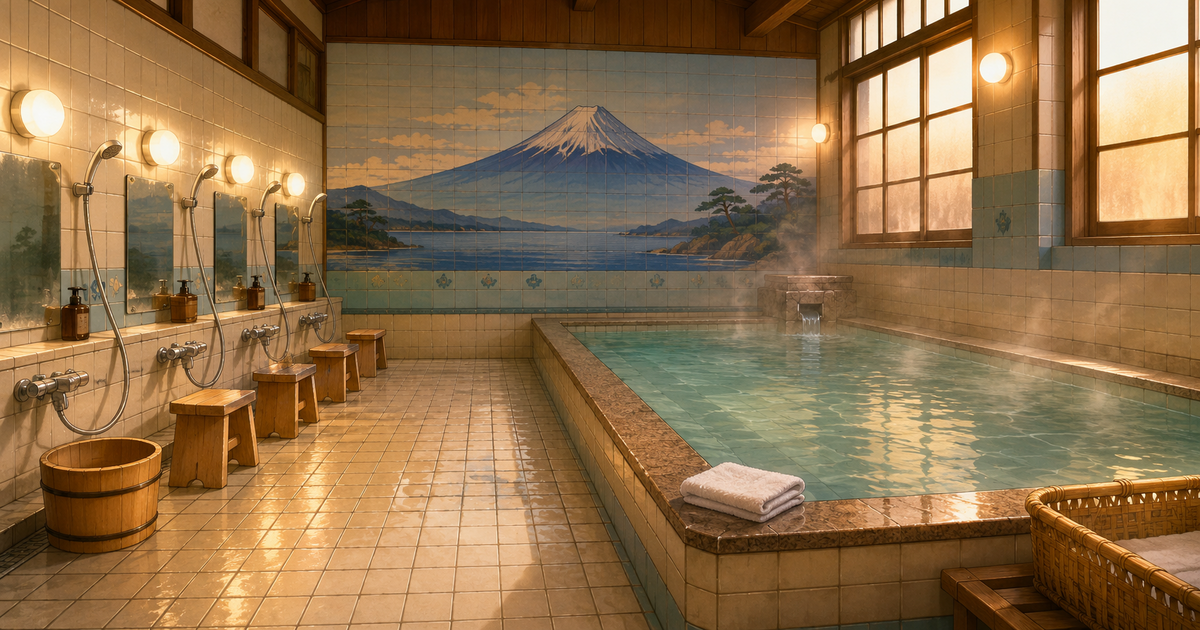
Go to an open washing station, sit on the low stool, and wash your body. Shampoo your hair if needed, then rinse away all soap and foam. Be careful not to spray the people beside or behind you. The shared bath is for soaking a clean body, not for bathing in the Western sense.
Rinse the stool and bucket when you finish, and return them neatly. If the sento has a small basin of hot water near the bath, you can use kakeyu—pouring water over your body—to help adjust to the temperature. Kakeyu does not replace washing when you are sweaty or dirty.
7. Enter the bath slowly
Test the temperature and step in carefully. Japanese baths can feel hotter than a typical U.S. bathtub. Do not jump, dive, swim, splash, or reserve a large area for yourself. Quiet conversation is fine when it matches the atmosphere, but a sento is not the place for shouting across the room.
Keep your small towel on your head or on the dry edge beside the bath. Do not let the towel, hair, or head enter the shared water. Tie up long hair before soaking.
8. Try other baths only when you understand them
A sento may have hot baths, jet baths, a cold bath, an open-air bath, or a sauna. Labels may be only in Japanese. Do not enter a bath simply because another customer did. Check its purpose and temperature, and skip anything you do not understand or do not feel comfortable using.
Saunas often have separate charges and local rules. You may need to wash first, use a designated towel, avoid bringing toiletries inside, and rinse sweat away before entering another bath. Follow the posted instructions.
9. Dry yourself before returning to the changing room
Use the small towel to remove excess water while you are still at the edge of the bathing area. You do not need to become completely dry, but do not walk into the changing room dripping wet. Then use your large towel, dress, and return any rental items or keys as directed.
10. Cool down and hydrate
Take your time after a hot bath. Water, tea, milk, and other drinks are often sold near the lobby, but availability differs. If you feel dizzy, unwell, or overheated, leave the bath, sit somewhere safe, and ask staff for help.
The Essential Sento Etiquette Rules
- Wash before soaking. This is the central rule.
- Do not wear a swimsuit. Ordinary sento baths are used nude unless the facility explicitly states otherwise.
- Keep towels out of the bathwater.
- Keep long hair out of the water.
- Do not swim, splash, or exercise in the bath.
- Keep your voice low. Follow the atmosphere around you.
- Do not use a phone or camera in private areas.
- Rinse your washing stool and bucket.
- Do not block shower stations with personal items after leaving.
- Dry excess water before entering the changing room.
The rule that matters most: The bath is shared. Anything that puts soap, sweat, hair, a used towel, or unnecessary noise into someone else’s experience is the wrong direction.
Can You Wear a Swimsuit or Underwear?
Normally, no. A standard sex-separated sento is used without clothing. Swimsuits and underwear stay in the changing room. A small towel can provide a little coverage while you walk, but it must not enter the bathwater.
A facility designed as a mixed-gender swimsuit zone, water park, or special bathing experience may have different rules. Follow the facility’s instructions rather than carrying those exceptions into an ordinary sento.
Children and Mixed-Gender Bathing
Age limits for a child entering the bath of a parent or guardian of another gender are determined locally and can differ across Japan. In Tokyo, children age 7 and older cannot use the opposite-gender bath. This has applied since January 1, 2022.
Families should check the rules in the prefecture and at the exact facility. A bathhouse may also have policies covering children who use diapers, unaccompanied children, or supervision. If one parent is traveling with an older child of another gender, do not assume the two can enter together. Contact the facility or choose a hotel room bath or reservable private bath.
For room layouts, bed policies, laundry, and other family considerations, see our guide to the best Japanese hotel chains for families.
What About Transgender and Nonbinary Travelers?
Most traditional sento divide their changing and bathing spaces into men’s and women’s sections. Practical admission decisions and available accommodations depend on the facility and applicable local rules. Because the conversation is private and facility-specific, contact the bathhouse before arriving rather than asking at a crowded entrance.
If a shared sex-separated bath would be uncomfortable or uncertain, consider a private bath at an accommodation, a reservable family bath, or a hotel room with its own bathtub. Check tattoo rules separately; a private space does not automatically remove every facility policy.
Health and Safety in a Hot Bath
A sento is relaxing, but hotter and longer are not automatically better. Enter slowly, take shorter soaks, rest between baths, and drink water. Leave immediately if you feel dizzy, nauseated, weak, short of breath, or unusually uncomfortable.
Avoid bathing while intoxicated. If you have a health condition, are pregnant, take medication that affects circulation or alertness, or are uncertain about hot baths, cold baths, saunas, or electric baths, obtain appropriate medical advice before using them. Facility staff can explain equipment, but they cannot assess your personal medical risk.
Can You Visit a Sento With Luggage?
Changing-room lockers are normally designed for clothes and small personal belongings, not large suitcases. A narrow neighborhood bathhouse may have no suitable storage area. Do not block an entrance, aisle, or changing space with luggage.
Leave large bags at your hotel, use a station locker, or ask the sento in advance. Our Japan coin locker guide explains locker sizes, payment, time limits, and what to do when lockers are full.
How to Find a Sento That Is Easy for Visitors
Do not choose only from an old listicle. Search the relevant local bathhouse association, map, or official facility page and verify:
- Today’s opening hours and last admission
- The regular closing day
- Adult admission and optional sauna charges
- Cashless payment availability
- Towel rental or sales
- Soap and shampoo availability
- Tattoo policy
- Access from the nearest station
- Rules for children or other accommodation needs
For Tokyo, the Tokyo Sento Association provides a bathhouse map and an English step-by-step bathing guide. Elsewhere, try the prefectural bathhouse association, a city tourism office, or the facility’s own current page.
A Note From Sho
Visitors sometimes worry that everyone will watch them make a mistake. In reality, regular customers usually want the same thing you do: a clean bath and a quiet moment.
You do not need elaborate knowledge. Watch where shoes are stored, ask when a sign is unclear, wash carefully, keep the towel and hair out of the bath, and respect other people’s privacy. That covers most of the experience.
What I would not treat casually is the phone. A changing room is a private space, even if you only want to check a message or photograph a beautiful mural. Keep the camera put away. The memory will survive without photographic evidence.
Common Sento Mistakes to Avoid
- Confusing a sento with an onsen or super sento
- Assuming every facility charges the same price
- Arriving just before closing without checking last admission
- Walking past the shoe area in outdoor footwear
- Entering the wrong side because you relied only on curtain color
- Wearing a swimsuit into a standard public bath
- Soaking before washing and rinsing
- Putting a towel or long hair into the bathwater
- Spraying nearby customers at the shower station
- Using a sauna without paying the additional charge
- Using a phone in the changing room
- Assuming a tattoo policy from another bathhouse applies here
- Bringing a large suitcase without checking storage
- Staying in very hot water after feeling unwell
Frequently Asked Questions
What is a sento in Japan?
A sento is a public bathhouse where customers pay to use shared bathing facilities. It is often located in a residential neighborhood and may use heated tap water rather than natural hot-spring water.
Do I have to be naked at a Japanese sento?
Yes, at a standard sex-separated sento. Leave swimsuits and underwear in the changing room. You may use a small towel for modest coverage while walking, but keep it out of the bathwater.
Do I shower before using the bath?
Yes. Sit at a washing station, wash your body, and rinse off all soap before soaking. The large tub is shared and is not used for washing.
Can foreigners use a sento?
Yes. Nationality is not a barrier to using a normal public bath. Follow the admission rules and bathing etiquette, and check the facility’s current policies like any other customer.
Are tattoos allowed in Japanese public baths?
The Japan National Sento Association says most ordinary sento permit tattoos, but individual rules still matter. Super sento, onsen, hotels, and spas may have stricter policies. Confirm before visiting.
How much is a sento in Tokyo in 2026?
From August 1, 2026, the maximum basic admission for a price-controlled Tokyo sento is ¥600 for adults age 12 and older, ¥200 for ages 6 to 11, and ¥100 for children under 6. Sauna access, towels, and other extras may cost more.
Are towels and shampoo provided?
It depends on the bathhouse. Some provide shampoo and body soap, some sell small toiletries, and some expect guests to bring them. Towels may be sold or rented. Check in advance or bring your own.
Can I take my phone into the sento?
Leave it stored in the changing-room locker. Do not photograph, record, or use a phone in changing and bathing areas where other customers expect privacy.
Can I go to a sento if I am shy about nudity?
You can, but you do not have to force the experience. A small towel can provide limited coverage while walking, although it cannot enter the water. A hotel room bath or reservable private bath is a better alternative when a shared bath would prevent you from relaxing.
Can children enter with a parent of another gender?
Only within the applicable local age limit and facility rules. In Tokyo, children age 7 and older cannot enter the opposite-gender bath. Check the destination before visiting because rules vary across Japan.
What is the difference between a sento and an onsen?
A sento is defined by its function as a public bathhouse; an onsen uses water that qualifies as hot-spring water under Japanese law. A sento can be inexpensive and neighborhood-based, while an onsen is often associated with hot-spring towns, resorts, or ryokan. Some facilities can be both.
Final Checklist
- Check the facility’s hours, last admission, and closing day
- Confirm the tattoo policy when relevant
- Bring a small towel, large towel, toiletries, and yen
- Remove shoes before the changing area
- Enter the correct men’s or women’s side
- Store your phone and clothes in the changing room
- Wash and rinse completely before soaking
- Keep towels, hair, and your head out of the bathwater
- Keep noise low and protect everyone’s privacy
- Dry excess water before returning to the changing room
A neighborhood sento is one of the simplest ways to experience an ordinary part of life in Japan. Prepare a few small items, learn the bathing sequence, and treat the shared space with care. The first entrance may feel unfamiliar; by the time you put your shoes back on, it probably will not.
Official Sources
- Tokyo Sento Association: How to Enjoy Sento
- Tokyo Sento Association: Admission Prices
- Tokyo Metropolitan Government: Public Bath Admission Price Controls
- Tokyo Sento Association: Sento Questions and Answers
- Japan National Sento Association: About Sento and Tattoos
- Japan National Tourism Organization: Frequently Asked Questions
- Japan National Tourism Organization: How to Best Enjoy Japan’s Onsen