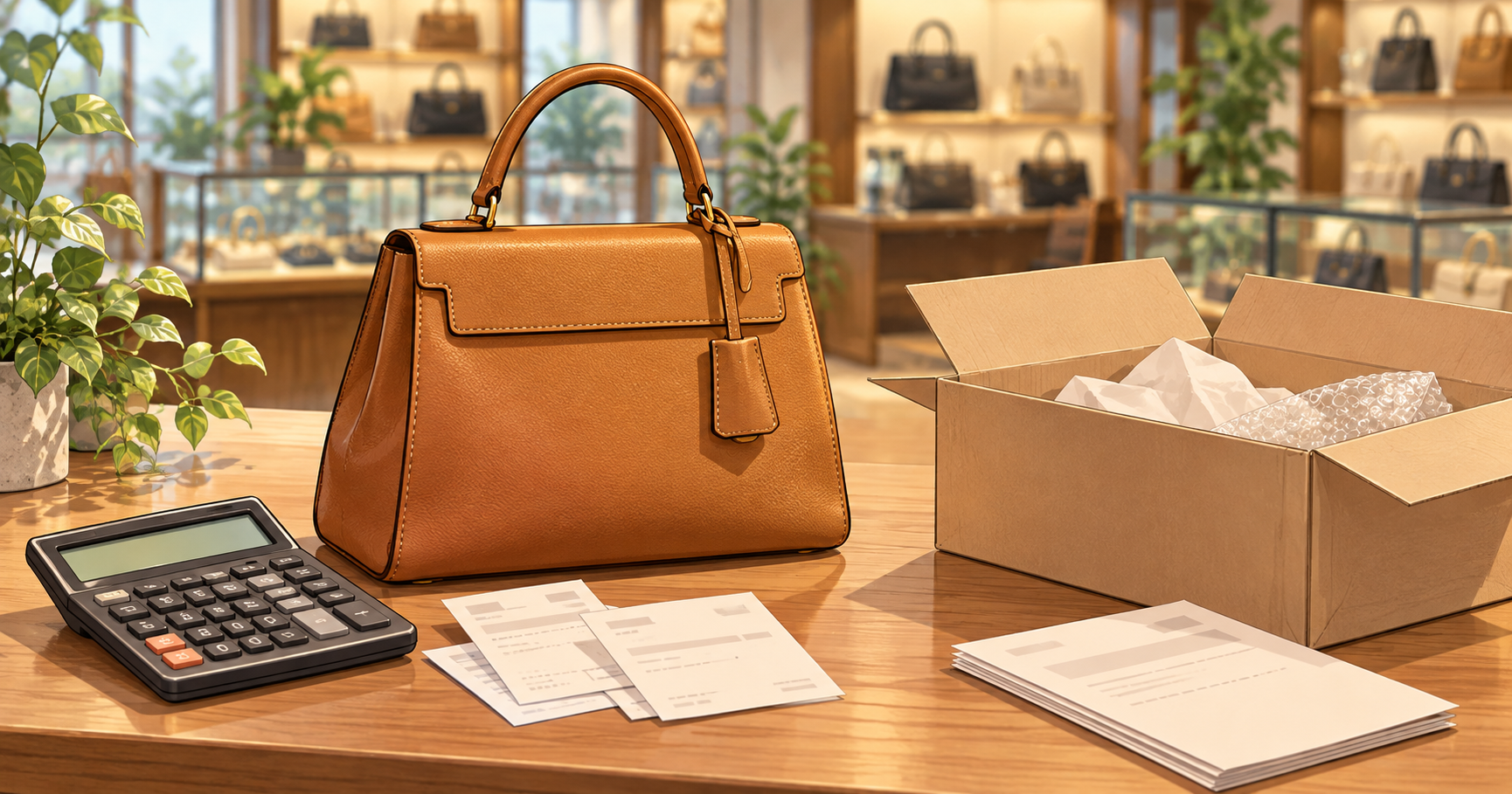
Are used luxury bags cheaper in Japan? Sometimes—but a lower Japanese price is only the beginning of the comparison. The useful number is the total you pay to receive a comparable bag, including payment fees, delivery, applicable import charges and any work it needs.
A bag can be a good purchase in Tokyo and a poor purchase when shipped overseas. Another can cost slightly more in Japan yet offer the exact size, color and condition you have struggled to find at home. This guide helps you compare both situations without assuming that every Japanese listing is a bargain.
Policy information reviewed October 2, 2026. All prices, exchange rates and cost examples below are fictional illustrations, not live offers or tax quotations.
- Quick answer: when buying in Japan can make sense
- 1. Compare the same bag before comparing the price
- 2. Calculate the total cost in your own currency
- 3. Buying during a trip versus ordering online
- 4. Understand the Japanese tax-free price
- 5. Example: a lower sticker price with only modest savings
- 6. Exchange rates can change the comparison
- 7. Budget for your destination’s import rules
- 8. Free shipping does not settle the whole comparison
- 9. When the cheaper bag is the wrong purchase
- Purchase checklist
- A practical note from Sho
- Frequently asked questions
Quick answer: when buying in Japan can make sense
- You are already visiting Japan: you can inspect the bag and compare the final purchase cost without treating your entire holiday as a shopping expense.
- The comparison is like-for-like: model, size, material, condition and included accessories are reasonably equivalent.
- The savings survive the extra charges: a payment fee, delivery bill or import assessment does not erase the difference.
- The seller’s terms suit you: you understand authenticity claims, disclosed repairs and what happens if the item is not as described.
Buying at home may be better when the price gap is small, inspection matters to you, or an international return would be difficult. There is no reliable percentage by which all used designer bags are cheaper in Japan.
1. Compare the same bag before comparing the price
A model name alone is not enough. Two similar-looking bags can have different dimensions, materials, production details, straps or repair histories. A low price may reflect a difference you would notice immediately in person.
| Match these details | What to check |
|---|---|
| Model and size | Reference number where available, measurements and exact version. |
| Material and color | Leather versus coated canvas, lining, hardware finish and color changes. |
| Condition | Corners, handles, strap, lining, odor, stickiness, cracks and shape. |
| Repairs and alterations | Recoloring, replaced components and disclosed third-party work. |
| Accessories | Detachable strap, pouch, keys or other parts you actually need. |
| Seller protection | Authentication policy, return eligibility, deadlines and dispute procedure. |
Compare several genuinely similar listings where possible. One unusually expensive domestic listing is not evidence that every Japanese offer is cheap. Asking prices also do not prove that buyers are paying those amounts.
Condition letters are seller-specific. An A at one store should not automatically be treated as an A elsewhere. Use our Japanese used luxury condition grades guide to understand the labels, then inspect the actual description and photographs.
2. Calculate the total cost in your own currency
Use this budgeting formula:
Total acquisition cost = item payment + payment/conversion fees + delivery and service charges + import charges payable separately + necessary work − refunds actually received.
Convert every component into the same currency. If tax or shipping is already included in the checkout total, do not add it again. If you use the final amount on your card statement, do not add an exchange-rate margin that is already reflected in that amount.
Keep confirmed charges separate from estimates. An unknown import charge is not zero, and a hoped-for tax refund is not money already back in your account.
For a sensible domestic comparison, include local delivery and applicable sales tax in the alternative price too. Comparing an overseas all-in total with a domestic pre-tax sticker price can be just as misleading as ignoring overseas fees.
3. Buying during a trip versus ordering online
| Cost or consideration | Buying during a Japan trip | Ordering from overseas |
|---|---|---|
| Inspection | You may inspect the actual bag before paying. | You rely on listing details, photographs and seller answers. |
| Japanese tax treatment | Eligible tourist purchases may qualify under the applicable tax-free rules. | Use the overseas storefront or buying service’s actual checkout treatment. |
| Transport costs | Additional shopping transport, insurance or baggage costs where relevant. | International delivery and any proxy, handling or clearance charges. |
| Arrival-country rules | Traveler declaration and exemption rules. | Shipment import rules; do not substitute a traveler’s allowance. |
| Returns | Consider what happens once you have left Japan. | Check overseas return eligibility and who pays each charge. |
If Japan is already your holiday destination, calculate the extra costs caused by the purchase. If you would book a trip mainly to buy a bag, include the airfare, accommodation and other trip expenses in the decision.
For online purchasing routes and retailer policy comparisons, see buying pre-owned luxury goods from Japan with international shipping.
4. Understand the Japanese tax-free price
Through October 31, 2026, eligible tourist purchases at participating stores generally use the existing at-purchase consumption-tax exemption. For purchases from November 1, 2026, shoppers pay the tax-inclusive amount first, with a refund following the required departure confirmation.
Under the new system, complete the departure procedure within 90 days of purchase, before baggage check-in, with the goods available. Refund arrangements are handled by the shop or its appointed provider. Confirm eligibility, fees and timing with the store.
These are tourist-shopping rules, not an automatic discount to subtract from an overseas website order. See the Japan Tourism Agency’s official explanation.
Removing 10% tax is not taking 10% off the sticker price
For a hypothetical price of ¥220,000 that includes 10% consumption tax:
- Price before tax: ¥220,000 ÷ 1.10 = ¥200,000.
- Tax component: ¥20,000.
- Reduction from the tax-inclusive amount: about 9.09%, before any applicable fees.
Subtracting 10% directly from ¥220,000 would produce ¥198,000, which is not the tax-exclusive price. After the refund-system change, you also need enough available funds to pay the full amount upfront.
5. Example: a lower sticker price with only modest savings
Fictional online-purchase example: the following charges are invented to demonstrate arithmetic. The import-cost line is not a tariff estimate for any country or bag.
| Component | Illustrative cost in USD |
|---|---|
| Japanese listing converted to USD | $1,000 |
| Payment fee | $30 |
| Shipping | $60 |
| Import and clearance charges, assumed separately payable | $180 |
| Necessary work, based on an assumed quote | $80 |
| Total acquisition cost | $1,350 |
| Comparable domestic bag, including tax and delivery | $1,450 |
| Difference | $100, or about 6.9% |
The apparent $450 advantage has become $100. That may still be worthwhile, but the return conditions and condition differences now matter much more.
If the overseas checkout already included the assumed $180 of import charges, do not add that amount a second time. Replace every example figure with the seller’s quote, your payment terms and destination-specific information.
6. Exchange rates can change the comparison
A yen price alone does not tell you what your bank account will be charged. For illustration, a ¥150,000 payment equals $1,000 at ¥150 per dollar, but approximately $1,071.43 at ¥140 per dollar, before fees. Neither rate is presented here as today’s rate.
Check the currency in which the seller actually charges you. A global storefront may use its own USD price rather than converting the Japanese domestic listing at the rate you found online.
If offered a choice between a yen payment and a merchant-converted home-currency amount, compare the quoted conversion with your card’s terms. Also check whether a foreign transaction fee applies. Our cash versus card guide covers practical payment considerations.
Record the comparison date. Do not assume a screenshot from several weeks ago still represents the available price or exchange rate.
7. Budget for your destination’s import rules
Japanese tax-free treatment does not remove obligations in your destination country. For U.S. travelers, purchases acquired abroad must be declared. Read our U.S. customs guide for luxury purchases in Japan before budgeting for a bag brought home in your luggage.
For a shipment, do not apply a traveler’s personal exemption to an ordinary online order. CBP’s published guidance states that duty-free de minimis treatment for covered low-value shipments was suspended from August 29, 2025. An order below $800 should therefore not be assumed duty-free simply because of its value. Check CBP’s current mail duty guidance before buying.
The material, classification, manufacturing origin and applicable measures can affect the assessment. Buying a bag in Japan does not automatically make Japan its country of origin. This guide does not assign one duty rate to all handbags.
Ask whether the quoted total includes duties, destination taxes and clearance-related fees for your delivery address. If you live outside the United States, use your own customs authority’s rules.
8. Free shipping does not settle the whole comparison
Retailer terms differ. For example, ALLU’s global shipping policy states that shipping is free. That is a useful input for that purchasing route, not a rule for every Japanese seller or marketplace.
Check the exact storefront and your destination. With a buying service, the initial payment may not be the final total. Before ordering, identify delivery, service fees, insurance arrangements and any charges collected later.
For returns, ask about eligibility, notification deadlines, tags, return authorization and postage. Also ask whether payment fees or import charges are recoverable; returning a bag does not by itself establish that every associated cost will be refunded.
9. When the cheaper bag is the wrong purchase
- Missing essential accessories: a replacement strap could remove the saving.
- Unclear interior condition: request photographs and a written answer about odor, peeling or stickiness.
- Undisclosed or poorly explained repairs: clarify what was changed and by whom.
- Uncertain authenticity protection: a condition grade is not proof of authenticity.
- Unworkable returns: a narrow saving may not justify a purchase you cannot inspect or conveniently return.
- A rushed decision: availability pressure is not a substitute for checking the details.
Do not assume damage can be cheaply repaired. Obtain a suitable repair assessment before treating a worn bag as a bargain. If its condition is unacceptable to you now, an optimistic repair budget does not make it a good purchase.
Purchase checklist
- Confirm the exact model, size, material and included parts.
- Compare photographs and written condition details, not grades alone.
- Find a realistic domestic alternative with tax and delivery included.
- Record the seller’s final price and payment currency.
- List separate payment, shipping, service and import charges.
- Separate confirmed refunds from expected refunds.
- Read authenticity, cancellation and return terms for your purchasing route.
- Save the listing, seller replies and receipt.
- Decide whether the remaining saving is worth the uncertainty and effort.
A practical note from Sho
I work as a lodging facility manager in Tokyo. My practical advice is to finish the comparison before your final shopping day. Give yourself time to ask questions, keep the receipt somewhere accessible and plan how you will carry the purchase home. A shopping decision is easier when you are not also watching the clock for an airport train.
Frequently asked questions
Are all used designer bags cheaper in Japan?
No. Compare the exact item with similar-condition alternatives. A lower price can reflect missing parts, wear or less convenient return conditions.
Is a weak yen enough to make a bag a bargain?
No. It can improve the currency conversion for a yen-priced purchase, but the underlying price and extra charges still determine the result.
Can I subtract Japanese tourist tax from an online order?
Do not make that assumption. Use the price and tax treatment quoted by the overseas storefront or buying service. Tourist purchases carried out of Japan use a different process.
Does free shipping mean there are no import charges?
No. Confirm which charges are included for your address and which may be collected separately. Avoid adding included charges twice.
How much cheaper should the Japanese bag be?
There is no universal threshold. Compare the actual saving with condition differences, return costs and unresolved charges. If a plausible extra cost would eliminate the saving, resolve that uncertainty before paying.