Last fact-checked: August 28, 2026. Admission hours, tattoo policies, private-bath rules, amenities, and health warnings vary by facility. Confirm current information directly before visiting.
Quick answer: At a typical Japanese onsen, remove all clothing in the changing room, wash and rinse your body before entering the bath, and keep your towel and hair out of the water. Speak quietly, do not swim, and leave your phone outside the bathing area. If you have tattoos, check the facility’s policy before you go because the rules vary.
The process can feel unfamiliar the first time, but you do not need to perform every custom perfectly. Cleanliness, consideration, and following the facility’s signs will take you most of the way.
The three rules to remember:
- Wash before you soak.
- Put only your body in the bath—not your towel, hair, phone, or swimsuit.
- Check tattoo and private-bath policies before arriving.
- Japan Onsen Etiquette: First-Time Checklist
- What Is an Onsen?
- How to Use an Onsen: Step by Step
- Onsen Rules: What Is and Is Not Allowed?
- Can You Use an Onsen in Japan With Tattoos?
- Public Onsen vs Private Onsen
- What Should You Bring to an Onsen?
- Can Children Use an Onsen?
- Accessibility and Assistance
- Onsen Safety: Heat, Hydration, and Alcohol
- Common Onsen Mistakes to Avoid
- A Note From Sho
- Frequently Asked Questions
- Do I Have to Be Completely Naked in a Japanese Onsen?
- Where Do I Put the Small Towel?
- Do I Need to Wash My Hair Before Entering?
- Can I Shower After the Onsen?
- Can I Use an Onsen Without Staying at a Ryokan?
- Can My Partner and I Use the Same Bath?
- Are Tattoos Illegal in Japanese Onsen?
- Can I Take a Photo When the Bath Is Empty?
- Is a Hotel Public Bath Always an Onsen?
- Can I Wear a Yukata to the Bath?
- Final Advice
- Official Sources
Japan Onsen Etiquette: First-Time Checklist
- Check the opening hours, final admission time, and tattoo policy.
- Bring a small towel and a larger bath towel if they are not included.
- Remove shoes where instructed.
- Confirm that you are entering the correct changing room.
- Remove all clothing and swimwear.
- Wash with soap and rinse completely before entering the bath.
- Keep your small towel and long hair out of the water.
- Enter slowly, soak quietly, and take a break if you feel too hot.
- Dry your body lightly before returning to the changing room.
- Drink water before and after bathing.
These basics match the bathing guidance published by the Japan National Tourism Organization and the Japan Onsen Association.
What Is an Onsen?
An onsen is a Japanese hot spring or a bathing facility using qualifying hot-spring water. Under Japan’s Hot Springs Act, water can qualify as onsen based on its temperature at the source or its mineral content. The Japan Onsen Association explains the legal definition in English.
A sento is a public bathhouse that does not necessarily use natural hot-spring water. A large recreational bath complex is often called a super sento. The water source and facilities may differ, but the essential shared-bath etiquette is usually similar: wash first, enter without a swimsuit, and keep towels out of the bath.
| Term | What It Usually Means | What Travelers Should Know |
|---|---|---|
| Onsen | Natural hot-spring water or a facility using it | Mineral content, temperature, tattoo policy, and amenities vary |
| Sento | Neighborhood public bathhouse | Often inexpensive; towels and toiletries may cost extra |
| Super sento | Large bath and relaxation complex | May include several baths, dining, saunas, or rest areas |
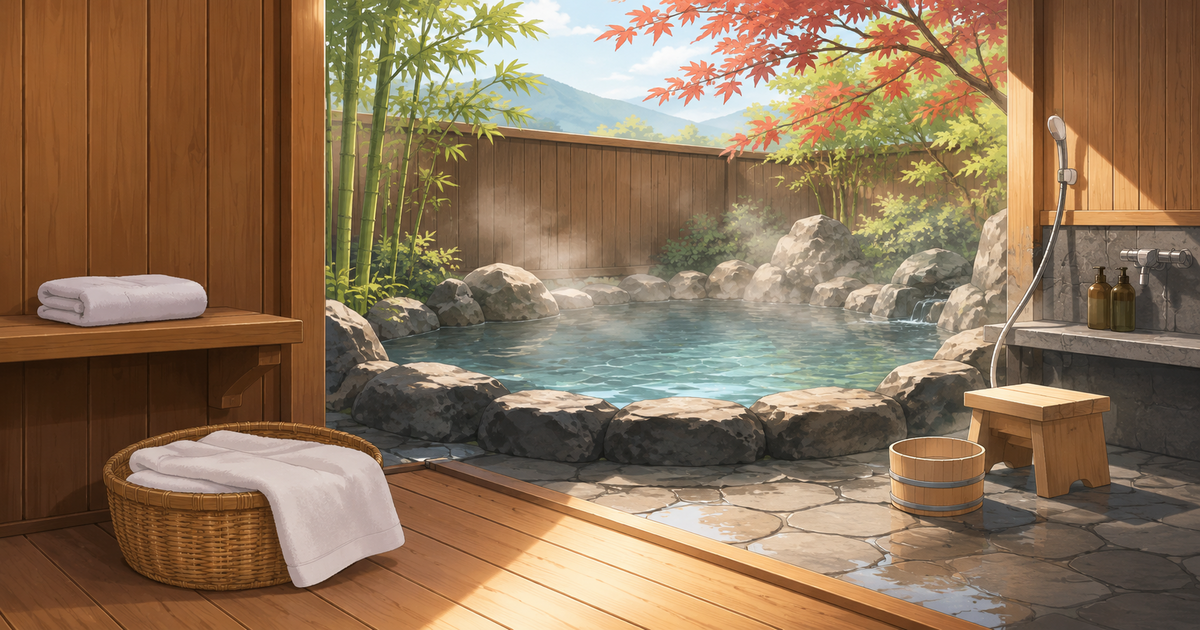
| Rotenburo | Open-air bath | Located outdoors but still subject to normal bathing rules |
| Kashikiri-buro | Reservable private bath | Useful for couples, families, shy bathers, and some tattooed guests |
| Higaeri onsen | Day-use hot spring | Lets you bathe without staying overnight |
How to Use an Onsen: Step by Step
1. Check the Rules Before You Pay
Look for the facility’s tattoo policy, bath hours, final entry time, towel rental, and any maintenance closures. A ryokan may reserve its baths for overnight guests during certain periods, while other facilities offer day-use admission.
If you need a private bath, do not assume it can be used at any time. Some must be reserved in advance, some are booked after check-in, and others are available only with a particular room or accommodation plan.
2. Remove Your Shoes Where Directed
Many facilities have a shoe area, locker, or raised floor near the entrance. Follow the signs and local guests rather than walking onto the clean interior floor in outdoor shoes. At a ryokan, you may already be wearing the provided slippers, but those slippers normally stay outside the changing or bathing area.
3. Enter the Correct Changing Room
Most public baths are separated by gender. The Japanese character 男 means men and 女 means women. Do not rely only on curtain color because layouts can differ, and some ryokan switch the men’s and women’s baths at different times so guests can experience both sides.
If you are transgender, nonbinary, or simply need more privacy, contact the property before visiting. Facility policies vary, so a reservable private bath or an in-room bath is often the most predictable option.
4. Undress Completely
Standard public onsen bathing is done without clothing. Leave your clothes, underwear, large bath towel, phone, and other belongings in a locker or basket in the changing room. Swimsuits are normally not allowed unless the facility clearly identifies a special mixed-gender or swimsuit zone.
You may carry a small modesty towel into the washing area. You can hold it in front of your body while walking, but it must stay out of the bathwater.
5. Wash Before Entering the Bath
Sit on one of the low stools at a washing station. Wash your body with soap, shampoo your hair if needed, and rinse away all soap and shampoo. Be careful not to spray water onto nearby bathers. When you finish, rinse the stool and wash area for the next person.
Some very small or rustic baths may have limited washing facilities. Follow the posted instructions and, at minimum, use kakeyu—pouring bath water or warm water over your body before entering. Start gently so your body can adjust to the heat.
6. Enter the Water Slowly
Step into the bath carefully and avoid jumping, splashing, or swimming. Onsen water may be hotter than the bath you use at home. There is no prize for staying in the longest; get out and cool down when you feel too warm.
Keep conversation quiet. A short conversation is usually fine, but a shared bath is intended to be calm. Respect other guests’ personal space even when the bath is busy.
7. Keep Your Towel and Hair Out of the Water
Place your small towel on the side of the bath or fold it on top of your head. If you have long hair, tie it up before entering. Do not wring a towel into the bath, wash inside the bath, or put your head underwater.
Remove jewelry before bathing when possible. Hot-spring minerals may discolor or damage some metals, and valuables are safer in a secure locker.
8. Dry Off Before Returning to the Changing Room
Use the small towel to remove excess water before stepping back into the changing room. This keeps the floor from becoming wet and slippery. Then use your large bath towel at your locker.
Whether to rinse again after soaking can depend on the spring and your skin. Follow any facility instructions. If the water irritates your skin, stop bathing and rinse with fresh water.
Onsen Rules: What Is and Is Not Allowed?
| Question | Usual Rule | Important Exception |
|---|---|---|
| Can I wear a swimsuit? | No, not in a standard public bath | Some mixed-gender or recreational facilities have designated swimsuit areas |
| Can my towel enter the water? | No | Keep it on the bath edge or on your head |
| Can I take photos? | No | Only in a clearly authorized area with explicit permission |
| Can I use my phone? | Keep it out of changing and bathing areas | Use it only in permitted lobby or relaxation areas |
| Can I swim? | No | Onsen baths are for quiet soaking |
| Can I enter with a tattoo? | It depends on the facility | Some allow tattoos, approved cover sheets, or private-bath use |
| Can I visit without staying overnight? | Often yes | Look for day-use hours and guest-only restrictions |
| Can couples bathe together? | Usually not in gender-separated public baths | Reserve a private or designated mixed-gender bath |
Can You Use an Onsen in Japan With Tattoos?
Sometimes. Tattoos do not generally cause problems in everyday travel, but some onsen, public baths, pools, and hotel baths restrict entry. There is no single policy that applies to every facility.
JNTO advises travelers to check each facility’s rules in advance. Some places accept tattoos openly, some permit a small tattoo when covered with an approved waterproof sheet, and some do not allow tattooed guests in the public bath. Tattoo restrictions are facility admission policies; having a tattoo is not generally illegal in Japan.
Best Options for Tattooed Travelers
- Choose a clearly tattoo-friendly onsen. Look for an explicit policy on the official website.
- Ask about cover sheets. Confirm the permitted size, number, and type before arriving.
- Reserve a private bath. Ask whether tattooed guests may use it; privacy does not automatically override the property’s rules.
- Book a room with its own bath. Check that it uses actual hot-spring water if that matters to you.
- Get written confirmation. Save the property’s email or message in case different staff members are on duty.
Useful message: “I have a tattoo. May I use the public bath if I cover it, or can I reserve a private bath?”
Japanese: タトゥーがあります。隠せば大浴場を利用できますか。または貸切風呂を予約できますか。
Tattoo ga arimasu. Kakuseba daiyokujo o riyo dekimasu ka? Matawa kashikiri-buro o yoyaku dekimasu ka?
Public Onsen vs Private Onsen
A private bath can remove much of the uncertainty for first-time visitors, but the words used in booking listings can be confusing.
| Bath Type | Privacy | Reservation | Best For |
|---|---|---|---|
| Public bath | Shared and usually gender-separated | Usually not required | The traditional communal experience |
| Kashikiri-buro | Private for a limited time | Often required | Couples, families, shy bathers, some tattooed guests |
| Kazoku-buro | Private family bath | Usually required | Families or companions bathing together |
| In-room bath | Private in your guest room | Booked with the room | Maximum privacy and flexibility |
“Private bath” does not always mean “open-air bath,” and “bath in the room” does not always mean natural onsen water. Read the room description carefully and ask the property when the distinction matters.
If you are still deciding where to stay, see our comparison of a ryokan vs hotel in Japan. For arrival procedures and luggage timing, read the Japan hotel check-in guide.
A large hotel bath is not automatically a natural onsen. Our APA Hotel vs Toyoko Inn vs Dormy Inn comparison explains how public baths differ among hotel chains and why you must check the exact property.
What Should You Bring to an Onsen?
- Small towel: for washing or modesty; keep it out of the bath.
- Large bath towel: for drying in the changing room.
- Hair tie or clip: essential if your hair can touch the water.
- Coins or cash: useful at small bathhouses for lockers, admission, or towel rental.
- Water: drink before and after bathing, where permitted.
- Tattoo cover: only when the facility has confirmed that it is acceptable.
Ryokan and larger onsen hotels commonly provide towels and toiletries, while a small neighborhood sento may charge separately or expect you to bring them. Check before visiting rather than assuming everything is included.
Can Children Use an Onsen?
Many onsen welcome children, but age, diaper, supervision, and opposite-gender bathing rules vary by facility and local policy. Check before visiting, especially when traveling with a baby or an older child who may not be permitted in the opposite-gender bath.
- Never leave a child alone in a bath or changing area.
- Ask whether children who still use diapers may enter the public bath.
- Keep the first soak short because children may overheat quickly.
- Stop running, splashing, swimming, or playing with bath equipment.
- Use a private family bath when the public-bath layout or gender rules do not fit your family.
A kazoku-buro or reservable private bath can make the experience easier, but capacity, age rules, price, reservation time, and tattoo policies still need confirmation. Our family hotel guide for Japan covers larger rooms, beds, kitchens, laundry, and child policies beyond the bath.
Accessibility and Assistance
Traditional bath areas can include steps, wet stone, low stools, deep bath edges, and limited handrails. Do not assume that an accessible guest room means the public bath is accessible.
Contact the property before booking if you need step-free access, a shower chair, handrails, a private accessible bath, help from a companion, or additional privacy. Facility staff can explain the layout, but personal assistance may not be available. A private in-room bath may be more predictable than a large communal bath.
Onsen Safety: Heat, Hydration, and Alcohol
Hot water can make you feel dizzy or overheated. The Japan Onsen Association advises bathers to drink water, enter gradually, move slowly when leaving the bath, and avoid bathing immediately around meals, alcohol, strenuous exercise, or when feeling unwell or exhausted.
- Drink water before and after bathing.
- Do not enter after drinking alcohol.
- Start with a short soak and take breaks.
- Stand up slowly.
- Leave immediately if you feel faint, sick, or unusually uncomfortable.
- Follow posted warnings for very hot, acidic, sulfurous, or otherwise specialized baths.
If you have a heart or blood-pressure condition, are pregnant, have recently had surgery, or have another medical concern, ask a qualified healthcare professional whether hot bathing is appropriate for you. The Japan Onsen Association specifically advises older people with hypertension or cardiac disease to avoid water hotter than 42°C. Facility guidance does not replace personal medical advice.
Leave the bath immediately if you feel dizzy, faint, nauseated, short of breath, confused, or unusually uncomfortable. Ask for help rather than trying to walk across a wet floor alone.
Common Onsen Mistakes to Avoid
Entering the Bath Before Washing
The bath is shared soaking water, not the place to wash. Use the washing station first and rinse off all soap.
Wearing a Swimsuit “for Modesty”
In a normal public onsen, swimwear breaks the facility’s bathing rules. Use the small towel while walking, then keep it out of the water. Choose a private bath if public nudity is not comfortable for you.
Dropping the Small Towel Into the Bath
This is one of the most noticeable etiquette mistakes. Put the towel on your head or leave it safely at the bath’s edge.
Bringing a Phone Into the Changing Room
Even if you do not intend to take a photo, a visible camera phone can make other guests uncomfortable. Store it with your belongings.
Assuming a Tattoo Cover Is Always Accepted
A cover sheet is not a universal permission slip. The facility decides whether it is acceptable, including the permitted size and number of covers.
Staying in Very Hot Water Too Long
Leave while you still feel comfortable. A shorter, relaxed soak is better than becoming dizzy in an unfamiliar facility.
A Note From Sho
I was born and raised in Japan and now work in accommodation management, where I assist many international guests. The onsen questions I hear are usually not about the scenery—they are about uncertainty: “Where do I undress?”, “Can I bring the towel?”, and “What happens if I have a tattoo?”
My advice is simple: check the one rule that may stop your visit—especially the tattoo policy—before you travel. Once you are inside, slow down, watch the signs, wash first, and be considerate. Staff do not expect overseas visitors to know every custom. They do appreciate guests who make a sincere effort.
Frequently Asked Questions
Do I Have to Be Completely Naked in a Japanese Onsen?
Yes, in a standard public onsen. Clothing and swimsuits remain in the changing room. Special mixed-gender or recreational facilities may have separate swimsuit zones, but they will state this clearly.
Where Do I Put the Small Towel?
Keep it on the edge of the bath or fold it on your head. Do not let it touch the bathwater.
Do I Need to Wash My Hair Before Entering?
You must wash and rinse your body before entering. If you do not wash your hair, tie it up securely so it cannot touch the water.
Can I Shower After the Onsen?
Practices vary with the spring. Follow the facility’s instructions. People with sensitive skin may prefer to rinse, particularly when the water causes irritation.
Can I Use an Onsen Without Staying at a Ryokan?
Yes. Many onsen towns, bathhouses, and some ryokan offer day-use bathing. Check admission times because they may differ from overnight guest hours.
Can My Partner and I Use the Same Bath?
Most public baths are gender-separated. Look for a reservable private bath, family bath, in-room bath, or a facility with an explicitly designated mixed-gender area.
Are Tattoos Illegal in Japanese Onsen?
No. A restriction is a facility admission policy, not a general law making tattoos illegal. Because policies differ, confirm directly with the onsen or accommodation.
Can I Take a Photo When the Bath Is Empty?
Do not assume that an empty bath means photography is allowed. Only take photos when the facility explicitly authorizes it and no other guest’s privacy can be affected.
Is a Hotel Public Bath Always an Onsen?
No. A public bath may use heated ordinary water. An onsen uses hot-spring water meeting the applicable legal definition. Check the property’s description when natural hot-spring water matters to you.
Can I Wear a Yukata to the Bath?
At many ryokan and onsen hotels, guests wear the provided yukata between the room and bath. Remove it with all other clothing in the changing room. Rules can differ at Western-style hotels and public facilities, so follow the property’s instructions.
Final Advice
For a comfortable first onsen visit, choose a facility with clear English information, confirm the tattoo policy, and arrive with enough time that you are not rushing before final admission. Once inside, remember the essentials: wash first, enter without a swimsuit, keep towels and hair out of the water, and enjoy the bath quietly.
A private bath is not a lesser experience. For many couples, families, tattooed travelers, and first-time visitors, it is the easiest way to relax without worrying about the public-bath routine.
Official Sources
- Japan National Tourism Organization: How to Best Enjoy Japan’s Onsen
- Japan National Tourism Organization: Hot Springs in Japan
- Japan National Tourism Organization: FAQ
- Japan National Tourism Organization: Enjoy Bath Culture in Japan
- Japan Onsen Association: What Is Onsen?
- Japan Onsen Association: Cautions for Bathing
Last fact-checked: August 28, 2026. Facility policies, admission hours, tattoo rules, and health guidance can change. Always confirm directly with the onsen or accommodation before visiting.