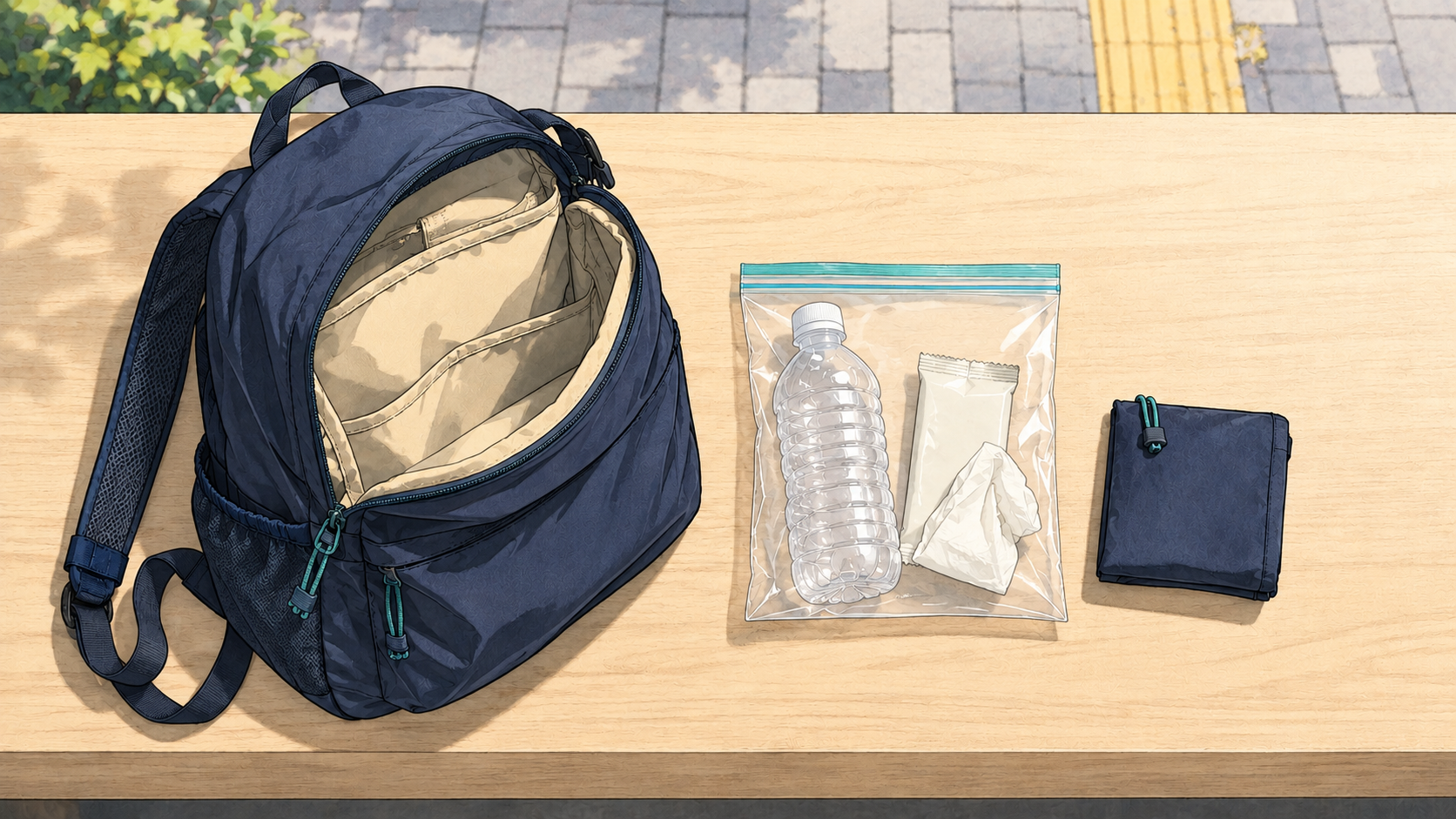
Quick answer: If you cannot find a trash can in Japan, keep the garbage with you until you reach a suitable bin or return to your accommodation. Carrying a small sealable bag is the simplest solution. You may find bins at some train stations, convenience stores, shopping centers, tourist facilities, and food courts, but they are not guaranteed.
Always check the label before using a bin. The box beside a vending machine is normally for empty drink containers only—not food wrappers, cups, tissues, or general garbage.
The rule to remember: If there is no clearly marked bin, do not leave the item beside a vending machine, on a station platform, in a public toilet, or at a neighborhood garbage collection point. Put it in your own bag and dispose of it properly later.
- Yes, the Lack of Trash Cans Is a Real Tourist Problem
- Where Can Tourists Find Trash Cans in Japan?
- What Should You Do With Garbage While Sightseeing?
- The Box Beside a Vending Machine Is Not a Trash Can
- How to Read Japanese Trash and Recycling Labels
- Can You Use a Neighborhood Garbage Collection Point?
- Can You Leave Garbage in a Public Toilet?
- Why Does Clean Japan Have So Few Public Bins?
- Reduce the Garbage You Need to Carry
- A Note From Sho: Ask the Business That Created the Waste
- Common Mistakes to Avoid
- Frequently Asked Questions
- Official Sources
Yes, the Lack of Trash Cans Is a Real Tourist Problem
You are not imagining it. In a survey published by the Japan Tourism Agency on April 28, 2026, the lack of trash cans was the most commonly reported problem among international visitors.
The agency surveyed 4,110 departing travelers at five major airports between November 18, 2025, and January 13, 2026. A total of 17.2% selected the lack of trash cans, placing it above communication with facility staff, overcrowding, transportation, multilingual information, and card use.
The previous Japan Tourism Agency survey reached the same general conclusion. In its more detailed findings, over 70% of travelers who had trouble finding a bin said they eventually gave up looking and carried their garbage away.
That is also the practical answer Japanese tourism authorities recommend. Japan National Tourism Organization (JNTO) asks travelers not to litter and to take their waste with them when a suitable garbage can is unavailable.
Where Can Tourists Find Trash Cans in Japan?
There is no nationwide map showing every public bin, and availability can change. A station with several bins today may relocate or remove them later. Instead of expecting a trash can on every street, check the following places.
| Place | What you may find | Important limitation |
|---|---|---|
| Train and subway stations | Separated bins on some platforms, concourses, or near shops | Many stations have few or no public bins |
| Convenience stores | General waste, plastic, can, or bottle bins at some locations | Bins may be inside, restricted, or unavailable; follow the store’s rules |
| Shopping malls and department stores | Bins near food courts, rest areas, or exits | Usually intended for waste generated inside the facility |
| Food courts and markets | Tray-return and separated disposal stations | Return waste from that dining area only |
| Tourist attractions and parks | Bins near entrances, cafés, or rest areas | Some facilities explicitly require visitors to take garbage away |
| Airports and highway rest areas | Clearly separated public disposal stations | Follow the pictures and labels carefully |
| Vending machines | Recycling boxes for empty beverage containers | Not a general trash can |
| Your accommodation | Room bins or a waste-sorting area | Ask before leaving large, unusual, or hazardous items |
When a bin is provided by a shop or dining facility, use it for waste connected with that business. Do not assume that every convenience store must accept a full bag of garbage collected elsewhere.
What Should You Do With Garbage While Sightseeing?
1. Carry a small sealable bag
Put one or two lightweight bags in your daypack before leaving the hotel. A zip-top bag is useful for wrappers, used tissues, and small items because it contains moisture and odors. A separate plastic bag can hold empty bottles or cans.
This does not need to become a large bag of mixed garbage. Remove unnecessary packaging before you leave your accommodation, buy only what you expect to consume, and dispose of each item when you reach the correct facility.
2. Keep wet and dry waste separate
Food residue, coffee cups, and wet tissues can leak into your bag. Seal them separately from clean paper, cans, and bottles. Finish drinks before storing the container, and keep the cap closed while carrying it.
If a food container contains liquid or leftovers, do not force it into a narrow recycling opening. Carry it upright and ask your hotel or the business that sold it where it should go.
3. Use the disposal area where you ate
Food courts, cafés, market halls, and convenience stores with eat-in spaces may provide a return station. Finish eating there, return the tray, and follow the displayed sorting instructions.
At a street-food stall or festival, look for a bin operated by the vendor or event. If you cannot see one, ask the staff before walking away. They may take back the skewer, cup, plate, or wrapper used for their product.
4. Ask rather than guess
If you are holding a small item and see a store bin, a simple question prevents mistakes:
- “Can I throw this away here?”
- Kore, sutete mo ii desu ka? — May I throw this away?
- Gomibako wa doko desu ka? — Where is the trash can?
Show the item while asking. The staff can point to the correct opening or tell you that the facility cannot accept it.
5. Take ordinary travel waste back to your hotel
For most visitors, the accommodation is the most reliable final disposal point. Ordinary room waste such as snack wrappers, receipts, used tissues, and empty drink containers can generally be placed in the room bin or the property’s sorting area.
If you have several bags, food with strong odors, broken glass, batteries, a suitcase, or another unusual item, speak to the front desk first. A guest-room bin is not permission to abandon oversized or hazardous waste. For other accommodation questions, see our Japan hotel check-in guide.
The Box Beside a Vending Machine Is Not a Trash Can
This is the most important sorting mistake to avoid. The box beside a drink vending machine is a recycling box for beverage containers.
According to the Japan Soft Drink Association, these boxes are intended to collect empty drink containers after consumption. General waste and leftover liquid interfere with recycling. The association reports that around 30% of the material found in these boxes has been non-beverage foreign material, including general garbage.
Usually acceptable when the label allows it
- Empty PET drink bottles
- Empty beverage cans
- Empty glass drink bottles
Do not put these in the recycling box
- Food wrappers or bento containers
- Paper coffee cups
- Plastic shopping bags
- Tissues, masks, or cigarette waste
- Umbrellas, batteries, or electronics
- Containers that still hold liquid
Read the pictures on the box because accepted containers can differ. If the box is full, keep the container with you. Do not place it on top or leave it on the ground beside the machine.
How to Read Japanese Trash and Recycling Labels
Waste categories vary by municipality and facility, so use the label in front of you rather than memorizing one national system. Pictures of bottles, cans, cups, or food waste are often more helpful than the English translation.
| Japanese label | Common English meaning | Typical examples |
|---|---|---|
| 燃えるごみ / 可燃ごみ | Burnable waste | Food-soiled paper, tissues, and general combustible waste |
| 燃えないごみ / 不燃ごみ | Non-burnable waste | Some glass, metal, and ceramic items |
| ペットボトル | PET bottles | Empty plastic beverage bottles marked for PET recycling |
| びん / ビン | Glass bottles | Accepted empty glass beverage bottles |
| かん / カン | Cans | Empty aluminum or steel beverage cans |
| プラスチック | Plastic | What qualifies depends on the local or facility rules |
| 紙くず | Paper waste | Paper that the facility accepts in that opening |
Do not worry if a facility’s categories differ from those at your previous hotel. JNTO notes that separation rules vary by prefecture and municipality. Follow the current label, remove remaining liquid when instructed, and ask staff if the item is unclear.
Can You Use a Neighborhood Garbage Collection Point?
No—not as a public trash can. The net-covered bags or cages you see on residential streets are designated collection points for local households and businesses. Residents follow specific collection days, categories, bag rules, and times.
For example, Shibuya City instructs residents to take sorted waste to designated collection sites by a specified time on the correct collection day. A collection point is therefore part of a local waste system, not an open disposal station for passing travelers.
Do not add your travel garbage to a pile, even if collection appears imminent. Take it to your accommodation or another facility that clearly provides a bin for visitors.
Can You Leave Garbage in a Public Toilet?
Only use a toilet bin for its intended sanitary waste. Do not place bottles, food containers, coffee cups, shopping bags, or a day’s accumulated garbage in a restroom bin.
Never flush anything except human waste and toilet paper unless the facility gives different instructions. Food, wipes, packaging, diapers, and sanitary products can block the plumbing.
Why Does Clean Japan Have So Few Public Bins?
There is no single nationwide rule that explains every missing trash can. Stations, municipalities, parks, stores, and private facilities make their own decisions about where bins are placed and how waste is collected. Security, operating costs, illegal dumping, contamination, and local sorting requirements can all affect those decisions.
What matters to a traveler is the social expectation that follows: a missing bin does not make littering acceptable. GO TOKYO advises visitors to carry a small garbage bag and bring waste back to their accommodation when public bins are unavailable.
Japan’s clean streets are not evidence that people create no waste. They reflect daily habits such as keeping small items until the correct disposal opportunity appears.
Reduce the Garbage You Need to Carry
- Carry a reusable water bottle where refilling is practical.
- Decline an unnecessary shopping bag, straw, spoon, or wet wipe.
- Finish food near the shop or designated eating area.
- Choose one larger drink instead of several small containers.
- Remove packaging at your hotel before starting the day.
- Carry a handkerchief instead of using multiple tissues.
- Keep a reusable pouch for clean wrappers and receipts.
Do not open or eat food inside a store unless an eat-in area is provided. Our Japan restaurant etiquette guide explains dining, payment, tipping, and common courtesy in more detail.
A Note From Sho: Ask the Business That Created the Waste
From my experience working in restaurant kitchens and accommodation management, the easiest solution is usually to deal with the waste close to where it was created.
If you buy street food, finish it near the vendor and ask where the skewer or container should go. If you eat in a food court, use its return station. If you bring normal snacks back to your hotel, sort them according to the property’s instructions.
What causes trouble is bringing unrelated garbage into a small business and assuming the staff must accept it. Commercial waste disposal costs money and businesses sort it according to their own contracts. A polite question is always better than quietly pushing an item into the wrong bin.
I recommend keeping two small bags in your daypack: one sealable bag for food-related waste and one for empty drink containers. It takes almost no space and removes one of the most common frustrations reported by visitors to Japan.
Common Mistakes to Avoid
- Using a vending-machine recycling box for general garbage
- Leaving a full bottle or cup beside an overflowing bin
- Putting travel garbage into a residential collection point
- Leaving food containers in a public toilet
- Assuming every convenience store has a public bin
- Mixing leaking food waste with electronics or valuables in your bag
- Leaving large items in a hotel room without speaking to staff
- Ignoring the pictures and separation labels on the bin
- Littering because no public bin is nearby
Frequently Asked Questions
Are there really no trash cans in Japan?
There are trash cans, but fewer public street bins than many travelers expect. You may find them at some stations, convenience stores, malls, airports, attractions, and dining facilities. Availability is not guaranteed, so be prepared to carry small items.
Can I throw my garbage away at a convenience store?
Only when the store provides an appropriate bin and your use follows its rules. Some stores have no customer bins, and others intend them mainly for products consumed there. Do not bring in a large bag of unrelated garbage. Ask the staff if you are unsure.
Can I leave ordinary garbage in my hotel room?
Normal small items generated during your stay can generally go in the room bin or designated sorting area. Separate recyclables if requested. Ask the property about large quantities, suitcases, electronics, batteries, broken glass, or hazardous items.
What should I do with an empty plastic bottle?
Finish the drink, close or remove the cap as the label instructs, and use a PET-bottle recycling opening. A properly labeled recycling box beside a vending machine may accept it. If no suitable box is available, carry it with you.
Where should I put a coffee cup?
Use the return or waste station at the café when possible. A paper or plastic cup does not belong in a vending-machine bottle-and-can recycling box. If you must carry it, empty it completely and seal it in a bag to prevent leaks.
What should parents do with diapers?
Use a diaper-disposal bin only where one is specifically provided. Otherwise seal the diaper in an odor-resistant bag and ask your accommodation or a staffed facility for instructions. Do not place it in a beverage-recycling box or leave it in a general public area.
Is it illegal to litter in Japan?
Local ordinances and facility rules vary, and some areas impose penalties for littering. Regardless of the specific location, tourism authorities clearly ask visitors not to litter. Carry the item until you find an appropriate disposal point.
Official Sources
- Japan Tourism Agency: 2025 Fiscal Year Survey of Problems Experienced by International Visitors
- Japan Tourism Agency: Previous Survey and Detailed Findings
- Japan National Tourism Organization: Japanese Customs and Etiquette
- Japan National Tourism Organization: Traveling Mindfully
- GO TOKYO: How to Be a Responsible Traveler in Tokyo
- Japan Soft Drink Association: Vending-Machine Recycling Boxes
- Shibuya City: Garbage and Recycling Rules
Trash-can locations and disposal rules can change by station, business, facility, and municipality. Follow the signs at the location and ask staff when you are unsure.