Quick answer: Hotel check-in in Japan is usually straightforward: show the reservation name, present the physical passport of every foreign guest who does not have an address in Japan, complete the guest registration, and pay any amount due. Check-in commonly begins around mid-afternoon, but the exact start time and final arrival time depend on the property. If you will be late, contact the accommodation before its stated deadline.
Most check-ins are straightforward, but small differences can surprise first-time visitors from the United States. A credit card used to reserve a room may not mean the stay is fully paid. A ryokan may need you to arrive before dinner. A small accommodation may lock its entrance when reception closes. This guide explains what to prepare, what staff will ask, and how to avoid being treated as a no-show.
Last fact-checked: September 16, 2026. Check-in hours, payment terms, deposits, luggage storage, meal service, and cancellation policies vary by property and booking plan. Always follow your current confirmation and the accommodation’s official instructions.
Bring these five things
- The physical passport of every overseas visitor in your party
- Your booking confirmation and reservation number
- The exact name used for the reservation
- An accepted payment card plus some Japanese yen
- The property’s phone number, address, and late-arrival instructions
- Japan Hotel Check-In at a Glance
- How Does Hotel Check-In Work in Japan?
- Do Tourists Need to Show a Passport at Japanese Hotels?
- Before Arrival: Check These Details in Your Reservation
- Check-In Time Is Not the Same as the Final Arrival Time
- Can You Check In Early?
- Sending a Suitcase to Your Hotel Before You Arrive
- Is Your Hotel Already Paid?
- Self-Check-In and Unstaffed Hotels
- Important Information to Listen for at Check-In
- A Note From Sho: What Front-Desk Staff Need From You
- Checking Out of a Hotel in Japan
- Useful Japanese Phrases
- Common Hotel Check-In Mistakes
- Frequently Asked Questions
- What time is hotel check-in in Japan?
- What do I need to check in to a hotel in Japan?
- Does every guest need to be present at check-in?
- Can a hotel keep my passport?
- Can I check in without the credit card used to book?
- Can I arrive before check-in and use the hotel facilities?
- Will the hotel speak English?
- What if I lose my room key?
- Final Check-In Checklist
- Official Sources
Japan Hotel Check-In at a Glance
| Common question | Short answer |
|---|---|
| What do tourists need? | Physical passports, the reservation name or confirmation, and an accepted payment method |
| What time is check-in? | Often in the afternoon, but use the exact time shown in your booking |
| Can you arrive late? | Usually only when the property permits it; contact the hotel before the final arrival time |
| Can you check in early? | Sometimes, but it is never guaranteed and a fee may apply |
| Can the hotel store luggage? | Many staffed hotels can, but storage hours, fees, and accepted items vary |
| Is the room already paid? | Not necessarily; check whether the booking says prepaid or pay at the property |
How Does Hotel Check-In Work in Japan?
A typical Japan hotel check-in follows these steps:
- Give the reservation name or show your confirmation.
- Present passports and complete the guest registration form.
- Confirm the number of guests, room plan, meals, and check-out date.
- Pay any amount due or provide the requested payment guarantee.
- Receive the room key, key card, or entry code.
- Listen to essential information such as breakfast hours, door-lock times, and check-out procedures.
Large hotels may complete this in a few minutes. A ryokan may explain meal times, bathing facilities, slippers, and where to remove your shoes. A hostel or small accommodation may explain shared-kitchen rules, quiet hours, and how to enter after reception closes.
Do Tourists Need to Show a Passport at Japanese Hotels?
Yes, if you are a foreign national without an address in Japan. Japan’s Ministry of Health, Labour and Welfare states that these guests must provide their nationality and passport number in addition to information such as their name, address, and contact details. The government also requires presentation and photocopying of the passport.
This requirement applies to the guests staying at the property, not only the person who made the booking. Bring the physical passport for each applicable traveler. A phone photo or paper copy may be useful as a backup, but it may not replace presenting the actual passport at check-in.
The rule specifically refers to foreign nationals who do not possess an address in Japan. A foreign resident with an address in Japan is not covered by that particular passport-copy requirement. However, an accommodation may still ask for identification or information under its own lawful check-in procedures. If you live in Japan, carry an appropriate form of ID and contact the property if its instructions are unclear.
Common misunderstanding: The hotel is not taking your passport as a deposit. Staff normally inspect it, record the required information, make or store the necessary copy, and return the passport to you.
Before Arrival: Check These Details in Your Reservation
Do not rely only on the short summary in your booking app. Open the full confirmation and check the following:
- Official property name and address
- Check-in opening time and final check-in time
- Check-out deadline
- Whether the booking is prepaid or payable at the property
- Accepted payment methods
- Room occupancy and the number of registered guests
- Whether breakfast or dinner is included
- Cancellation and no-show conditions
- Instructions for self-check-in or arrival after reception closes
Save the information offline or take screenshots. Airport delays, dead batteries, and poor reception become much more stressful when the property name is available only inside an app that will not load.
Make sure the reservation name is easy to find
Use the same spelling shown on your passport when possible. If another person booked the room, save that person’s name as well. For two rooms or a large group, know whether there is one confirmation number or several.
Confirm the correct number of guests
Japanese accommodation prices and room plans may depend on occupancy. A reservation for one person does not automatically permit two people to stay, even if the room contains a double bed. Children may also need to be registered, and their meal or bedding charges can depend on age and the selected plan.
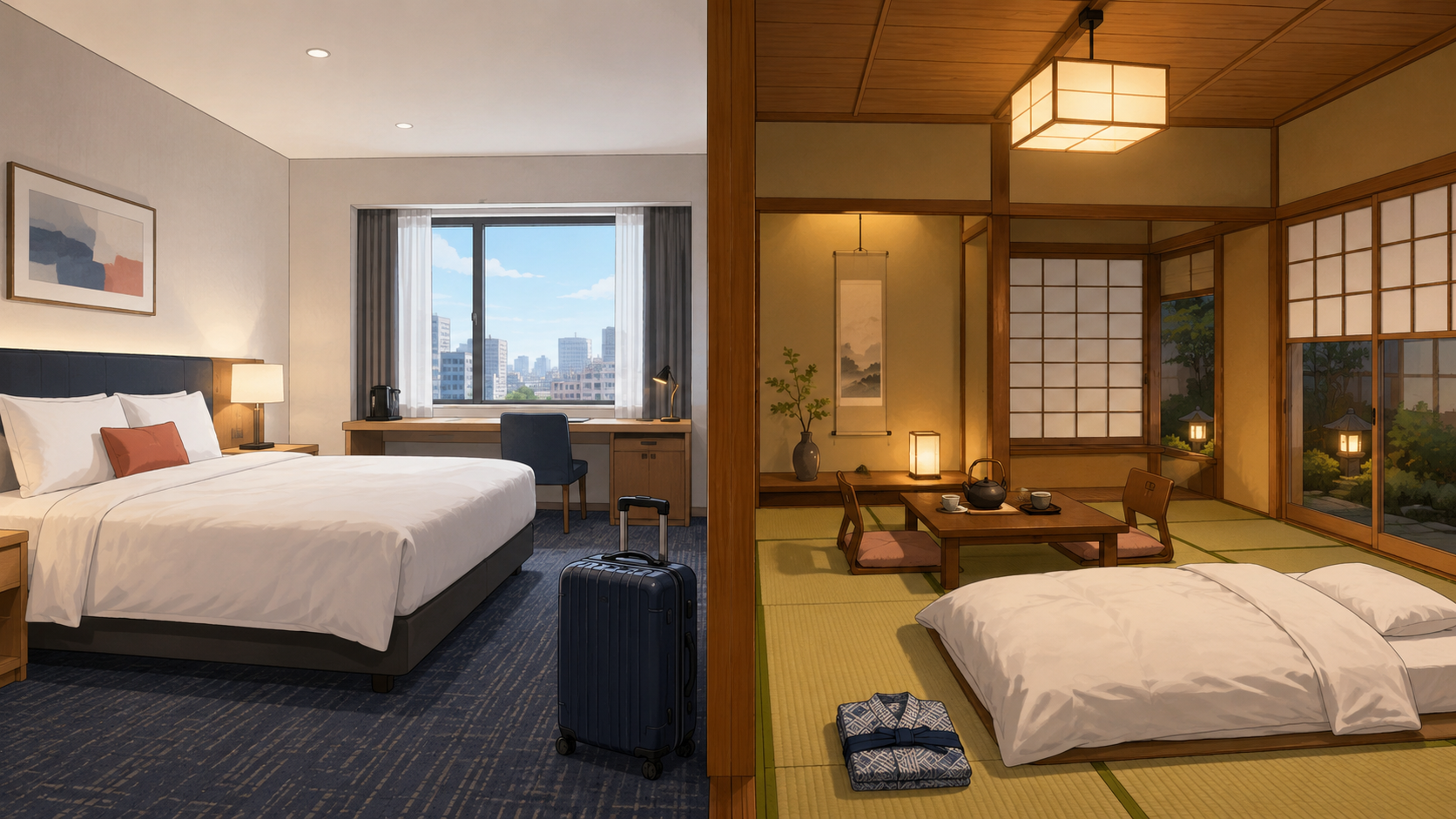
Room labels can also be confusing: a double room normally has one bed, while a room with two semi-double beds has two separate beds. Before paying, compare the bed count, bed width, occupancy, and floor area in our guide to Japanese hotel room types.
Check-In Time Is Not the Same as the Final Arrival Time
If a confirmation says check-in begins at 3:00 p.m., that does not necessarily mean you can arrive at any hour after 3:00 p.m. Look for a separate final check-in time, reception closing time, or late-arrival notice.
Full-service hotels often operate a 24-hour front desk, but many small hotels, hostels, minshuku, and ryokan do not. An unstaffed property may require advance online registration and send an entry code only after identity verification.
If your flight or train is delayed, contact the property as soon as you know. Give your reservation name, expected arrival time, and booking number. JNTO’s responsible-travel guidance specifically recommends calling ahead when running late for hotel reservations.
Why late arrival is especially important at a ryokan
A ryokan plan may include a multi-course dinner prepared for a scheduled time. Arriving after dinner service can mean missing the meal even if the room remains available. Contact the ryokan before booking when your arrival depends on a late flight or a long train connection.
For a full comparison of arrival times, meals, room styles, and service, read our Ryokan vs Hotel in Japan guide.
What happens if you do not contact the property?
The property may treat the reservation as a no-show under the terms you accepted. Depending on the booking, that can mean losing the room, being unable to enter after reception closes, or being charged a cancellation fee. There is no single nationwide grace period that guarantees the room will be held all night.
Can You Check In Early?
Early check-in is never automatic. The room may still be occupied, inspected, or cleaned. Even when an empty room is available, the property may charge an early check-in fee or permit access only from the official time.
Ask in advance if entering the room early is essential. Otherwise, plan around the published check-in time and treat any early access as a bonus.
Can the hotel store luggage before check-in?
Many staffed hotels will hold a registered guest’s luggage on the arrival day, but this is a service policy, not a legal entitlement. Small, unstaffed, capsule-style, or security-limited properties may have no storage space. Some will accept bags only during reception hours.
Confirm these four points:
- What time the luggage desk or reception opens
- Whether same-day storage is free or paid
- Whether oversized items are accepted
- Whether the property stores bags after check-out
Keep passports, medicine, money, electronics, fragile items, and valuables with you. Do not assume refrigerated items, open food, dangerous goods, or wet equipment can be stored.
If storage is unavailable, use a coin locker, station storage counter, or luggage delivery service. For longer transfers, see our Japan luggage forwarding guide.
Our complete guide to arriving before hotel check-in in Japan explains early registration, same-day luggage storage, station alternatives, what to keep in your day bag, and how to handle a delayed arrival.
Sending a Suitcase to Your Hotel Before You Arrive
Many hotels can receive forwarded luggage, but you must confirm before sending it. The name on the shipping label should match the reservation, and the label may need your check-in date and booking information.
Do not send a suitcase to a vacation rental, hostel, unstaffed property, or small accommodation without permission. There may be nobody available to sign for it, no secure storage area, or no way for staff to match the bag to the reservation.
Ask both the courier and hotel about delivery timing. Carry one night of clothes, medicine, chargers, documents, and anything irreplaceable in your day bag in case the suitcase arrives later than planned.
Is Your Hotel Already Paid?
A card number used to guarantee a reservation does not always mean payment has been collected. Your confirmation should say something similar to:
- Prepaid: the room charge was collected before arrival.
- Pay at the property: the hotel collects payment during check-in or check-out.
- Partial prepayment: a deposit was collected and the balance remains due.
Even with a prepaid booking, the property may collect charges that were excluded from the online total, such as local accommodation tax, meals, upgrades, or incidentals. Read the price breakdown rather than relying on the word “confirmed.”
Will the hotel require a deposit?
Some hotels request a credit-card authorization or cash deposit for incidentals; many smaller properties simply collect the room price. Policies vary by hotel, booking plan, and payment status. If a temporary authorization is placed on your card, the time required for it to disappear can depend on your card issuer.
Should you carry cash?
Yes, keep some yen available. International cards are widely accepted at major urban hotels, but JNTO notes that smaller or rural accommodations can still be cash-only. A mobile wallet or overseas contactless card may also fail even when another physical card works.
For advice on foreign cards, Japanese ATMs, IC cards, and how much cash to carry, see our Cash vs Card in Japan guide.
Self-Check-In and Unstaffed Hotels
Self-check-in can involve a lobby kiosk, tablet, video call, lockbox, smart lock, or online form. Complete any pre-arrival registration before traveling, and save every PIN and QR code offline.
Check whether:
- The building entrance and room use different codes
- The code becomes active only after the official check-in time
- Passport verification is required online or at a kiosk
- There is a deadline for completing registration
- Emergency support is available by phone or intercom
- Your phone can place calls in Japan if the system fails
Do not wait until midnight to open the instructions for the first time. If a link, code, or guest name is wrong, it is much easier to resolve while support staff are still available.
Important Information to Listen for at Check-In
Travelers sometimes focus so heavily on receiving the key that they miss the instructions they will need later. Confirm:
- How to enter after the front door locks
- Whether the physical key must be left at reception
- Breakfast location and final entry time
- Public bath, shower, laundry, or lounge hours
- Quiet hours
- Smoking rules
- Emergency exits and evacuation route
- Check-out method and deadline
JNTO advises guests to check evacuation routes when arriving at a hotel. Take a moment to look at the diagram on the room door and locate the nearest stairway.
A Note From Sho: What Front-Desk Staff Need From You
I have worked in accommodation management and have assisted many guests arriving from overseas. From the property side, the easiest check-ins are not necessarily the ones with perfect Japanese. They are the ones where the guest has the correct reservation name, all passports ready, and has contacted us before a late arrival.
The most preventable problems happen when a guest books for the wrong number of people, assumes the card guarantee was payment, or discovers after reception closes that an entry code was sent to an old email address. Five minutes spent checking the confirmation before departure can save an hour of stress at night.
If you do not understand an important instruction, ask staff to write it down or show it on your phone. Front-desk staff would rather explain it once during check-in than receive an emergency call later.
Checking Out of a Hotel in Japan
Check-out may be completed at reception, by inserting a key card into a machine, or by placing a key in a designated box. Some hotels use express check-out when the room is fully paid and there are no additional charges.
Before leaving:
- Confirm the check-out time; late fees may apply after it.
- Check the safe, refrigerator, outlets, bathroom, and space under the bed.
- Return physical keys, cards, borrowed chargers, and rental items.
- Settle meals, local taxes, or other remaining charges.
- Ask about luggage storage before leaving your bags.
Do not take reusable hotel items such as sleepwear, towels, hair dryers, adapters, or room equipment. Individually packaged toiletries and clearly labeled complimentary amenities are different, but ask if you are unsure.
For late check-out fees, luggage storage after departure, express check-out, and what to do with room keys, see our complete Japan hotel check-out guide.
Useful Japanese Phrases
| Japanese | Meaning | Use |
|---|---|---|
| Chekku-in o onegaishimasu. | I’d like to check in. | At reception |
| Yoyaku shita Sho desu. | I have a reservation under Sho. | Giving the booking name |
| Tōchaku ga osoku narimasu. | I will arrive late. | Contacting the property |
| Nimotsu o azukatte moraemasu ka? | Can you store my luggage? | Before check-in or after check-out |
| Chekku-auto wa nanji desu ka? | What time is check-out? | Confirming the deadline |
English, a translation app, and your booking screen are usually enough. Clear numbers and written times are more important than perfect pronunciation.
Common Hotel Check-In Mistakes
- Leaving one traveler’s passport in a locked suitcase or with another person
- Assuming the card used to book means the room is prepaid
- Arriving after reception closes without contacting the property
- Booking a room for one guest and bringing an unregistered second guest
- Expecting early check-in or luggage storage without confirmation
- Sending luggage to an unstaffed property without permission
- Ignoring ryokan dinner time because the room itself is held later
- Keeping entry codes only in an online app
- Missing breakfast, bath, door-lock, or check-out hours explained at arrival
Frequently Asked Questions
What time is hotel check-in in Japan?
Many hotels begin check-in in the afternoon, often around 3:00 p.m., but there is no universal time. Your reservation may also show a separate final check-in time. Follow the exact hours stated by your property.
What do I need to check in to a hotel in Japan?
Bring the reservation name or confirmation, the physical passport of every applicable overseas guest, and a payment method accepted by the property. Also keep any self-check-in code or late-arrival instructions available offline.
Does every guest need to be present at check-in?
Property procedures vary, but every applicable overseas guest must be properly registered and have passport information handled as required. If your group will arrive separately, contact the hotel in advance rather than assuming the first person can complete everything for everyone.
Can a hotel keep my passport?
The government requirement is to present the passport and allow the required copy for applicable guests. The original should normally be returned after the process. If anyone asks to retain it beyond check-in, ask why and when it will be returned.
Can I check in without the credit card used to book?
Possibly, but the hotel or booking terms may require that card, especially for prepaid, fraud-protected, or cardholder-only reservations. Check before travel if the booking was paid by another person or a company.
Can I arrive before check-in and use the hotel facilities?
Not automatically. Lobbies, lounges, baths, gyms, and other facilities have their own access rules. Ask whether registered guests may use them before receiving the room.
Will the hotel speak English?
English support is common at large hotels and in major tourist areas, but not guaranteed everywhere. Keep names, dates, and questions in writing. Translation apps work well for straightforward check-in details.
What if I lose my room key?
Contact the property immediately. Identity verification and a replacement fee may be required. Do not write the hotel name or room number on a key card you carry outside.
Final Check-In Checklist
- Check the final arrival time—not only the check-in start time.
- Confirm whether the room is prepaid or payable at the property.
- Register the correct number of adults and children.
- Bring every required physical passport.
- Save the address, phone number, confirmation, and entry codes offline.
- Contact the property immediately if you will be late.
- Ask before relying on early check-in or luggage storage.
- At arrival, confirm breakfast, door-lock, emergency, and check-out procedures.
With those details prepared, checking in to a hotel in Japan is usually quick and easy. The key is to separate government requirements—such as passport registration for applicable overseas visitors—from services that depend on the individual property.
Official Sources
- Ministry of Health, Labour and Welfare: Request for Producing Passports for Identification
- Japan National Tourism Organization: Frequently Asked Questions
- Japan National Tourism Organization: Accommodation in Japan
- Japan National Tourism Organization: Traveling Mindfully
- Japan National Tourism Organization: Luggage and Storage
- Japan National Tourism Organization: Cashless Payments in Japan
- Japan National Tourism Organization: Japanese Ryokan Guide
- Japan National Tourism Organization: Staying Safe in Japan