Last fact-checked: September 10, 2026
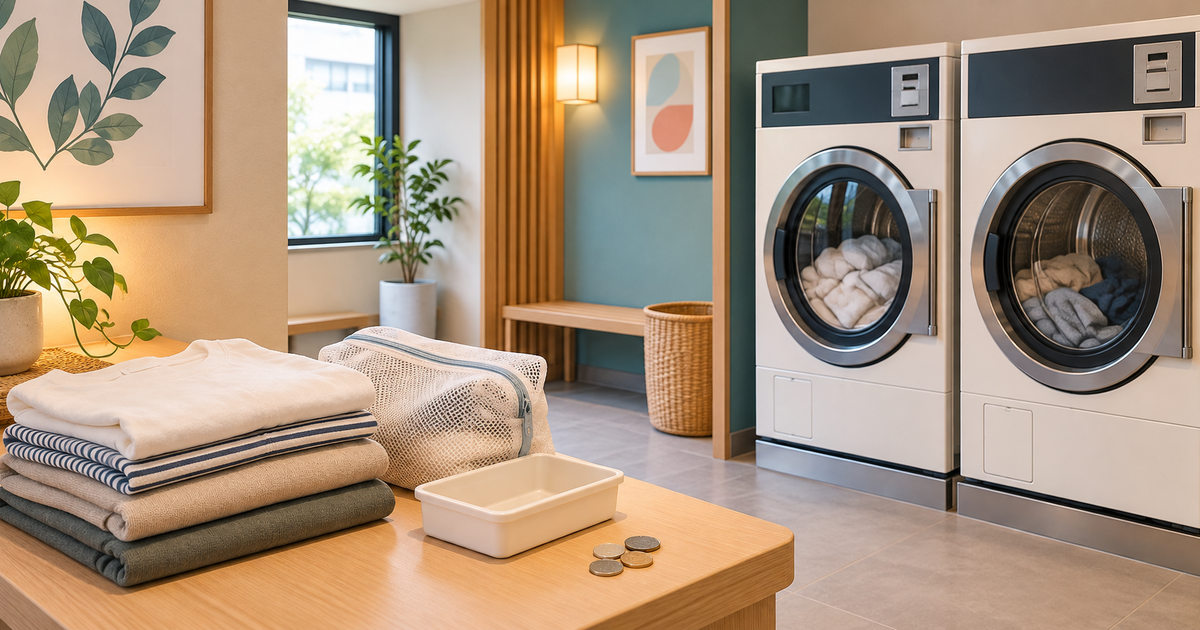
Doing laundry in Japan is usually easy once you know which machine you are looking at. The confusing part is that there is no single national setup: one hotel may have separate coin-operated washers and dryers, another may have a combined washer-dryer, and an apartment hotel may put a machine inside your room.
The same variation applies to detergent and payment. Detergent may be dispensed automatically, provided by the hotel, sold at reception, or left for you to supply. A machine may accept 100-yen coins, an app, a payment terminal, or a hotel-specific method.
Quick answer: Check the instructions on the exact machine before adding clothes, detergent, or money. Confirm whether it washes, dries, or does both; whether detergent is automatic; which payment method works; and when the cycle will finish. Do not assume the setup will match your previous hotel.
- Four Ways to Do Laundry in Japan
- How to Check Laundry Facilities Before Booking
- Hotel Laundry Room vs. Public Coin Laundry
- How to Use a Japanese Hotel Washing Machine
- Is Detergent Included?
- Japanese Laundry Words You Should Know
- Payment: Do You Need 100-Yen Coins?
- Why Japanese Dryers Sometimes Seem Slow
- Laundry-Room Etiquette
- Security: Can You Leave While the Machine Runs?
- In-Room Washer-Dryers and Apartment Hotels
- How to Find a Public Coin Laundry
- Useful Japanese Phrases
- Common Laundry Mistakes in Japan
- Frequently Asked Questions
- Final Laundry Checklist
- Official Sources
Four Ways to Do Laundry in Japan
Most travelers will use one of these four options:
- A hotel self-service laundry room: Convenient and reserved for guests, but the number of machines can be limited.
- An in-room washer or washer-dryer: Excellent for families and longer stays because you do not need to wait in a shared room.
- A public coin laundry: Often has larger machines and more capacity than a small hotel laundry room.
- A hotel laundry or dry-cleaning service: Useful for business clothes or when you do not have time, but normally more expensive than self-service washing.
There is no universally best choice. For one small load, the hotel laundry room is normally the easiest. For a family, a public laundromat or an apartment-style hotel may save time. For a suit, delicate garment, or item marked dry-clean only, ask the hotel about professional service instead of experimenting with a hot dryer.
How to Check Laundry Facilities Before Booking
Do not stop after seeing the words “laundry facilities” on a booking site. That description can mean a shared washer, a full washer-dryer in the room, or a paid service handled by the hotel.
Check the hotel’s official room and facility pages, then confirm these details:
- Is the machine inside the room or in a shared laundry area?
- Is it a washer, dryer, or washer-dryer combination?
- Is detergent included or automatically dispensed?
- What payment methods are accepted?
- What hours can guests use the laundry room?
- How many machines are available?
Official hotel information demonstrates why this matters. Toyoko Inn lists coin-operated washing machines and dryers among its services. Individual APA Hotel property pages may list the number of coin-operated machines available. Tokyu Stay promotes washer-dryer combinations in many rooms, but also warns that some listed equipment may not be available in every guest room. MIMARU says almost all locations either provide 24-hour coin laundries or have washers and dryers in the applicable rooms.
In other words, check the property and room type—not only the chain name. Our guide to Japanese hotel room types explains why two rooms at the same hotel can have very different layouts and equipment.
Hotel Laundry Room vs. Public Coin Laundry
| Feature | Hotel laundry | Public coin laundry |
|---|---|---|
| Convenience | No need to leave the building | May require a walk with your clothes |
| Capacity | Often designed for ordinary travel loads | More likely to offer several drum sizes |
| Availability | Can become busy in the evening | Often has more machines, but popular locations can still be busy |
| Payment | Coins or a property-specific system | Coins, central terminal, or supported app depending on the store |
| Help | Hotel staff may be able to assist | Some stores are unattended; use the posted support number if needed |
My practical recommendation is simple: use the hotel machine for a small load, but search for a nearby public laundromat if the hotel has only one machine, you have several travelers’ clothes, or you need a larger dryer.
How to Use a Japanese Hotel Washing Machine
The exact order varies, so treat the instructions on the machine as the final authority. A safe general sequence is:
- Check the operating hours. Some laundry rooms are open around the clock; others close overnight or sit inside an area with restricted hours.
- Check your pockets. Remove your passport, cash, transit card, receipts, tissues, and room key. A forgotten tissue can decorate an entire load with white paper confetti.
- Read the machine label. Identify whether it is a washer, dryer, or combination machine.
- Look inside the drum. Check for forgotten items and visible dirt. If the machine offers a free drum-cleaning cycle, use it before loading your clothes.
- Check the capacity line. Do not pack the drum tightly. Clothes need space to move, and an overloaded dryer works poorly.
- Confirm the detergent rule. Never pour in your own detergent until you know it is required.
- Select the course. Make sure you have chosen wash only, dry only, or wash and dry.
- Pay and start. Insert the required coins or follow the terminal or app instructions.
- Photograph the finish time. Set a phone alarm and return before the cycle ends.
- Remove your clothes promptly. Check the drum, door seal, and lint area for small socks or other items.
If you cannot understand the controls, use a translation app’s camera before inserting money. Our guide to using your phone in Japan can help you prepare mobile service before the trip.
Is Detergent Included?
Sometimes—but never assume. Modern commercial laundromats often dispense detergent automatically, while a hotel or older machine may require a separate packet.
For example, Baluko Laundry Place’s official FAQ says its detergent and fabric softener are automatically dispensed. Its instructions also warn users to select the no-softener option before payment when available. That rule belongs to Baluko’s equipment; it should not be treated as a rule for every laundromat in Japan.
At a hotel, detergent might be:
- automatically included in the machine cycle;
- provided in the room or at check-in;
- sold at reception or from a vending machine; or
- something you must buy yourself.
Adding extra detergent to an automatic-dispensing machine can create excess foam and cause trouble. Look for 洗剤自動投入 (detergent automatically dispensed) or ask the front desk:
洗剤は自動で入りますか?
Senzai wa jidō de hairimasu ka?
Is detergent added automatically?
If you have sensitive skin, use a machine that clearly permits your own detergent or ask whether an extra rinse is possible. Shared machines can retain traces of products used in earlier loads, so a public or hotel machine cannot guarantee an allergen-free wash.
Japanese Laundry Words You Should Know
| Japanese | Reading | Meaning |
|---|---|---|
| 洗濯 | sentaku | wash / laundry |
| 乾燥 | kansō | dry |
| 洗濯乾燥 | sentaku kansō | wash and dry |
| 脱水 | dassui | spin / water extraction—not full drying |
| すすぎ | susugi | rinse |
| 洗剤 | senzai | detergent |
| 柔軟剤 | jūnanzai | fabric softener |
| 残り | nokori | remaining |
| 使用中 | shiyō-chū | in use |
| 空き | aki | available |
| スタート | sutāto | start |
| 停止 / 取消 | teishi / torikeshi | stop / cancel |
| ドラム洗浄 | doramu senjō | drum cleaning |
| 料金 | ryōkin | fee / price |
Important: 脱水 means the spin cycle removes much of the water. It does not mean your clothes will come out dry. Choose 乾燥 or move the load to a separate dryer.
Payment: Do You Need 100-Yen Coins?
Many machines still accept 100-yen coins, so carrying several is sensible. However, “coin laundry” does not always mean coin-only. Some modern stores use a central payment terminal or an app, and the supported payment methods vary by operator and location.
For example, the official Baluko app advertises machine controls, availability checks, completion notifications, and supported cashless payment at participating stores. The official WASH House app also supports course selection and smartphone payment at compatible locations. These features are convenient, but visitors should not download an app until they have confirmed that the particular store and machine support it.
Hotel laundry rooms may be more limited. Ask reception for change before loading the machine, and do not assume a nearby vending machine will change a large bill. If you are still deciding how much cash to carry, see our guide to cash versus cards in Japan.
Why Japanese Dryers Sometimes Seem Slow
A displayed cycle time is an estimate, not a promise that every item will be completely dry. Thick jeans, hoodies, towels, and tightly packed loads can need more time. Small combination units may also dry differently from a large commercial gas dryer.
If your clothes are still damp:
- remove items that are already dry;
- separate thick and thin garments;
- clean the lint filter if the posted instructions ask users to do so;
- reduce the load rather than repeatedly drying an overfilled drum; and
- add a short drying cycle only if the care labels permit tumble drying.
Heat-sensitive clothing, printed shirts, bras, wool, and some synthetic fabrics can shrink or suffer damage. Check the care label first. If you would not put the item in a hot dryer at home, Japan is not the place to become adventurous.
Some combination machines also run a short cooldown after drying. A machine that shows a cooldown code may not be malfunctioning. Baluko, for example, explains that its “cd” display indicates a brief cooldown while the drum temperature drops. Again, use the instructions for the machine in front of you.
Laundry-Room Etiquette
The main rule is simple: shared machines are not private storage lockers.
- Return on time. Set an alarm and be ready when the cycle finishes.
- Do not reserve a machine. A basket or detergent packet does not hold your place.
- Do not overload it. This wastes time, produces poor results, and may stop the machine.
- Check prohibited items. Shoes, heavily oily workwear, pet bedding, diapers, and other specialized items may be prohibited unless a dedicated machine is provided.
- Keep the room tidy. Remove lint when instructed and take all packaging and personal items with you.
- Do not handle another guest’s clothes unless the posted rules allow it. At a hotel, ask reception what to do if a finished machine has been abandoned.
Leaving a finished load for a long time creates an awkward situation for everyone. It can also lead to your clothes being moved according to hotel or store policy. I work in hospitality, and this is one of those tiny actions that makes a shared space run smoothly: arrive a few minutes early, not twenty minutes late.
Security: Can You Leave While the Machine Runs?
Many travelers leave the laundry room during a long cycle, but doing so is at their own risk. A locked hotel floor, security camera, or app notification does not guarantee that belongings will be safe.
Before washing, remove:
- passport and wallet;
- cash and credit cards;
- hotel key cards;
- phones, earbuds, and chargers;
- medication; and
- small jewelry or sentimental items.
Keep a simple inventory of anything valuable, and return before the cycle ends. If something disappears, contact hotel staff or the laundromat support number immediately. Do not confront another customer based only on suspicion.
In-Room Washer-Dryers and Apartment Hotels
An in-room machine can be the best option for parents, long stays, and travelers who want to pack light. MONday Apart property FAQs, for example, may specify a fully automatic washer with drying function and provided detergent. Tokyu Stay highlights washer-dryers and other long-stay equipment in many rooms. MIMARU explains that the setup varies by location and room type.
The words “in-room laundry” still do not guarantee a separate full-size dryer. Check whether the listing says:
- washer only;
- washer with drying function;
- washer-dryer combination; or
- bathroom drying system.
A bathroom drying system circulates warm, dry air in the bathroom so that clothes can hang indoors. It is useful, but it is not the same as tumble drying. Ask the hotel how to operate it and use only the provided hanging area. Do not hang wet laundry from sprinklers, smoke detectors, hallway fixtures, or emergency equipment.
Families comparing longer-stay accommodation can also read our guide to the best Japanese hotel chains for families, which covers kitchens, beds, laundry equipment, and luggage space.
How to Find a Public Coin Laundry
Search Google Maps or another map app for coin laundry or コインランドリー. Check recent photos and reviews for:
- current business hours;
- machine sizes;
- wash-and-dry combination machines;
- payment methods;
- English instructions;
- detergent policy; and
- whether luggage or waiting space is available.
Do not bring a large suitcase into a tiny laundry room if it blocks the aisle. If you are between hotels, use a station coin locker or your hotel’s luggage storage service when appropriate, then carry only the clothes you need to wash.
Useful Japanese Phrases
コインランドリーはありますか?
Koin randorī wa arimasu ka?
Is there a coin laundry?
洗濯機はどこですか?
Sentakuki wa doko desu ka?
Where is the washing machine?
洗剤は必要ですか?
Senzai wa hitsuyō desu ka?
Do I need detergent?
この機械は乾燥もできますか?
Kono kikai wa kansō mo dekimasu ka?
Can this machine dry clothes too?
両替できますか?
Ryōgae dekimasu ka?
Can you make change?
機械が止まってしまいました。
Kikai ga tomatte shimaimashita.
The machine has stopped.
Common Laundry Mistakes in Japan
- Assuming detergent is always included. Check first.
- Adding detergent to an auto-dispensing machine. More soap does not mean cleaner clothes.
- Choosing 脱水 and expecting dry clothing. That is spin extraction, not drying.
- Starting a wash-only cycle late at night. You may discover too late that every dryer is occupied.
- Overloading a combination machine. A load that washes successfully may still be too large to dry well.
- Forgetting the finish time. This inconveniences other guests and risks having your clothes moved.
- Washing delicate or dry-clean-only clothing. A travel emergency can become an expensive wardrobe emergency.
- Leaving coins until the last minute. Confirm payment before placing all your clothes in the drum.
Frequently Asked Questions
Do Japanese hotels usually have washing machines?
Many business hotels, apartment hotels, and long-stay properties offer either shared machines or in-room equipment, but it is not guaranteed. Check the official page for the exact hotel and room type before booking.
Are hotel laundry machines free?
Some in-room machines are included in the room rate, while shared hotel washers and dryers are often paid. Fees and payment methods vary by property.
Do I need to bring detergent?
Not always. Some machines dispense it automatically, some hotels provide it, and others sell it separately. Read the label or ask staff before adding detergent.
Can I pay by credit card?
Some modern laundromats offer app or cashless payment, but many hotel machines still rely on coins or another property-specific method. Carrying several 100-yen coins is a useful backup.
Can I wash clothes after midnight?
Only if the hotel or laundromat permits it. Some facilities operate 24 hours, while others have restricted hours or quiet-time rules. Check before starting a long cycle.
What should I do if another person’s cycle has finished?
At a hotel, ask reception rather than immediately removing someone else’s clothing. At a public laundromat, follow the posted policy. Do not leave the other person’s clothes on the floor or an unclean surface.
Can I wash shoes in the regular machine?
Do not do so unless the rules explicitly permit it. Some laundromats have dedicated sneaker washers and dryers. Use those machines according to their instructions.
Final Laundry Checklist
- Confirm the machine type and capacity.
- Check whether detergent and softener are automatic.
- Separate colors and review care labels.
- Empty every pocket.
- Confirm payment before loading.
- Choose wash, dry, or wash-and-dry carefully.
- Photograph the finish time and set an alarm.
- Return early and remove everything promptly.
Doing laundry in Japan is not difficult; it is simply less standardized than travelers sometimes expect. Read the exact machine, ask one clear question if necessary, and return on time. With that small amount of preparation, you can pack lighter, make room for souvenirs, and avoid spending your evening staring suspiciously at a blinking washing machine.
Official Sources
- Tokyu Stay: User Guide and room facilities
- MIMARU: Official hotel information and laundry FAQ
- Toyoko Inn: Rooms and services
- APA Hotel: Individual hotel facility listings
- MONday Apart: Property facilities and FAQs
- Baluko Laundry Place: Self-laundry instructions
- Baluko Laundry Place: Official FAQ
- WASH House: Official machine instructions
Facilities, prices, operating hours, detergent, and payment methods can change and may differ by hotel, room type, store, and machine. Always follow the current instructions at the property you are using.