Last fact-checked: September 16, 2026. Room names, bed sizes, occupancy limits, and child policies vary by property. Always confirm the specifications on the hotel’s official website before booking.
Quick answer: If your booking says “2 semi-double beds,” the room has two separate beds—not one bed split in two. Each bed is usually narrower than the hotel’s standard double bed. The wording does not automatically mean the room will be comfortable for four adults, even when four-person occupancy is permitted. Check the width of each bed, floor area, permitted occupancy, and bed-sharing rules before booking.
A hotel room can look perfectly comfortable in photographs and still feel very different when two travelers arrive with two large suitcases. Japanese booking pages also use terms such as “semi-double,” “small double,” and “Hollywood twin,” which may be unfamiliar to visitors.
This guide explains the most common Japanese hotel room types and shows you what to check before paying.
- Japan Hotel Room Types at a Glance
- What Is a Single Room in Japan?
- What Is a Semi-Double Room?
- What Does “2 Semi-Double Beds” Mean in Japan?
- Double Room vs Twin Room in Japan
- What Does “Hollywood Twin” Mean?
- What Is a Triple Room?
- Japanese-Style and Japanese-Western Rooms
- How to Read Room Size in Square Metres
- How Much Room Do You Need for Luggage?
- Maximum Occupancy Does Not Guarantee Equal Beds
- Check the Official Hotel Page Before Booking
- A Note From Sho: The Room Name Is Only the Beginning
- Questions to Send the Hotel
- Frequently Asked Questions
- Can two adults sleep in a semi-double room in Japan?
- Does “2 semi-double beds” mean two beds?
- Is a twin room bigger than a double room?
- Does “double room” mean two beds?
- Is a Japanese double bed the same size as an American queen?
- What if the booking site and hotel website show different details?
- Can I request an extra bed after arrival?
- What should tall or broad-shouldered travelers check?
- Final Booking Checklist
- Official Examples and Sources
Japan Hotel Room Types at a Glance
| Room label | Usual arrangement | Best suited to | What to verify |
|---|---|---|---|
| Single | One room with one bed | One traveler | Occupancy, bed width, and luggage space |
| Semi-double / small double | One relatively narrow bed | One traveler or a couple comfortable sharing a compact bed | Exact width and whether two adults are permitted |
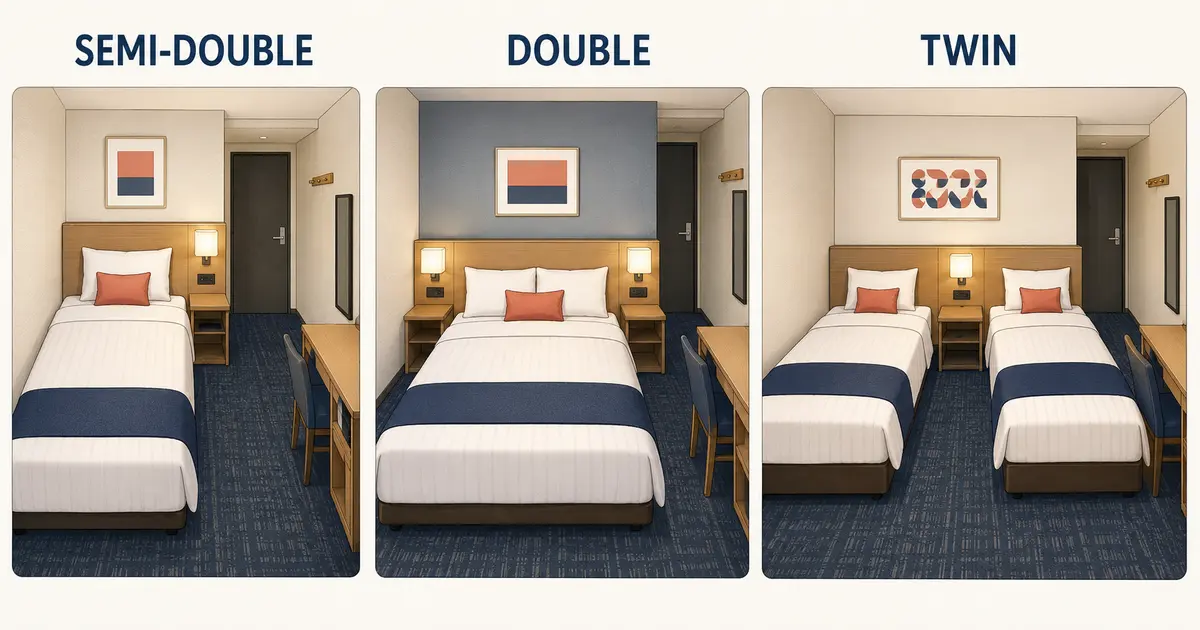
| Two semi-double beds | Two separate relatively narrow beds | Two travelers, or more guests when the hotel explicitly permits bed-sharing | Width of each bed, permitted occupancy, and whether two people must share each bed |
| Double | One bed | One or two travelers sharing a bed | Bed width, access around the bed, and room area |
| Twin | Two separate beds | Friends, couples wanting separate beds, or two travelers | Width of each bed and space between them |
| Hollywood twin | Two beds placed directly beside each other | Couples or families who want a wider sleeping surface | Whether the beds can be separated and whether there is a gap |
| Triple | Three sleeping places | Three travelers | Whether the third bed is permanent, a sofa bed, or an extra bed |
| Japanese-style | Futons placed on tatami | Travelers wanting a traditional stay | Shared bathrooms, futon setup, and house rules |
| Japanese-Western | Western beds plus a tatami area | Families and mixed-preference groups | How many guests use beds and how many use futons |
What Is a Single Room in Japan?
A single room is primarily a room for one guest. It usually contains one bed, but “single” describes the intended occupancy more reliably than the physical width of the bed.
Do not assume that every single room has a narrow single bed. For example, Toyoko Inn states that many of its single rooms use double-sized beds, while also noting that sizes may vary by location. A wide bed does not automatically mean that the hotel permits two adults to stay in the room.
When booking for two people, enter two guests in the search. If a room disappears from the results, it is probably not sold for double occupancy even if the bed looks large enough.
What Is a Semi-Double Room?
A semi-double room—sometimes translated as a small double—usually contains one bed that is narrower than the hotel’s standard double bed. It is common in Japanese business hotels because it allows a compact single room to be sold to a couple at a relatively low price.
The important word is usually. “Semi-double” is not a promise of one universal measurement.
Official hotel listings demonstrate the variation:
- Sotetsu Fresa Inn Kanda-Otemachi lists a semi-double room of approximately 10.8–11.0 m² with one 125 cm-wide bed.
- Sotetsu Fresa Inn Tokyo-Kyobashi lists semi-double rooms of approximately 11.5–13.0 m² with one 120 cm-wide bed.
The same label can therefore describe noticeably different sleeping arrangements. For two adults, do not book from the words “semi-double” alone. Check the published width and decide whether you are comfortable sharing it for the entire stay.
A semi-double can be a sensible budget choice for a short stay. It can also become a very long night if both travelers need more personal space. Saving money is nice; conducting a midnight border dispute over the center of the mattress is less relaxing.
What Does “2 Semi-Double Beds” Mean in Japan?
On most hotel booking pages, “2 semi-double beds” means two physical beds, with each bed described by that hotel or booking platform as semi-double. It does not mean one double bed, and it does not mean two full-size double beds.
The phrase describes the bed arrangement, not a guaranteed number of comfortable sleepers. Depending on the hotel’s rules, the same room might be sold to two adults, three guests using bed-sharing, or four guests with two people sharing each bed. The only reliable occupancy number is the one shown for your exact room and rate plan after you enter every traveler’s age.
| Booking wording | Physical beds in the room | What it usually means |
|---|---|---|
| 1 semi-double bed | One | One adult, or two people sharing when the hotel permits it |
| 2 semi-double beds | Two separate beds | Two people can use one bed each; additional guests may need to share |
| Twin room | Two separate beds | Bed widths vary, so check whether they are single, semi-double, or another size |
Simple example: If a room has two 125 cm-wide semi-double beds and permits four adults, four-person use normally means two adults sharing each 125 cm bed. The hotel’s occupancy approval does not guarantee that every guest will find that arrangement spacious.
Is a Room With Two Semi-Double Beds a Twin Room?
Usually, yes: it has two separate beds, so it is a type of twin arrangement. However, booking sites may label it “Twin Room,” “Economy Twin,” “Standard Twin,” or simply “Room with 2 Semi-Double Beds.” The label matters less than the specifications.
Before booking, verify:
- Bed count: confirm that the listing states two beds, not one bed for two people.
- Width of each bed: semi-double is not one universal measurement.
- Permitted occupancy: check the exact number of adults and children accepted under your rate.
- Bed-sharing: determine whether a third or fourth guest must share an existing bed.
- Room area: two wider beds can leave very little open floor space.
- Luggage space: photographs taken without suitcases can make a compact room look more generous.
How Wide Is a Semi-Double Bed in Japan?
There is no single width that every Japanese hotel uses for the term. Current official listings show why travelers must check the number rather than relying on the name:
| Official hotel example | Room label | Published bed arrangement | Published room area |
|---|---|---|---|
| Sotetsu Fresa Inn Kanda-Otemachi | Semi-double | One 125 cm-wide bed | Approximately 10.8–11.0 m² |
| Sotetsu Fresa Inn Tokyo-Kyobashi | Semi-double | One 120 cm-wide bed | Approximately 11.5–13.0 m² |
| APA Hotel TKP Tokyo Nishikasai | Single | One 120 cm-wide bed | 10 m² |
| APA Hotel TKP Tokyo Nishikasai | Double | One 140 cm-wide bed | 10 m² |
These are examples, not national standards. They also demonstrate why the measurement matters: even two official semi-double listings use different widths, while a 120 cm bed may appear under a single-room label elsewhere. Read the number attached to the exact room instead of converting the label into a fixed U.S. bed size.
Can Four Adults Use Two Semi-Double Beds?
Only when the hotel sells that exact room and rate for four adults. If permitted, it normally means two adults share each bed. Do not book the room for two guests and arrive with four, even if the photographs show two beds.
For four adults, compare the total cost with a room containing four fixed beds, two connecting rooms, or two separate twin rooms. The cheapest nightly price is not always the best value once sleep, bathroom timing, and suitcase space join the discussion.
What About Two Adults and Two Children?
Child bed-sharing rules are property-specific. Some hotels allow one qualifying child to share each existing bed, while others set different age, room-type, or occupancy limits. A free bed-sharing policy may not include a separate pillow, towel, amenity set, or breakfast.
Enter both children and their correct ages when searching. For properties designed around larger groups, kitchens, laundry, and fixed sleeping places, compare the options in our guide to Japanese hotel chains for families.
Double Room vs Twin Room in Japan
The clearest difference is the number of beds:
- Double room: normally one bed for one or two guests.
- Twin room: normally two separate beds.
A twin room is often more comfortable for friends, travelers with different sleep schedules, or anyone who wants more personal sleeping space. However, the word “twin” does not guarantee a large room. Two beds can occupy most of the available floor area.
Likewise, a double room is not necessarily more luxurious. It may simply be a compact room with one bed instead of two.
Check all of the following:
- The number of beds
- The width of each bed
- The total room area in square metres
- Whether the bed is against a wall
- Whether both travelers can access the bed comfortably
- Whether two suitcases can be opened
What Does “Hollywood Twin” Mean?
A Hollywood twin room usually has two separate mattresses placed directly next to each other. From a distance, they may look like one large bed, but each traveler still has a separate mattress and bedding.
This arrangement can work well for couples and families. It may also reduce the open floor space normally found between twin beds.
Do not assume the beds can be moved apart. Headboards, bedside tables, wiring, or the room layout may make separation impossible. If separate beds are essential, ask the hotel before booking.
What Is a Triple Room?
A triple room accommodates three guests, but it does not always contain three identical permanent beds. Depending on the property and plan, the third sleeping place may be:
- A regular single bed
- An extra or rollaway bed
- A sofa bed
- A daybed
- A futon in a tatami area
Read the room description and photographs carefully. Adding an extra bed can make an otherwise comfortable room feel crowded and may leave little space for luggage.
Japanese-Style and Japanese-Western Rooms
Japanese-style room
A Japanese-style room normally has tatami flooring and futons rather than permanent Western beds. Staff may prepare the futons in the evening, or the property may ask guests to arrange them themselves.
These rooms can provide flexible floor space during the day, but travelers with knee, back, or mobility concerns should consider whether sleeping and sitting close to the floor will be comfortable.
Japanese-Western room
A Japanese-Western room combines one or more Western beds with a tatami area. Additional guests may sleep on futons. This can be useful for families, but confirm exactly how many fixed beds are included.
If you are still choosing between a traditional inn and a conventional hotel, see our ryokan vs hotel guide.
How to Read Room Size in Square Metres
Japanese hotel listings commonly show floor area in square metres (m²). Travelers familiar with square feet can use the following approximate conversions:
| Room area | Approximate area in square feet |
|---|---|
| 10 m² | 108 sq ft |
| 12 m² | 129 sq ft |
| 15 m² | 161 sq ft |
| 20 m² | 215 sq ft |
| 25 m² | 269 sq ft |
| 30 m² | 323 sq ft |
Floor area is useful, but it is not the whole story. A narrow entrance, large desk, bathroom layout, structural column, or bed position can change how much usable space remains.
Two rooms with the same floor area may handle luggage very differently. Look for a floor plan, 360-degree view, under-bed storage, or photographs showing the space between the bed and wall.
How Much Room Do You Need for Luggage?
There is no reliable universal minimum because suitcase size and room layout vary. Instead, use this practical check:
- Count the travelers and full-size suitcases.
- Check the room area and official photographs.
- Look for a luggage rack, entrance space, closet, or storage under the bed.
- Check whether the bed touches one or more walls.
- If the layout remains unclear, ask the hotel directly.
For a one-night stay, taking turns opening suitcases may be manageable. For a week-long stay, constantly moving luggage from the floor to the bed can become frustrating.
If you do not need every suitcase with you, Japan’s delivery services may help. Read our Japan luggage forwarding guide before sending bags to your next hotel.
Maximum Occupancy Does Not Guarantee Equal Beds
A room listed for three or four guests may use bed-sharing, sofa beds, extra beds, or futons. “Maximum occupancy: four” does not necessarily mean four identical beds.
Children’s policies also vary significantly. A hotel may allow a young child to share an existing bed without an additional room charge, while another property may require the child to be included in paid occupancy. Breakfast, towels, pillows, and amenities may not be included for a child staying free.
Enter the correct number and ages of all guests when searching. Never reserve a room for one adult and arrive with two adults because the bed appears wide enough. The property must maintain an accurate guest record and may charge the correct rate, require another room, or refuse an occupancy that violates its rules.
For a chain-by-chain example, Toyoko Inn’s current room guide lists one bed for double rooms and two beds for twin rooms, while noting that twin-room capacity varies by hotel. Its child policy separately explains when a child may share an existing bed. Our APA Hotel vs Toyoko Inn vs Dormy Inn comparison explains additional differences travelers should check at the individual-property level.
Check the Official Hotel Page Before Booking
Booking platforms are useful for comparing prices, but translated room labels can be inconsistent. Before the free-cancellation deadline, compare the listing with the hotel’s official room page.
Confirm these eight details:
- Exact room name
- Number of guests permitted
- Number and type of beds
- Width of each bed
- Room area in m²
- Smoking or non-smoking status
- Bathroom arrangement
- Cancellation and room-change conditions
Keep a screenshot or copy of the room specifications shown when you booked. This can help if the translated description later changes or if you need to explain the reservation at check-in.
A Note From Sho: The Room Name Is Only the Beginning
From my experience working in accommodation management, many room problems begin before the guest arrives. The guest sees “double,” imagines a large room, and discovers that the listing only promised one bed for two people.
Hotel staff may want to help, but a free upgrade or room change is not always possible—especially when the property is full. The safest time to solve the problem is before the cancellation deadline.
I recommend checking the numbers instead of trusting the label: bed width, room area, number of beds, and maximum occupancy. It takes two extra minutes and can save several uncomfortable nights.
Questions to Send the Hotel
If the room description is unclear, you can send this message:
Hello. I am considering booking the [room name] for [number] adults. Could you please confirm the number of beds, the width of each bed, and whether there is enough floor space to open [number] large suitcases? Thank you.
Useful Japanese:
| Japanese | Pronunciation | Meaning |
|---|---|---|
| ベッドは何台ありますか? | Beddo wa nandai arimasu ka? | How many beds are there? |
| ベッドの幅は何センチですか? | Beddo no haba wa nan-senchi desu ka? | How wide is the bed? |
| スーツケースを二つ開けられますか? | Sūtsukēsu o futatsu akeraremasu ka? | Can we open two suitcases? |
| ベッドを離すことはできますか? | Beddo o hanasu koto wa dekimasu ka? | Can the beds be separated? |
Frequently Asked Questions
Can two adults sleep in a semi-double room in Japan?
Sometimes. The hotel must permit two-person occupancy, and both guests should be comfortable with the published bed width. Semi-double beds and rooms vary, so check the exact specifications.
Does “2 semi-double beds” mean two beds?
Yes. It normally means the room contains two separate semi-double beds—not one bed and not two standard double beds. Check the width of each bed and the permitted occupancy because a room sold for four may require two people to share each bed.
Is a twin room bigger than a double room?
Not necessarily. A twin room has two beds, but its total floor area may be similar to or even smaller than another property’s double room. Compare the m² figure and layout.
Does “double room” mean two beds?
No. A double room normally has one bed. A twin room normally has two separate beds.
Is a Japanese double bed the same size as an American queen?
Do not rely on the name alone. Hotels use different beds, and translated listings may use unfamiliar labels. Compare the published width in centimetres with the bed you normally use.
What if the booking site and hotel website show different details?
Contact the hotel or booking platform before the free-cancellation deadline. Give them the exact room name and ask them to confirm the bed arrangement, room area, and occupancy in writing.
Can I request an extra bed after arrival?
You can ask, but many compact rooms cannot legally or physically accommodate one. Extra beds may be limited, chargeable, or available only in specific room categories. Arrange this before arrival.
What should tall or broad-shouldered travelers check?
Check both bed width and length, whether one side is against a wall, and whether the room permits a larger bed category. If the listing does not publish the measurements, ask the property directly.
Final Booking Checklist
- Search using the correct number and ages of all guests
- Count the actual beds—not only the maximum occupancy
- Check bed width and length
- Convert the room area if you normally use square feet
- Inspect the floor plan and official photographs
- Think about where each suitcase will go
- Confirm child bed-sharing and amenity rules
- Ask about Hollywood twin separation or extra beds in advance
- Save the room description and cancellation deadline
Once your room is selected, prepare for arrival with our Japan hotel check-in guide, covering passports, late arrival, payments, and luggage storage. You can also compare the practical differences in our APA Hotel vs Toyoko Inn vs Dormy Inn guide, or review Japanese hotel chains for families when fixed beds and extra space matter most.
Official Examples and Sources
- Sotetsu Fresa Inn Kanda-Otemachi: official room specifications
- Sotetsu Fresa Inn Tokyo-Kyobashi: official room specifications
- APA Hotel TKP Tokyo Nishikasai: official room and bed specifications
- Toyoko Inn: official room-type guide
- Toyoko Inn: official child bed-sharing information
- Hotel Chinzanso Tokyo: official Japanese-Western room example