Short answer: Restaurant etiquette in Japan is easier than it may look. Wait to be seated, follow the restaurant’s ordering system, do not leave a tip, avoid the two major chopstick taboos, and pay where the staff directs you. Most small mistakes will not offend anyone—a polite attitude and clear communication matter far more than perfect technique.
This guide explains what U.S. travelers should expect from the moment they enter a restaurant in Japan until they pay the bill. It also covers the questions that cause the most confusion: ticket machines, otoshi charges, noodle slurping, cashless payment, allergies, and splitting the check.
Quick etiquette checklist
- Wait at the entrance until staff show you to a seat.
- Check whether you order from staff, a tablet, a QR code, or a ticket machine.
- Do not leave extra cash as a tip.
- Never stick chopsticks upright in rice or pass food directly between chopsticks.
- Ask before assuming the restaurant can split the bill or prepare takeout.
- Tell the restaurant about serious allergies before ordering—ideally when reserving.
- Is Restaurant Etiquette in Japan Strict?
- 1. Entering the Restaurant and Waiting for a Seat
- 2. How Ordering Works in Japan
- 3. Do You Tip at Restaurants in Japan?
- 4. What Is Otoshi at an Izakaya?
- 5. The Two Chopstick Rules You Really Need to Know
- 6. Is Slurping Noodles Polite?
- 7. Water, Tea, and the Wet Towel
- 8. Paying the Bill
- 9. Reservations, Arrival Times, and No-Shows
- 10. Allergies and Dietary Restrictions
- 11. Photography, Takeout, and Leftovers
- 12. Useful Restaurant Phrases
- A Note From Sho: What Restaurant Staff Actually Appreciate
- Common Mistakes to Avoid
- Frequently Asked Questions
- Final Checklist Before You Dine
- Official Sources
Is Restaurant Etiquette in Japan Strict?
Not usually. Japan has recognizable dining customs, but ordinary restaurants do not expect international visitors to know every detail. Casual ramen shops, family restaurants, cafes, sushi chains, and izakaya all have different systems. Watch what other customers do, read the signs, and ask staff when you are unsure.
The goal is not to perform Japanese culture perfectly. The useful rules are the ones that prevent practical problems: blocking the entrance, ordering incorrectly, misunderstanding a table charge, ignoring an allergy risk, or trying to pay in the wrong place.
1. Entering the Restaurant and Waiting for a Seat
When you enter, pause near the host stand or doorway. Even if you can see an empty table, wait for a staff member to seat you. A restaurant may be holding tables for reservations, limiting seating because of staffing, or assigning counter seats in a particular order.
If there is a line, look for a sign-up sheet, numbered ticket machine, or touchscreen near the entrance. Some popular restaurants require you to register your party before joining the physical line. If you are not sure, say “Sumimasen” and show the staff how many people are in your group with your fingers.
At restaurants with tatami rooms, you may be asked to remove your shoes. Place them neatly in the designated area or locker, and do not step onto the raised tatami floor in outdoor shoes.
Useful phrase
Futari desu. — Two people.
Replace futari with hitori for one person. For larger groups, showing the number with your fingers is perfectly practical.
2. How Ordering Works in Japan
There is no single ordering method. Check the entrance and your table before trying to call a server.
Order from a staff member
This is the familiar system. When you are ready, make brief eye contact or say “Sumimasen” in a normal voice. In many casual restaurants, calling staff politely is expected; you do not need to wait for repeated table visits as you might in the United States.
Press the call button
Many family restaurants, izakaya, and casual chains have a small call button on the table. Press it once and wait. Repeatedly pressing it will not make the order arrive faster.
Use a tablet or QR code
Digital menus are increasingly common. Look for a language setting before ordering. A QR code may open a browser-based menu on your own phone, while a table tablet may send the order directly to the kitchen. Review the cart carefully because toppings, set upgrades, and drink sizes can be separate selections.
Buy a meal ticket first
Many ramen and casual set-meal restaurants use a vending machine near the entrance. Insert cash or select an accepted cashless method, choose the dish and any toppings, take the printed ticket, and hand it to staff. The Japan National Tourism Organization notes that this pay-first system is common at ramen shops, although not universal.
If the machine has no English mode, photos, prices, and a translation app can help. Do not take a seat before buying a ticket unless the staff tells you to.
For translation-app setup, offline preparation, and phrases that work in restaurants, see What If You Don’t Speak Japanese?
Watch for “last order”
The kitchen or drink service may stop before the posted closing time. Staff may announce rāsto ōdā (last order) or ask whether you would like anything else. This is the final chance to order, not a request to leave immediately.
3. Do You Tip at Restaurants in Japan?
No tip is normally expected. The Japan National Tourism Organization states that tipping is not common at Japanese restaurants, bars, cafes, taxis, or hotels. Pay the amount shown on the bill and take your change.
Do not leave coins or bills on the table as a thank-you. Staff may think you forgot your money and try to return it. A sincere “Gochisōsama deshita” as you leave is a better way to show appreciation.
This does not mean every bill contains only menu prices. A venue may separately state tax, a service charge, a cover charge, or another fee. Those charges are part of the restaurant’s pricing, not a voluntary tip. Check the menu or reservation terms, especially at hotels, fine-dining restaurants, live venues, and bars.
4. What Is Otoshi at an Izakaya?
At many izakaya, a small appetizer called otoshi (or tsukidashi in some regions) is brought to the table soon after you sit down. It commonly functions as part of the table or cover charge. You may be charged for it even though you did not order it from the menu.
This is not a scam and it is not a tip. It is a standard practice at many—but not all—izakaya. The dish, price, and policy vary by venue. If you have an allergy or dietary restriction, tell staff immediately rather than eating an unknown appetizer. Whether it can be declined depends on the restaurant, so ask before assuming.
Before sitting down at a bar or izakaya: Look for phrases such as table charge, cover charge, service charge, or otoshi on the English menu. If the pricing is unclear, ask staff before ordering.
5. The Two Chopstick Rules You Really Need to Know
Do not worry if your chopstick technique is imperfect. Focus on these two major taboos:
- Do not stick chopsticks vertically into a bowl of rice. This resembles a practice associated with funerals.
- Do not pass food directly from your chopsticks to another person’s chopsticks. This also resembles a funeral-related ritual.
Other good habits include placing chopsticks on the provided rest, not pointing with them, not pulling dishes across the table with them, and not spearing food unless there is no reasonable alternative. Avoid rubbing disposable chopsticks together dramatically; it can suggest that you think they are poor quality.
For shared dishes, use serving utensils when provided. If there are none, follow the restaurant’s setup and your group’s comfort level rather than inventing a complicated ritual.
6. Is Slurping Noodles Polite?
Slurping ramen, soba, or udon is accepted in Japan, and you will often hear it in noodle shops. However, it is not required. Eat in the way that is comfortable for you without making exaggerated noise.
At a busy ramen counter, the more important courtesy is practical: keep your belongings compact, finish at a natural pace, and free the seat when you are done rather than treating the counter as a place for a long conversation.
7. Water, Tea, and the Wet Towel
Many restaurants provide water or tea at no charge, but service varies. Self-service water stations are common in casual shops. If nothing arrives, look for a dispenser or ask staff instead of assuming drinks are included.
The small wet towel is called an oshibori. Use it to clean your hands before eating. It is generally not intended for wiping your face, glasses, phone, or the table. Leave it at the restaurant when you finish.
8. Paying the Bill
Payment may happen at the table, at a register near the exit, or in advance. Look for a bill slip placed on your table. If there is a register, take the slip with you when paying. At some higher-end restaurants, staff bring the bill and card terminal to the table.
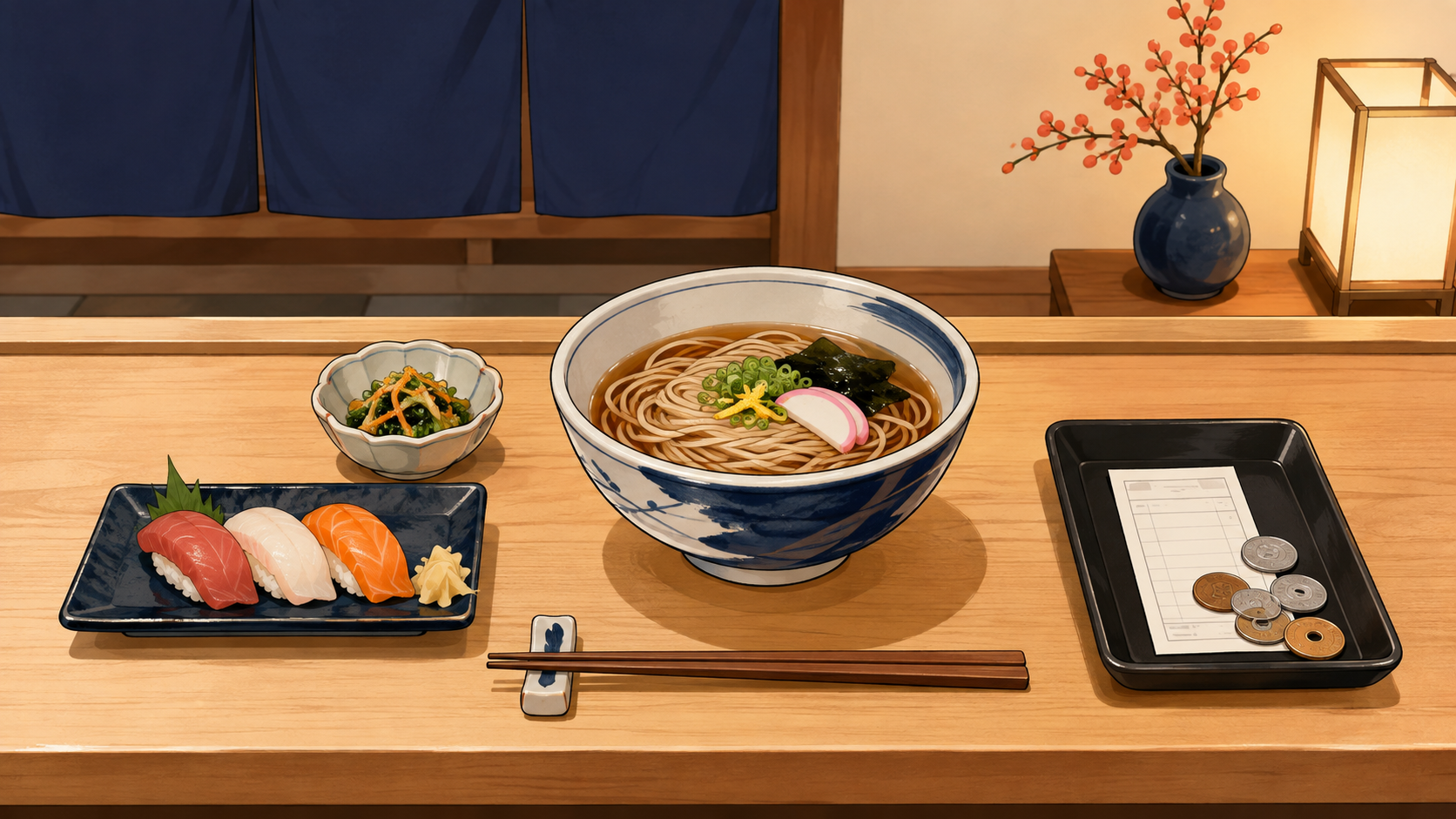
When paying cash, place money on the small tray rather than handing it directly to the cashier. The tray makes coins and change easier to count, but staff will still help if you forget.
Do not assume every restaurant accepts your card
Cashless payment is widespread in major cities, but Japan still has cash-only restaurants and venues that accept only selected cards or domestic payment systems. Check the symbols at the entrance or register and keep enough yen for the meal. An IC transit card may work at some restaurants, but acceptance is not guaranteed.
For practical advice on cash, foreign cards, ATMs, and IC-card payments, read our Cash vs Card in Japan guide.
Can you split the check?
Some restaurants allow separate payments; others do not, especially when they are busy or use one table bill. Ask before the cashier begins processing the payment. The easiest solution is often for one person to pay the restaurant and for the group to settle among themselves afterward.
Useful phrase: Okaikei onegaishimasu. — The check, please.
9. Reservations, Arrival Times, and No-Shows
Arrive on time for a reservation. Small restaurants may have limited seats, timed courses, or ingredients prepared specifically for your party. If you will be late or cannot attend, contact the restaurant or booking service as soon as possible.
Cancellation and no-show fees depend on the restaurant and the terms you accepted. Some reservations require a card guarantee or prepayment. Read the cancellation deadline before booking and keep the confirmation message.
If you are staying at a hotel, the concierge may be able to help make a reservation, but do not ask several hotels or services to book the same restaurant simultaneously.
Our complete restaurant reservation guide for Japan compares official websites, booking platforms, phone calls, and hotel assistance, including card guarantees, cancellation terms, allergies, and late arrivals.
10. Allergies and Dietary Restrictions
Communicate serious allergies before ordering—preferably when reserving. Kitchen staff may need time to check sauces, soup stock, marinades, garnishes, and shared equipment. A request made after the dish arrives may be impossible to fix safely.
The word “vegetarian” is not always interpreted in exactly the same way. Foods that appear meat-free may contain fish-based dashi, bonito flakes, meat extract, or other animal-derived ingredients. Explain what you cannot eat rather than relying only on a dietary label.
For a serious food allergy, bring a clearly translated allergy card and show it before ordering. The Consumer Affairs Agency of Japan provides an English Food Allergy Communication Sheet that travelers can download. No restaurant can guarantee accommodation simply because a request was made; if staff say they cannot prepare the meal safely, choose another venue.
Our complete food allergy guide for Japan explains the 8 mandatory labeled allergens, Japanese ingredient terms, restaurant cross-contact, allergy cards, medication planning, and what to do during an emergency.
Safety note: This guide is general travel information, not medical advice. Ingredient labels and restaurant practices vary, and cross-contact can occur. Follow your medical plan and carry prescribed emergency medication.
11. Photography, Takeout, and Leftovers
Photographing your own food is often acceptable, but restaurant rules vary. Avoid including other guests or staff without permission, turn off the flash, and do not block service while arranging a long photo shoot. At a chef’s counter, ask before recording video or photographing the preparation area.
Do not assume leftovers can be packed to go. Food-safety policies, dish type, and restaurant rules differ. Ask staff, accept the answer, and never bring your own container behind a counter or buffet line. Likewise, outside food and drinks are usually not allowed unless the venue explicitly permits them.
12. Useful Restaurant Phrases
| Japanese | Meaning | When to use it |
|---|---|---|
| Sumimasen | Excuse me | Getting a staff member’s attention |
| Eigo no menyū wa arimasu ka? | Do you have an English menu? | Before ordering |
| Kore o onegaishimasu | This one, please | Pointing to a menu item |
| Okaikei onegaishimasu | The check, please | When you are ready to pay |
| Gochisōsama deshita | Thank you for the meal | As you leave |
You do not need perfect pronunciation. Pointing politely to the menu, using a translation app, and confirming quantities can be more effective than memorizing a long sentence.
A Note From Sho: What Restaurant Staff Actually Appreciate
I have worked in restaurant kitchens in Japan and have also served many guests from overseas. From the staff side, the best guest is not the person who knows every unwritten rule. It is the person who communicates clearly, respects the restaurant’s pace, and tells us important information early.
Dietary requests are much easier to handle when they are shared during the reservation or before the order reaches the kitchen. The same is true for large groups, young children, and tight schedules. A short, polite question at the beginning can prevent a much bigger problem later.
Common Mistakes to Avoid
- Sitting at an empty table without waiting for staff.
- Leaving money on the table as a tip.
- Mistaking an otoshi or stated service charge for a hidden tip.
- Sticking chopsticks upright in rice.
- Passing food directly from chopsticks to chopsticks.
- Assuming a dish is vegetarian because it contains no visible meat.
- Waiting until food arrives to mention a serious allergy.
- Assuming the restaurant accepts your card, can split the bill, or packs leftovers.
- Arriving late for a reserved course without contacting the restaurant.
- Photographing other guests, staff, or the kitchen without permission.
Frequently Asked Questions
Is it rude to leave food in Japan?
Finishing what you order is appreciated, but you should not force yourself to eat when you are full or when a dish is unsafe for you. Order conservatively, especially at small restaurants or multi-course meals.
Can I eat sushi with my hands?
Yes. Nigiri sushi may be eaten with clean hands or chopsticks. Use the method you can manage neatly; there is no need to imitate complicated rules from social media.
Do Japanese restaurants have English menus?
Many restaurants in major destinations do, and tablets often include several languages. Small or rural establishments may not. Photos, translation tools, and polite pointing usually solve basic ordering problems.
Should I say “itadakimasu” before eating?
You may, but foreign visitors are not required to. It is a customary expression of gratitude before a meal, not a password you must use to receive good service.
Is eating alone acceptable?
Absolutely. Counter seating at ramen, sushi, soba, curry, and set-meal restaurants makes solo dining easy. Some tablet systems even let you complete the entire order with minimal conversation.
Final Checklist Before You Dine
- Check the restaurant’s hours, payment methods, and reservation rules.
- Arrive on time and wait to be seated.
- Identify the ordering system before choosing a table.
- Share allergy or dietary information before ordering.
- Follow the two essential chopstick rules.
- Pay the exact bill without adding a tip.
- Thank the staff and leave the table ready for the next guest.
That is enough for almost any casual meal in Japan. Be observant, ask when unsure, and enjoy the food—restaurant staff would much rather see a relaxed, considerate traveler than someone anxious about every tiny rule.
Last fact-checked: August 19, 2026. Restaurant procedures, fees, and payment methods vary by venue. Always check the restaurant’s current menu and reservation terms.
Official Sources
- Japan National Tourism Organization: Tipping in Japan
- Japan National Tourism Organization: Japanese Food Etiquette Guide
- Japan National Tourism Organization: Japanese Customs and Etiquette
- Japan National Tourism Organization: Ramen Guide
- Japan National Tourism Organization: Vegetarian and Vegan Guide
- GO TOKYO: Diverse Culinary Culture and Restaurant Customs
- Consumer Affairs Agency: Food Allergy Communication Sheet and Food Labelling