Last fact-checked: September 7, 2026. Japan added cashew nuts to its mandatory allergen-labeling list on April 1, 2026. Food-labeling rules, restaurant practices, medicine-import procedures, and emergency services can change, so confirm current information before traveling.
Quick answer: You can travel to Japan with food allergies, but you need a plan that does not depend on one translated menu. Applicable packaged processed foods must identify Japan’s 9 mandatory allergens, while restaurants and unpackaged foods do not offer the same legal labeling protection. Carry a bilingual allergy card, contact restaurants in advance, bring the medication prescribed for you, pack verified emergency food, and know that 119 is the number for an ambulance.
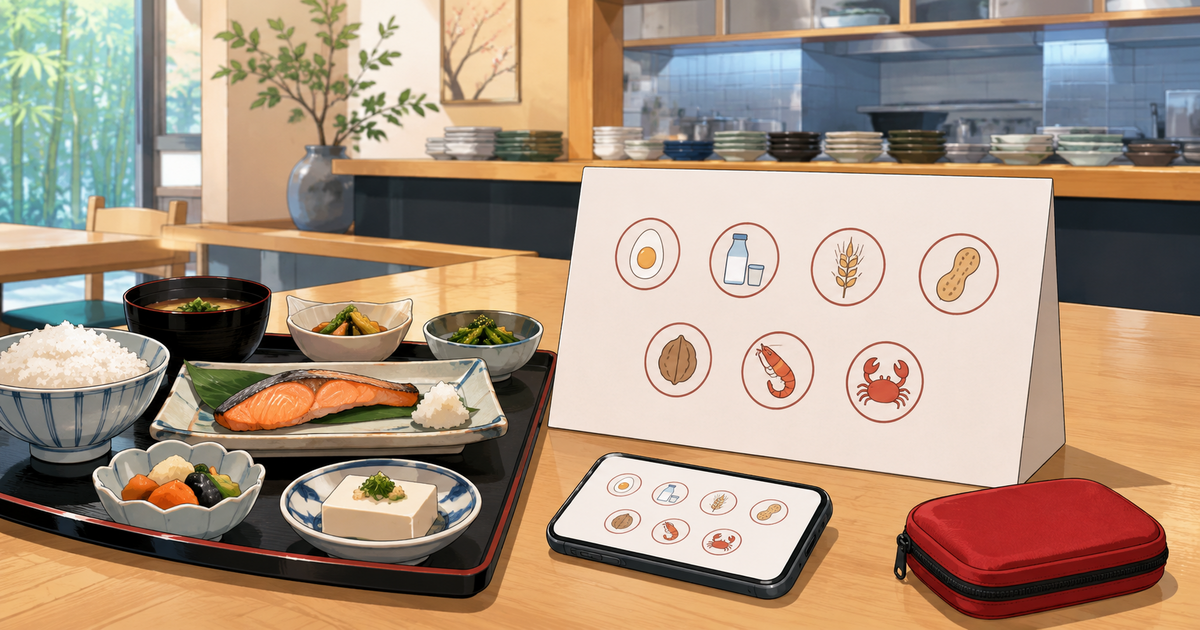
Japan’s nine mandatory allergens are shrimp, cashew nut, crab, walnut, wheat, buckwheat, egg, milk, and peanut. Another 20 ingredients have recommended labeling. Your allergen may be outside both groups, and an ingredient list cannot by itself rule out cross-contact.
Medical safety note: This article provides general travel information, not individual medical advice. Follow the emergency plan prepared with your allergist or clinician. Do not change when or how you use prescribed medication based on a travel guide.
Do not rely only on a translation app, a familiar brand, or a staff member saying “probably okay.” A restaurant may understand your allergy and still be unable to separate fryers, utensils, grills, or preparation areas. An honest refusal is safer than a polite guess.
This article may contain affiliate links. If you buy through one of these links, Japan Travel, Solved. may earn a commission at no additional cost to you. Recommendations are based on practical suitability and published information, not commission rates.
- Food Allergies in Japan: Your Quick Safety Plan
- Can You Visit Japan Safely With a Food Allergy?
- Japan’s 2026 Allergen-Labeling System
- How to Read a Japanese Packaged-Food Label
- Packaged Food, Deli Food, and Restaurant Food Are Different
- Download a Japanese Food Allergy Communication Sheet
- A Short Allergy Card Template
- Useful Japanese Phrases
- Cross-Contact Risks in Japanese Kitchens
- Japanese Foods With Ingredients That Are Easy to Miss
- How to Choose and Contact a Restaurant
- Convenience Stores and Supermarkets
- Hotels, Ryokan, and Breakfast Buffets
- Bringing Epinephrine and Other Medication to Japan
- What to Do During an Allergic Emergency
- A Note From Sho: Clear Information Is More Helpful Than Politeness
- Common Mistakes to Avoid
- Frequently Asked Questions
- What allergens must be labeled in Japan in 2026?
- When did cashew nuts become a mandatory allergen in Japan?
- Do Japanese restaurants have allergen menus?
- Are Japanese food labels written in English?
- Does no allergy warning mean a packaged food is safe?
- Is soy sauce gluten-free in Japan?
- Is soba safe for someone with a wheat allergy?
- Can I bring epinephrine auto-injectors to Japan?
- What is the ambulance number in Japan?
- Can a translation app replace an allergy card?
- Final Checklist Before You Fly
- Official and Medical Sources
Food Allergies in Japan: Your Quick Safety Plan
| Situation | Main risk | Practical response |
|---|---|---|
| Packaged processed food | The label is usually in Japanese, and your allergen may not be one of the mandatory nine | Read the complete ingredient list and allergen statement every time |
| Restaurant meal | Ingredients, substitutions, and cross-contact may be uncertain | Contact the restaurant early and show a bilingual allergy card before ordering |
| Buffet, bakery, or shared fryer | Utensils, crumbs, oil, grills, and surfaces may be shared | Ask specifically about shared equipment; do not eat when the answer is unclear |
| Hotel or ryokan meal | Fixed menus may be planned or prepared before arrival | Discuss the exact allergy before booking or well before check-in |
| Train day or late arrival | A verified meal may not be available when you need one | Carry food you have already confirmed is safe for you |
| Suspected severe reaction | Anaphylaxis can progress quickly | Follow your medical emergency plan, use prescribed epinephrine as directed, and call 119 |
Can You Visit Japan Safely With a Food Allergy?
Many people with food allergies travel successfully in Japan. The difficulty is not that Japanese food is automatically unsafe. The difficulty is that Japan’s labeling system, common ingredients, restaurant procedures, and language may differ from what you use at home.
A strong travel plan uses several layers:
- A written emergency plan from your clinician
- The prescribed medication and backup quantity your clinician recommends
- A bilingual allergy card that names the exact food and derivatives
- Restaurants and accommodations contacted before arrival
- Verified packaged foods or snacks for delays and uncertain meals
- Offline access to emergency numbers, insurance details, and your location
- Travel companions who know where your medication is and what to do
Describe the medical risk accurately. “I do not eat nuts” may sound like a preference. “I have a severe cashew-nut allergy, and even a small amount or shared equipment may cause a medical emergency” gives the kitchen information it can act on.
Japan’s 2026 Allergen-Labeling System
Japan’s Consumer Affairs Agency currently lists 9 specified ingredients with mandatory labeling and 20 additional ingredients for which labeling is recommended on applicable packaged processed foods.
What changed in 2026? Cashew nuts became a mandatory specified ingredient on April 1, 2026. Older websites and saved graphics may still show eight mandatory allergens and list cashew nuts in the recommended group. That list is now outdated.
The 9 mandatory allergens
| English | Japanese label | Reading |
|---|---|---|
| Shrimp | えび / 海老 | ebi |
| Cashew nut | カシューナッツ | kashuu nattsu |
| Crab | かに / 蟹 | kani |
| Walnut | くるみ / 胡桃 | kurumi |
| Wheat | 小麦 | komugi |
| Buckwheat | そば / 蕎麦 | soba |
| Egg | 卵 / 玉子 / たまご | tamago |
| Milk | 乳 / 乳成分 | nyu / nyu-seibun |
| Peanut | 落花生 / ピーナッツ | rakkasei / piinattsu |
The rules permit recognized alternative wording. For example, a label may use 玉子 or たまご instead of 卵. Milk commonly appears as 乳成分, meaning milk components. This is one reason that searching for only one saved word is not enough.
The 20 allergens with recommended labeling
| English | Japanese | English | Japanese |
|---|---|---|---|
| Almond | アーモンド | Abalone | あわび |
| Squid | いか | Salmon roe | いくら |
| Orange | オレンジ | Kiwi fruit | キウイフルーツ |
| Beef | 牛肉 | Sesame | ごま |
| Salmon | さけ | Mackerel | さば |
| Soybean | 大豆 | Chicken | 鶏肉 |
| Banana | バナナ | Pistachio | ピスタチオ |
| Pork | 豚肉 | Macadamia nut | マカダミアナッツ |
| Peach | もも | Yam | やまいも |
| Apple | りんご | Gelatin | ゼラチン |
“Recommended” does not mean medically minor. It describes the labeling requirement, not the seriousness of a person’s reaction. If your allergen is in this group—or is absent from Japan’s list entirely—read the full ingredients and contact the manufacturer when necessary.
Japan’s list is not the same as the U.S. list
Japan and the United States organize major allergens differently. Japan separates shrimp and crab, includes buckwheat, and currently treats soybean and sesame as recommended rather than mandatory under this system. A U.S. “Top 9” assumption cannot replace checking the Japanese product.
Japan’s system contains 29 named ingredients in total, but a person can be allergic to foods outside those 29. The absence of your allergen from a highlighted statement does not prove that the product is safe.
How to Read a Japanese Packaged-Food Label
Food sold in Japan is normally labeled in Japanese. Start with 原材料名 (genzairyo-mei), meaning ingredients. Allergen information may appear immediately after individual ingredients or in a collective statement near the end.
| Japanese | Meaning | Why it matters |
|---|---|---|
| 原材料名 | Ingredients | Read the whole section, not only the front of the package |
| 一部に〇〇を含む | Contains ___ in part | A common collective allergen statement |
| 〇〇を含む | Contains ___ | May appear after an individual ingredient |
| 〇〇由来 | Derived from ___ | May identify the source of an additive |
| 乳成分 | Milk components | Often used instead of a simple word for milk |
| 本品製造工場では〇〇を含む製品を製造しています | This factory also manufactures products containing ___ | An advisory about possible cross-contact |
The Consumer Affairs Agency permits either individual allergen labeling or a collective statement. Do not stop after seeing one familiar ingredient; the information may be distributed across the complete label.
Camera translation is helpful but imperfect. Curved packaging, glare, tiny print, stylized fonts, ingredient abbreviations, and multiple columns can produce errors. Photograph the label in good light, translate both the full ingredients and allergen statement, and compare the original Japanese characters with your saved list.
The same international brand or flavor may use a different recipe in Japan. Check the Japanese package every time, even when the product looks identical to one you buy at home.
A warning about “may contain” assumptions: Japan’s rules and wording are not identical to U.S. labeling practices. The Consumer Affairs Agency prohibits vague possibility statements such as simply saying an ingredient “might be included,” while recommending specific factory cross-contact warnings when risk cannot be eliminated. Never treat the absence of one familiar English-style warning as proof of zero cross-contact.
Packaged Food, Deli Food, and Restaurant Food Are Different
The mandatory system primarily helps with container-packaged processed foods. Food from a bakery tray, buffet, convenience-store hot case, supermarket deli counter, restaurant, or hotel breakfast may not give you the same standardized label.
The Consumer Affairs Agency’s July 2026 guidance for eating out and prepared takeout food emphasizes communication, unintended contamination, voluntary information practices, and real examples of accidental consumption. In practical terms, restaurant information is useful but must not be treated as a guarantee.
| Food setting | What you may receive | Main limitation |
|---|---|---|
| Sealed packaged product | Japanese ingredient and allergen labeling | Your allergen may be recommended or outside the official 29 |
| Restaurant chain | Online or in-store allergen chart | It may cover intentional ingredients but not every shared surface or substitution |
| Independent restaurant | Verbal or written explanation | Recipes and suppliers may change; a formal chart may not exist |
| Bakery, buffet, or deli | Product card or staff explanation | Shared tongs, crumbs, trays, and preparation areas can create cross-contact |
| Hotel or ryokan meal | Advance confirmation or modified menu | Fixed meals may be prepared in advance, and substitutions may not be possible |
Download a Japanese Food Allergy Communication Sheet
The Consumer Affairs Agency provides an English Food Allergy Communication Sheet for smartphones. The agency recommends downloading it before use because its checkboxes may not work correctly when opened only in a browser; Adobe Reader is recommended.
The official sheet is a useful starting point, but confirm that it clearly covers your exact allergen, derivatives, severity, and cross-contact requirements. A general icon or one food name may not explain everything your kitchen needs to know.
A useful personal allergy card should include:
- Your exact allergen in English and Japanese
- Common derivatives or ingredients made from it
- That this is a medical allergy, not a preference
- Whether a small amount, shared oil, or shared equipment is unsafe for you
- A request to check broth, sauces, marinades, dressings, garnishes, and seasoning powders
- A clear instruction to say no if the restaurant cannot confirm safety
Show the card when making the reservation and again before ordering. A card improves communication; it does not certify that a meal is safe.
Keep one printed copy with your medication and another with a travel companion. For offline translation, phone settings, and communicating without fluent Japanese, see What If You Don’t Speak Japanese?
A Short Allergy Card Template
Japanese:
私は[アレルゲン名]に重い食物アレルギーがあります。少量でも食べられません。料理に含まれる原材料、だし、ソース、調味料を確認してください。[必要な場合:同じ油や調理器具を使った料理も食べられません。]安全に提供できない場合は、はっきり教えてください。
English meaning:
I have a serious food allergy to [allergen]. I cannot eat even a small amount. Please check all ingredients, broth, sauces, and seasonings. [If applicable: I also cannot eat food prepared with the same oil or equipment.] Please tell me clearly if you cannot provide it safely.
This is a communication template, not personalized medical advice. Ask a qualified translator or allergy organization to review your final card, particularly for a severe or unusual allergy.
Useful Japanese Phrases
| Japanese | Pronunciation | Meaning |
|---|---|---|
| 食物アレルギーがあります。 | Shokumotsu arerugii ga arimasu. | I have a food allergy. |
| 〇〇を食べることができません。 | ___ o taberu koto ga dekimasen. | I cannot eat ___. |
| これは〇〇を含みますか? | Kore wa ___ o fukumimasu ka? | Does this contain ___? |
| だしやソースにも入っていませんか? | Dashi ya soosu ni mo haitteimasen ka? | Is it also absent from the broth and sauce? |
| 同じ油を使っていますか? | Onaji abura o tsukatteimasu ka? | Do you use the same oil? |
| 調理器具は共用ですか? | Chori kigu wa kyoyo desu ka? | Is the cooking equipment shared? |
| 安全に作れない場合は、はっきり教えてください。 | Anzen ni tsukurenai baai wa, hakkiri oshiete kudasai. | Please tell me clearly if it cannot be prepared safely. |
| 救急車を呼んでください。 | Kyukyusha o yonde kudasai. | Please call an ambulance. |
For a severe allergy, show written Japanese instead of depending only on pronunciation. Keep the message concise enough for busy staff to read and take to the kitchen.
Cross-Contact Risks in Japanese Kitchens
Removing a visible ingredient does not remove cross-contact. Possible sources include:
- A deep fryer used for several breaded foods
- A grill or teppan used for meat, seafood, egg, and sauces
- A noodle boiler shared by wheat noodles and buckwheat soba
- Knives, cutting boards, strainers, tongs, and serving utensils
- Shared sauce brushes, condiment containers, and preparation surfaces
- Buffet utensils moved from one dish to another
- Bakery trays and airborne or transferred crumbs
- Commercial broth, sauce, or seasoning whose complete supplier information is unavailable
As someone who has worked in restaurant kitchens, I would never judge a dish only by what is visible on the plate. Broth, sauce, batter, seasoning powder, and shared equipment may matter more than the garnish.
Give the restaurant permission to say no. Staff may understand your request perfectly and still be unable to control the risk in a compact kitchen. “We cannot guarantee it” is important safety information, not bad hospitality.
Japanese Foods With Ingredients That Are Easy to Miss
These foods are not automatically unsafe for every allergic traveler. Recipes vary by restaurant and manufacturer. The examples show why you need to ask about the exact product or dish.
Dashi and soup stock
Dashi can use bonito, sardine, kelp, shiitake, shellfish, or mixed commercial seasonings. A clear broth or vegetable-looking dish may still contain fish, shellfish, soy, wheat, or another ingredient.
Soy sauce, miso, and prepared sauces
Standard soy sauce commonly contains soybean and wheat. Miso is commonly made from soybeans, but grains and additional ingredients vary. Dressings, marinades, dipping sauces, curry roux, and seasoning powders may combine several allergens.
Soba and other noodles
Soba means buckwheat, one of Japan’s mandatory allergens. Many soba noodles also contain wheat. A restaurant may boil several kinds of noodles in shared water or use the same strainers and work surfaces.
Tempura and fried food
Tempura batter may contain wheat and egg. The oil may also be used for shrimp, crab, fish, dairy-containing croquettes, or other breaded foods. Removing the coating after cooking is not a solution for a food allergy.
Ramen and Japanese curry
Broth and curry roux can contain meat, seafood, wheat, soy, dairy, sesame, nuts, fruit, and commercial flavorings. The bowl’s appearance cannot reveal every component.
Japanese sweets and desserts
Sweets may contain soybean flour, sesame, walnuts, cashew nuts, wheat, egg, milk, gelatin, or ingredients processed on shared lines. Rice-based appearance does not automatically mean allergen-free.
Vegan, vegetarian, and gluten-free dishes
These labels answer different questions. Vegan food can contain wheat, soy, sesame, nuts, or other allergens. Gluten-free food may contain egg, milk, peanuts, tree nuts, or shellfish. A dietary label is not a substitute for naming your allergy.
How to Choose and Contact a Restaurant
No restaurant category is automatically safe, but advance communication makes an informed decision more likely.
- Look for a current allergen chart or written policy on the official website.
- Contact the restaurant before booking, preferably outside busy service hours.
- Name the exact allergen, severity, derivatives, and cross-contact limits.
- Ask about the specific menu item, broth, sauces, fryer, and equipment.
- Save the restaurant’s written response and show it when you arrive.
- Confirm again before ordering because staff, ingredients, and suppliers can change.
- Leave if the kitchen cannot verify what you need.
Chain restaurants may have standardized charts, but standardization does not guarantee separate preparation equipment. Fine dining may communicate carefully, but a tasting menu can contain many sauces and pre-prepared components. A small restaurant may be flexible—or may have no physical space for separation. Judge the individual kitchen.
Our Japan restaurant reservation guide explains online platforms, phone calls, allergy notes, deposits, cancellation policies, and no-shows. For ordering, payment, and behavior inside the restaurant, see our Japan restaurant etiquette guide.
Convenience Stores and Supermarkets
Sealed packaged food can be easier to investigate because you can examine a label, but do not assume that every convenience-store item is equally documented.
Check the complete label on:
- Onigiri fillings and seasonings
- Sandwich bread, spreads, and sauces
- Bento sauces, fried items, and garnishes
- Salads and separate dressing packets
- Snacks with factory cross-contact statements
- Products whose recipe or packaging has changed
Food from a bakery case, hot-food cabinet, self-service counter, or store kitchen may not have the same label as a sealed factory product. Shared tongs and display areas add another risk. Ask staff and choose something else when the answer is uncertain.
Carry several verified snacks for train journeys, rural day trips, delayed flights, and late hotel arrivals. Hunger is uncomfortable, but an unverified ingredient is a medical decision.
Hotels, Ryokan, and Breakfast Buffets
Contact the property before booking when meals are an important part of the stay. A ryokan may plan dinner and breakfast days in advance, and a same-day substitution may be impossible.
Send the property:
- The exact allergen in English and Japanese
- The affected guest’s name
- The severity and whether traces are unsafe
- Whether shared oil and equipment must be avoided
- The reservation date, meal, and booking number
Ask for a written reply. Do not send only “allergy-friendly meal required.” That phrase does not explain what the kitchen must remove or whether it can control cross-contact.
At a buffet, shared tongs, serving spoons, toaster areas, and spilled food can contaminate a dish that contains no intentional allergen. Ask whether an individually prepared meal is possible. Hotel staff may help communicate, but they cannot medically certify another restaurant’s kitchen.
Our Japan hotel check-in guide explains advance requests, arrival details, identification, payment, and information to keep with your reservation.
Bringing Epinephrine and Other Medication to Japan
Bring medication in its original packaging when practical, together with a prescription copy or clinician’s letter showing the generic name, dose, and medical need. Keep urgently needed medicine in your carry-on rather than checked baggage, subject to airline and security rules.
Japan’s Ministry of Health, Labour and Welfare currently says that an individual may generally bring up to a one-month supply of prescription medicine without an Import Confirmation. It also lists up to a one-month supply of an injectable drug and its syringe without that confirmation when it is a pre-filled syringe or self-injection kit.
This general quantity rule does not override restrictions on narcotics, stimulant raw materials, prohibited substances, or controlled drugs. Check the exact medicine, generic ingredient, quantity, and required permission before leaving home.
The American College of Allergy, Asthma & Immunology states that epinephrine is the first-line treatment for anaphylaxis and advises patients with food allergies to carry their prescribed device. It also advises having two doses available. Your own allergist should tell you what to carry, how to store it, and when to use it.
For Import Confirmation, quantity limits, and controlled-drug exceptions, read our guide to bringing prescription medication to Japan.
What to Do During an Allergic Emergency
For a suspected severe reaction: Follow your clinician-approved emergency plan immediately. If that plan tells you to use prescribed epinephrine, do not delay while looking for a translation or waiting for restaurant staff. Call 119 for an ambulance.
Useful phrases include:
- 救急車をお願いします。 Kyukyusha o onegaishimasu. — Please send an ambulance.
- アナフィラキシーの可能性があります。 Anafirakishii no kanosei ga arimasu. — It may be anaphylaxis.
- アドレナリン自己注射を使いました。 Adorenarin jiko chusha o tsukaimashita. — An epinephrine auto-injector was used.
- 場所は〇〇です。 Basho wa ___ desu. — The location is ___.
Give the location first: restaurant name, address, station exit, building, floor, nearby landmark, or map pin. Ask someone to meet the ambulance if the entrance is difficult to find.
JNTO’s Japan Visitor Hotline operates 24 hours a day, 365 days a year in English, Chinese, and Korean:
- Inside Japan: 050-3816-2787
- From overseas: +81-50-3816-2787
The hotline can provide tourism information and assistance during illness, accidents, disasters, and other emergencies. It is not a substitute for calling 119 when an ambulance is needed, and JNTO says it generally does not provide three-way interpretation or make reservations on a traveler’s behalf.
Keep your passport information, insurance details, medication list, emergency contacts, allergy card, and clinician’s plan available offline. Do not keep the only copy behind one phone passcode.
A Note From Sho: Clear Information Is More Helpful Than Politeness
I have worked in restaurant kitchens and now work as a lodging facility manager. From the staff side, the safest allergy conversation is early, specific, and honest.
Tell us the exact food, not only the name of a diet. Explain whether broth, sauce, shared oil, or equipment creates a risk. Most importantly, allow the kitchen to say that it cannot provide the meal safely.
Japanese hospitality may make staff want to help, but goodwill cannot create a separate fryer, reverse food that was prepared earlier, or identify an ingredient when supplier information is unavailable. Choosing another restaurant can be the correct result of good communication.
Common Mistakes to Avoid
- Using an old list with seven or eight mandatory Japanese allergens
- Assuming Japan’s list matches the U.S. major-allergen list
- Reading only a bold allergen line instead of the complete ingredients
- Trusting camera translation as the only label check
- Waiting until the meal arrives to mention the allergy
- Assuming visible ingredient removal prevents cross-contact
- Using “vegan,” “vegetarian,” or “gluten-free” without naming the allergen
- Believing a chain’s allergen chart guarantees a separate fryer or preparation area
- Arriving at a ryokan without discussing fixed meals in advance
- Carrying medicine where a companion cannot find it
- Calling the visitor hotline instead of 119 during an immediate medical emergency
Frequently Asked Questions
What allergens must be labeled in Japan in 2026?
The nine mandatory specified ingredients are shrimp, cashew nut, crab, walnut, wheat, buckwheat, egg, milk, and peanut. Japan also has 20 additional ingredients for which labeling is recommended.
When did cashew nuts become a mandatory allergen in Japan?
The Consumer Affairs Agency added cashew nuts as a specified ingredient on April 1, 2026. Older guides may still place cashew nuts in the recommended group.
Do Japanese restaurants have allergen menus?
Some chains and larger restaurants publish allergen charts, while many independent restaurants do not. A chart may identify intentional ingredients without guaranteeing protection from shared surfaces, oil, utensils, or equipment.
Are Japanese food labels written in English?
Usually not. Food labeling for products sold in Japan is generally in Japanese. Use the original characters and complete ingredient list, with translation as a support tool.
Does no allergy warning mean a packaged food is safe?
No. Your allergen may be one of the recommended ingredients or outside Japan’s named list. Cross-contact information and labeling practices may also differ from those in your home country.
Is soy sauce gluten-free in Japan?
Do not assume so. Standard Japanese soy sauce commonly contains wheat and soybean. Check the exact product label or restaurant ingredient information.
Is soba safe for someone with a wheat allergy?
Not automatically. Soba contains buckwheat, which is itself a mandatory allergen in Japan, and many soba noodles also contain wheat. Noodle shops may share boilers, strainers, and work surfaces.
Can I bring epinephrine auto-injectors to Japan?
MHLW generally allows up to a one-month supply of an eligible prescription medicine and pre-filled syringe or self-injection kit without Import Confirmation. Check your exact product, ingredients, quantity, and documentation because controlled or prohibited substances have separate rules.
What is the ambulance number in Japan?
Call 119 for an ambulance or fire emergency. Give your location first and say that the person may be experiencing anaphylaxis.
Can a translation app replace an allergy card?
No. An app can support conversation, but a prepared bilingual card is faster and more consistent. Neither an app nor a card can guarantee that a kitchen can prevent cross-contact.
Final Checklist Before You Fly
- Review your trip and emergency plan with your allergist or clinician.
- Carry the medication and backup quantity they recommend.
- Check Japan’s rules for every medicine and device.
- Download the Consumer Affairs Agency communication sheet.
- Create a personal card naming your exact allergen and cross-contact limits.
- Save the current Japanese characters for your allergens.
- Contact restaurants, hotels, and ryokan before arrival.
- Pack verified food for delays and uncertain meals.
- Teach companions your emergency steps and medication location.
- Save 119 and the JNTO Visitor Hotline offline.
- Leave whenever ingredients or preparation cannot be confirmed.
Japan can still be a rewarding food destination when safety leads the planning. Prepare the message, verify the kitchen, keep medication accessible, and never exchange medical certainty for politeness.
Official and Medical Sources
- Consumer Affairs Agency: Current Food-Allergy Labeling Information
- Consumer Affairs Agency: 2026 Allergen-Labeling Rules
- Consumer Affairs Agency: English Food-Labelling Resources
- Consumer Affairs Agency: Food Allergy Communication Sheet
- Consumer Affairs Agency: Food Allergies When Eating Out or Buying Prepared Food
- Ministry of Health, Labour and Welfare: Bringing Medicines for Personal Use
- JNTO: Guide for When You Are Feeling Ill
- JNTO: Japan Visitor Hotline
- American College of Allergy, Asthma & Immunology: Using Epinephrine
Always follow your clinician’s instructions and the emergency plan written for you. Ingredients, suppliers, labeling, and kitchen procedures can change without notice, and no travel guide can confirm that a particular meal is safe.