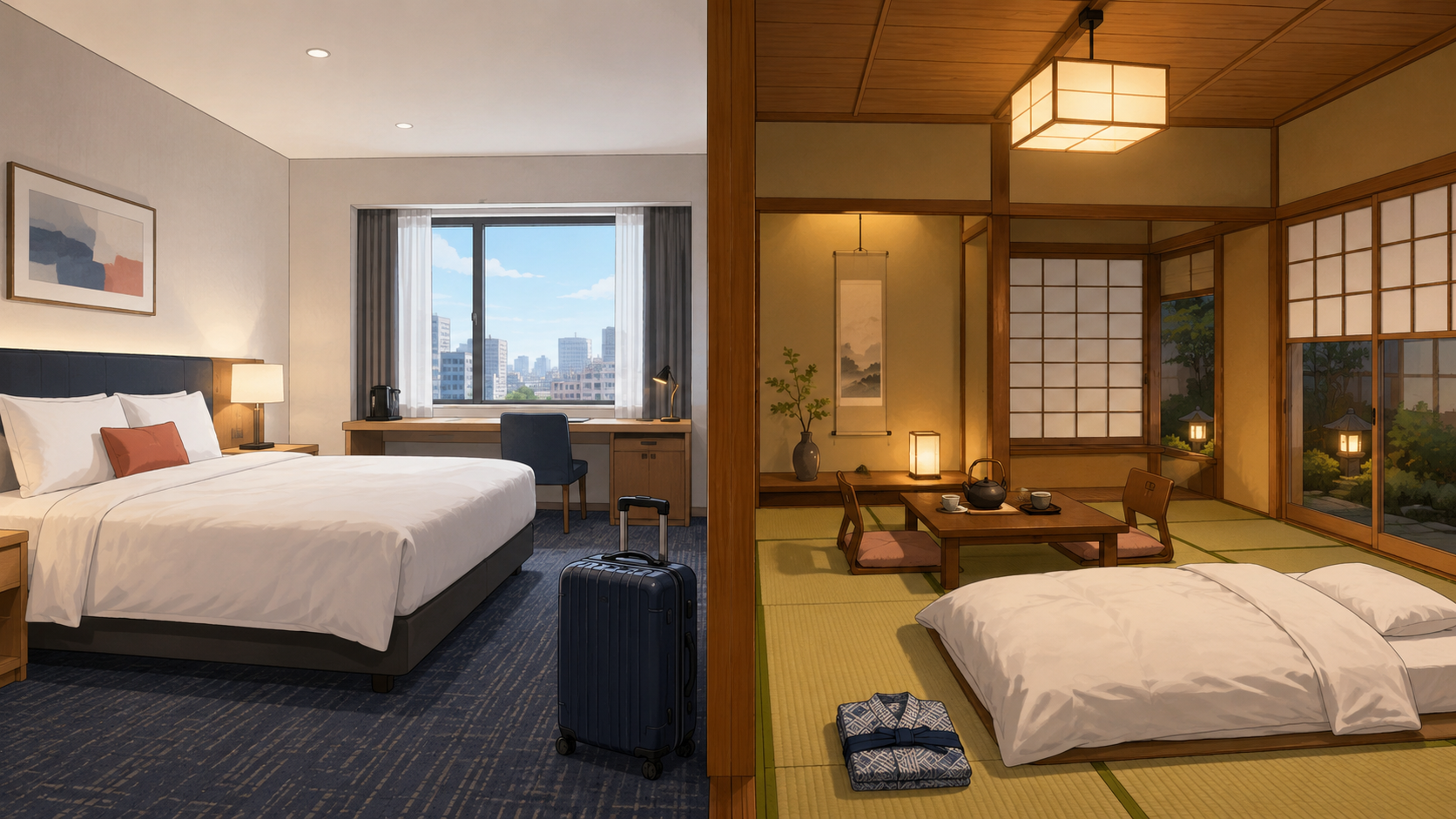
Quick answer: Choose a hotel if you want a familiar bed, flexible meal plans, convenient city access, and a straightforward base for sightseeing. Choose a ryokan if you want the accommodation itself to be part of the experience, with tatami rooms, Japanese hospitality, seasonal meals, futon bedding, and often a public or private bath.
For many first-time visitors, the best answer is not one or the other. Stay in hotels while exploring major cities, then book one or two nights at a ryokan in an onsen town or scenic area.
The most important difference: A hotel mainly sells you a room. A traditional ryokan often sells a complete stay built around the room, dinner, breakfast, bathing, and service. Compare the entire package—not just the price shown at the top of the booking page.
- Ryokan vs Hotel in Japan: Quick Comparison
- What Is a Ryokan?
- What Is a Japanese Hotel?
- 1. Price: Compare Per Person, Not Only Per Room
- 2. Room and Bedding: Bed vs Futon
- 3. Meals: Flexible Dining vs a Scheduled Experience
- 4. Bathing: Private Bathroom vs Onsen Experience
- 5. Arrival Time: Hotels Are Usually More Flexible
- 6. Service and Privacy
- 7. Location and Transportation
- 8. Luggage: A Smaller Bag Makes Ryokan Easier
- Which Is Better for Your Trip?
- Best Choice by Traveler Type
- A Note From Sho: The Wrong Expectation Causes More Problems Than the Wrong Choice
- Booking Checklist: Questions to Answer Before You Pay
- Common Mistakes to Avoid
- Frequently Asked Questions
- Final Recommendation
- Official and Primary Sources
Ryokan vs Hotel in Japan: Quick Comparison
| Feature | Hotel | Ryokan |
|---|---|---|
| Best for | Convenience and flexibility | Culture, relaxation, food, and onsen |
| Typical room | Western-style room with bed | Tatami room with futon; some have beds |
| Pricing | Often displayed per room | Often displayed per person |
| Meals | Usually optional or breakfast-only | Dinner and breakfast often included |
| Bathing | Private bathroom is common | Large shared bath or onsen is common; room facilities vary |
| Arrival time | Often more flexible | Earlier arrival may be required for dinner |
| Service style | Functional and standardized | More personal and experience-focused |
| Length of stay | Easy for multiple nights | One or two nights suits many itineraries |
| Ideal luggage | Usually easier with large suitcases | Light luggage is more comfortable |
These are general patterns, not fixed legal definitions. Modern ryokan may have Western beds, private bathrooms, and room-only plans. Some Japanese hotels include public baths, tatami areas, and elaborate meals. Always check the exact room and plan you are booking.
What Is a Ryokan?
A ryokan is a Japanese-style inn. Traditional features can include tatami flooring, futon bedding, yukata robes, Japanese dinner and breakfast, and shared or private baths. Ryokan range from simple family-run inns to high-end retreats with private open-air onsen.
JNTO describes ryokan as more than a place to sleep: the room, hospitality, meals, bathing, and atmosphere combine to create the experience. Many are located in onsen areas, mountain towns, coastal destinations, and historic cities, although urban ryokan also exist.
A ryokan is not automatically an onsen hotel. Onsen means naturally sourced hot-spring water that meets applicable standards; a property can be a ryokan without having an onsen. Likewise, a Western-style hotel can have an onsen.
What Is a Japanese Hotel?
A hotel in Japan generally works much like a hotel in the United States: you book a room with a bed, private bathroom, and selected meal plan. Options range from compact business hotels to international luxury properties and resorts.
Japanese city hotel rooms can be smaller than U.S. travelers expect, especially at budget and business hotels. Check the room size in square meters or square feet, bed width, bathroom type, and whether you can open your luggage without blocking the walkway.
Room labels such as semi-double, double, twin, and Hollywood twin can be confusing because they do not guarantee one universal bed or room size. Our Japanese hotel room-type guide explains what each label usually means and what to check before booking.
Hotels are often the easiest choice when you plan to spend most of the day outside, arrive late, change cities frequently, or want restaurants and transport close by.
1. Price: Compare Per Person, Not Only Per Room
Pricing is the first source of confusion in a ryokan vs hotel comparison.
Hotel rates are often shown per room, although occupancy, breakfast, taxes, and booking platforms can change the displayed total. Ryokan rates are commonly calculated per person because the plan may include dinner, breakfast, bedding, and use of the baths. The Japan Ryokan and Hotel Association explains that ryokan charges commonly use a room-per-person structure.
For example, a ryokan listing that appears to cost ¥25,000 may mean ¥25,000 per guest, not ¥25,000 for the entire room. Two adults could therefore produce a base total of ¥50,000 before excluded taxes or extras.
When comparing value, check:
- Is the displayed price per room or per person?
- How many adults and children are included?
- Are dinner and breakfast included?
- Are consumption tax and service charges included?
- Will accommodation tax or bathing tax be collected separately?
- Does the room include a private bathroom or private onsen?
- Is the reservation refundable?
A ryokan can look expensive beside a room-only hotel, but the comparison changes when you add a multi-course dinner and breakfast to the hotel stay. It can also work in the opposite direction: if you do not want the meals or baths, paying for a complete ryokan package may offer poor value for your needs.
2. Room and Bedding: Bed vs Futon
Hotel rooms
Hotels usually provide Western beds that remain set up throughout the stay. The room may be compact, but the layout is familiar. A private toilet and shower or bathtub are common, although capsule hotels, hostels, and some budget properties are different.
Ryokan rooms
A traditional ryokan room has tatami flooring and a low table. Staff may prepare futons on the tatami while you are at dinner, then store them again in the morning. At smaller inns, guests may be asked to arrange or fold their own bedding.
A futon is not simply a thin camping mat. Japanese bedding normally includes a floor mattress, sheets, a pillow, and a comforter. Comfort is personal, however. Travelers with knee, hip, back, or mobility concerns may find getting down to floor level difficult.
Do not assume every ryokan requires a futon. Many now offer rooms with Western beds or a Japanese-Western layout containing both beds and tatami. Select the exact room type rather than relying on property photos from another category.
Booking tip: If a bed, chair, elevator, private toilet, or step-free route is essential, ask the property to confirm it for your specific room. The word “accessible” can cover different features at different accommodations.
3. Meals: Flexible Dining vs a Scheduled Experience
At most hotels, meals are optional. You can book room-only, add breakfast, eat at the hotel restaurant, or dine elsewhere. This works well when your sightseeing schedule changes or you want to explore neighborhood restaurants.
A classic ryokan plan often includes dinner on the arrival day and breakfast the next morning. Dinner may be kaiseki, a multi-course Japanese meal based on seasonal and regional ingredients. Depending on the property and room plan, meals may be served in your room, a private dining space, or a shared restaurant.
Meal times are important. The kitchen may prepare each course for a set service window. Arriving late can mean missing dinner even when you can still use the room. Check the final arrival time for meal-inclusive plans, and contact the property immediately if your travel is delayed.
Dietary restrictions require advance communication
Ryokan meals can include many small dishes, sauces, broths, garnishes, and shared kitchen processes. Fish-based dashi, soy, wheat, seafood, egg, and other ingredients may appear in dishes that are not obvious from the menu.
Tell the property about allergies and dietary restrictions before booking or immediately afterward. Do not assume a full kaiseki menu can be changed at check-in. Some ryokan can adapt with enough notice; others may be unable to guarantee substitutions or prevent cross-contact.
Travelers who need complete control over ingredients may be more comfortable with a hotel near suitable restaurants or a ryokan offering a verified room-only plan.
4. Bathing: Private Bathroom vs Onsen Experience
Hotels usually provide a private bathroom inside the room. Some hotels also have a communal bath or onsen, but you can normally use the room bathroom instead.
Many ryokan center the stay around a large communal bath. Men’s and women’s bathing areas are generally separate, and guests wash before entering the water. Swimsuits are normally not worn in standard Japanese public baths.
Room facilities vary. A traditional room may have a toilet and sink but no private shower, because guests are expected to bathe in the shared area. Other rooms have a standard bathroom, and premium rooms may include a private indoor or open-air bath.
What if you have tattoos?
Tattoo rules are property-specific. JNTO notes that some traditional onsen still restrict tattoos, while more facilities are becoming tattoo-friendly. A small tattoo may be permitted with an approved cover at one property and prohibited at another.
Check directly before booking. A private bath, reservable family bath, or room with its own bath may be a solution, but privacy does not automatically override the property’s policy.
Our complete Japan onsen etiquette guide explains tattoo policies, towel rules, washing order, public and private baths, children, health precautions, and common first-time mistakes.
What if you do not want to bathe naked with strangers?
Choose a room with a confirmed private bathroom or private onsen, or reserve a kashikiri-buro (private-use bath) if the property offers one. Do not assume that “private bath available” means it is included; it may require a separate reservation and fee.
5. Arrival Time: Hotels Are Usually More Flexible
A full-service city hotel may allow arrival late at night, especially with a 24-hour front desk. That does not apply to every hotel, and guests should still contact the property when arriving after the time entered in the reservation.
Ryokan often operate on a more structured schedule because of dinner, bath preparation, and personalized service. Reception may close earlier than at a large hotel. In rural areas, the final bus or property shuttle may also stop running in the evening.
Read the complete check-in instructions before paying. For passport rules, late arrivals, self-check-in, and what to bring, see our Japan hotel check-in guide.
6. Service and Privacy
Hotel service is generally functional and predictable. Staff assist at reception, while guests have privacy in the room unless housekeeping is requested or scheduled.
Traditional ryokan service can be more personal. Staff may welcome you with tea, explain the room and baths, serve food, and enter later to prepare futons. This can feel wonderfully attentive or more interactive than some travelers prefer.
Modern ryokan vary widely. Some use restaurant dining and minimal room entry; others maintain traditional in-room service. Check reviews and the property description for the service style, but rely on the official room plan for what is actually included.
Tipping is not normally expected at either hotels or ryokan in Japan. Pay the stated charges and thank the staff. Do not copy an unfamiliar gratuity custom from social media unless the property provides specific guidance.
7. Location and Transportation
Hotels dominate major station areas, airports, and city centers. They are usually better when your priorities are train access, restaurants, shopping, and early departures.
Ryokan are especially common in onsen towns, historic areas, mountains, and coastal destinations. The setting may be part of the appeal, but public transportation can be limited. Confirm:
- The last train or bus
- Whether a shuttle requires advance reservation
- The distance and slope from the station
- Whether taxis are available at your arrival time
- How you will continue your trip the next morning
A beautiful rural ryokan is not a good one-night choice if reaching it consumes most of the day. Build enough time to enjoy the bath, room, meal, and surroundings.
8. Luggage: A Smaller Bag Makes Ryokan Easier
Hotels near major stations are generally easier with full-size suitcases, although room space may still be tight. Ryokan rooms can be spacious, but dragging a large wheeled case across entrances, stairs, or tatami areas is inconvenient.
Ask where suitcases should be placed and never roll luggage directly over tatami. For a one-night ryokan stay, consider sending the main suitcase to your next hotel and carrying a small overnight bag. Our Japan luggage forwarding guide explains hotel-to-hotel delivery and timing.
Which Is Better for Your Trip?
Choose a hotel if you:
- Will arrive late or leave early
- Want a Western bed and private bathroom
- Prefer to choose your own restaurants
- Are changing cities frequently
- Need easy station or airport access
- Plan to spend most of the day sightseeing
- Need consistent business facilities or workspace
Choose a ryokan if you:
- Want the stay itself to be a major experience
- Would enjoy tatami, futons, yukata, and Japanese service
- Want a seasonal Japanese dinner and breakfast
- Want to relax in an onsen or large bath
- Can arrive early enough to enjoy the property
- Are comfortable following meal and bathing schedules
- Are visiting an onsen town or scenic rural area
Best Choice by Traveler Type
| Traveler | Usually the easier choice | Why |
|---|---|---|
| First-time visitor | Hotel plus one ryokan night | Combines convenience with a cultural experience |
| Couple or honeymoon | Ryokan with private bath | Privacy, meals, and a slower pace |
| Solo traveler | Hotel | Many ryokan plans require or favor two-person occupancy |
| Family with young children | Depends on room and meal policy | Tatami can be useful, but child charges and meals vary |
| Traveler with mobility needs | Accessible hotel or confirmed modern ryokan | Beds, elevators, chairs, and step-free bathrooms require verification |
| Traveler with strict dietary needs | Hotel or confirmed accommodating ryokan | Fixed ryokan menus can be difficult to change |
| Traveler with tattoos | Hotel or tattoo-friendly/private-bath ryokan | Bath policies vary by property |
| Late-night arrival | Hotel with confirmed late reception | Ryokan dinner and reception may finish earlier |
A Note From Sho: The Wrong Expectation Causes More Problems Than the Wrong Choice
From my experience working in accommodation management, guests are happiest when the property matches the trip they actually planned. Problems usually happen when someone expects a ryokan to function like a city hotel—or expects a budget hotel to provide the space and service of a ryokan.
If you arrive at 9:00 p.m., leave at 7:00 a.m., and spend the entire day outside, a convenient hotel is probably better value. If you can arrive in the afternoon, enjoy the bath, eat dinner slowly, and relax in the room, the ryokan experience can become one of the best parts of the trip.
For ryokan, always confirm the number of guests, meal plan, room type, and arrival time. Requests involving allergies, children, beds, stairs, or private baths should be handled before arrival—ideally before the free-cancellation deadline.
Booking Checklist: Questions to Answer Before You Pay
- Is the price per person or per room?
- Which meals are included?
- What is the final arrival time for dinner?
- Will I sleep on a futon or bed?
- Does my exact room have a toilet, shower, or bath?
- Is the onsen shared, private, reservable, or in the room?
- What is the tattoo policy?
- Can the kitchen handle my dietary restrictions safely?
- Are children accepted, and how are they charged?
- Is there an elevator and a step-free route?
- Can the property receive or send luggage?
- Which taxes or service charges remain payable?
Common Mistakes to Avoid
- Reading a ryokan’s per-person price as the total room price
- Assuming every ryokan has a natural onsen
- Booking a meal plan despite arriving after dinner service
- Assuming all rooms have a private shower
- Expecting staff to redesign a fixed menu at check-in
- Booking a futon room despite needing a raised bed
- Ignoring tattoo rules until entering the bath
- Sending luggage without confirming that the property accepts deliveries
- Using a ryokan only as a late-night place to sleep
- Assuming the room shown in the first listing photo is the room you selected
Frequently Asked Questions
Is a ryokan always more expensive than a hotel?
No. Both categories range from simple to luxurious. Ryokan prices often look higher because they may be per person and include two meals. Compare the full stay, room type, location, and inclusions.
Do all ryokan have futons?
No. Traditional rooms usually use futons, but many ryokan offer Western beds or mixed Japanese-Western rooms. Confirm the selected room description.
Do all ryokan have private bathrooms?
No. Some rooms have a full bathroom, others have only a toilet and sink, and some rely more heavily on communal bathing facilities. Never assume from the property-level amenities; check the exact room.
Can I stay at a ryokan without eating the meals?
Some offer room-only or breakfast-only plans, while others specialize in meal-inclusive stays. Choose the correct plan at booking. Skipping an included dinner usually does not create an automatic refund.
Is one night at a ryokan enough?
For many first-time visitors, one night provides a good introduction. Arrive early enough to use the bath and eat dinner without rushing. Two nights can be better at a remote resort or when you want a full rest day.
Can solo travelers book a ryokan?
Yes, but not every room or plan accepts single occupancy, and the per-person price may be higher than for two guests sharing. Filter for one adult before comparing options.
Should I tip at a ryokan?
Tipping is generally not expected. Pay the stated charges and express your thanks. If a property provides specific guidance about an exceptional gratuity custom, follow that guidance rather than leaving loose cash.
Final Recommendation
For a first trip of a week or longer, use hotels for the practical parts of the itinerary and add one carefully chosen ryokan stay. A city hotel makes transportation and sightseeing easier; a ryokan rewards you for slowing down.
Choose based on the experience you want, not the label alone. Read the exact room and meal plan, check the final arrival time, and confirm any non-negotiable needs before the cancellation deadline. That is more important than whether the property calls itself a hotel, ryokan, resort, or inn.
Last fact-checked: August 19, 2026. Room features, prices, meal plans, bath rules, tattoo policies, taxes, accessibility, and arrival times vary by property and booking plan. Confirm current details directly with the accommodation before booking.
Official and Primary Sources
- Japan National Tourism Organization: Japanese Ryokan Guide
- Japan National Tourism Organization: Accommodation in Japan
- Japan National Tourism Organization: Frequently Asked Questions
- Japan National Tourism Organization: How to Best Enjoy Japan’s Onsen
- Japan National Tourism Organization: Vegetarian and Vegan Guide
- Japan Ryokan and Hotel Association
- Japan Ryokan and Hotel Association: How to Enjoy Staying at a Ryokan