Quick answer: Japan is no longer a cash-only destination. Major credit cards are widely accepted at hotels, department stores, convenience stores, chain restaurants, and many tourist attractions. However, cash is still important at some small businesses, temples and shrines, rural transport, ticket machines, and independently operated restaurants.
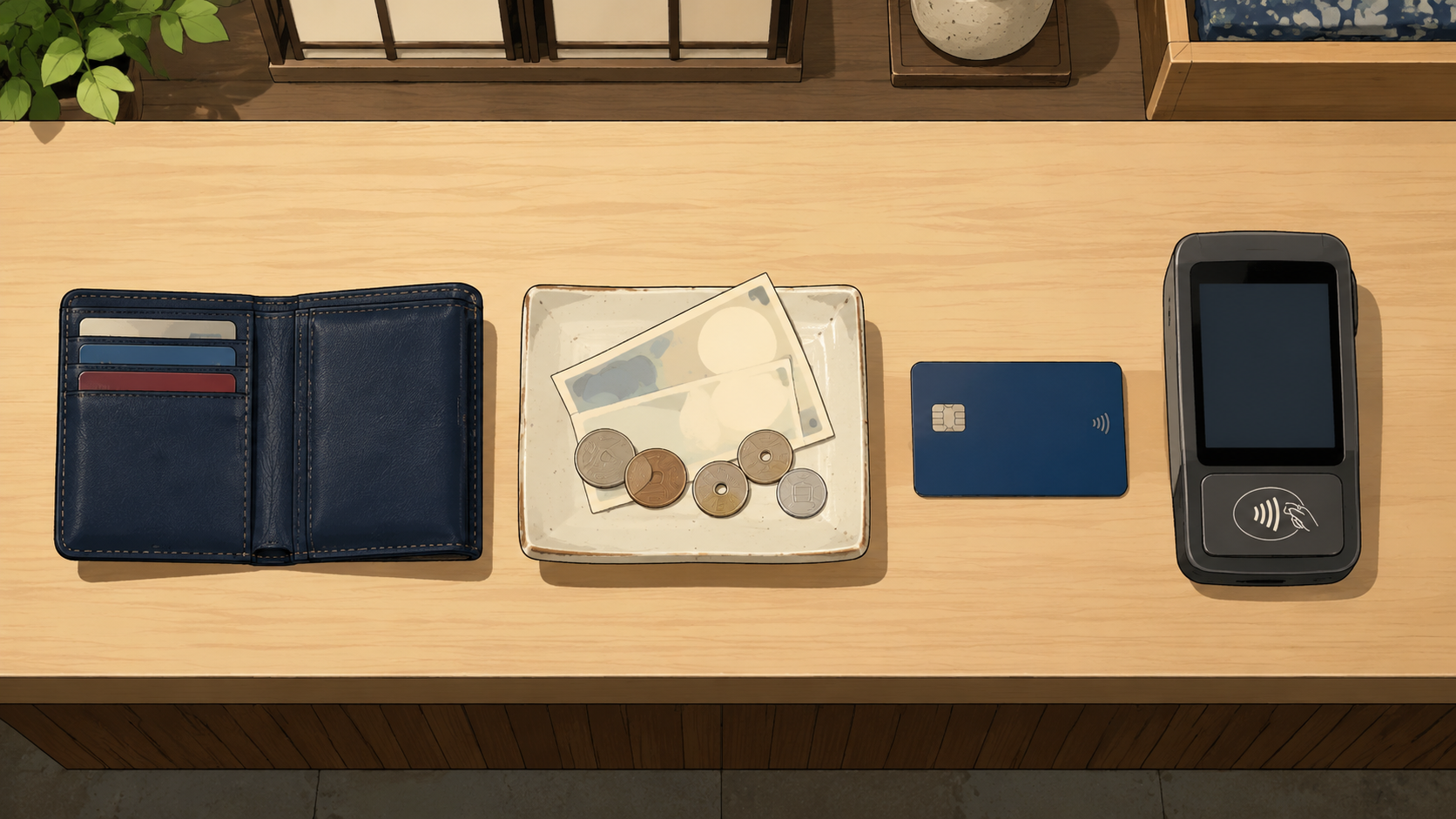
The safest setup is to carry one primary card, one backup card stored separately, some Japanese yen, and an IC transit card. Do not rely entirely on a phone wallet or a single U.S.-issued card.
Best strategy for most visitors: Use a card for larger purchases and places that clearly accept it. Use cash for small local payments and as a backup. Use an IC card for compatible trains, buses, convenience stores, vending machines, and lockers. Check the payment symbols before ordering or entering.
- Cash vs Card in Japan: Quick Comparison
- Do You Still Need Cash in Japan?
- Where Credit Cards Usually Work
- Best ATMs for Foreign Cards in Japan
- Always Choose Japanese Yen at the ATM or Terminal
- How IC Cards Fit Into Your Payment Plan
- Can U.S. Travelers Rely on Apple Pay or Google Pay?
- Hotels, Deposits, and Preauthorizations
- Paying at Restaurants and Small Businesses
- What to Do If Your Card Is Declined
- If Your Card or Cash Is Lost
- A Note From Sho: Payment Problems Usually Come From Assumptions
- Common Payment Mistakes to Avoid
- Frequently Asked Questions
- Official Sources
Cash vs Card in Japan: Quick Comparison
| Payment method | Best for | Main limitation |
|---|---|---|
| Japanese yen | Small shops, local restaurants, rural areas, temples, ticket machines, and emergencies | Loss or theft is difficult to recover |
| Credit card | Hotels, shopping, larger restaurants, attractions, and major transport bookings | Acceptance, foreign transaction fees, and issuer blocks vary |
| Debit card | Purchases and ATM withdrawals when supported | May place a direct hold on your bank balance; fees vary |
| IC card | Local transit and fast small payments | Not accepted everywhere and usually must be loaded in yen |
| Phone wallet | Compatible stores, gates, and services | Foreign cards, devices, and Japanese payment systems may not be compatible |
There is no single payment method that works everywhere. Japan National Tourism Organization (JNTO) recommends carrying cash even as cashless payment becomes more common, especially when traveling outside major cities.
Do You Still Need Cash in Japan?
Yes. You may complete most of a day in central Tokyo, Osaka, or Kyoto without using much cash, but that does not make cash unnecessary. A neighborhood restaurant, rural bus, shrine office, older vending machine, or small admission counter may accept yen only.
Cash is especially useful at:
- Small family-run restaurants and bars
- Local markets and independent shops
- Temples, shrines, donation boxes, and some admission counters
- Rural buses, local trains, and ticket machines outside major networks
- Coin lockers, laundromats, and older vending machines
- Remote ryokan, guesthouses, and campgrounds
- Medical clinics or other places whose card system is unavailable
- Any business experiencing a terminal, network, or power problem
Look for card and electronic-money logos near the entrance or register. If you are unsure, ask before ordering: “Credit card OK?” is widely understood. A displayed card logo is more reliable than assuming that every branch of a chain has identical equipment.
How much cash should you carry?
There is no official amount that suits every traveler. Your destination, accommodation, dining style, and access to ATMs matter more than a universal number.
As a practical starting point, I would personally keep roughly ¥10,000 to ¥20,000 per traveler available, then replenish it when necessary. This is a planning suggestion, not an official requirement. Carry more before a rural day trip or cash-only stay, and less if you will remain near major stations and convenience stores.
Do not keep all of your cash in one wallet. Store an emergency reserve separately from the money you use during the day.
Where Credit Cards Usually Work
Visa, Mastercard, JCB, American Express, and other major networks are accepted at many businesses in Japan. JNTO says international credit, debit, and prepaid cards are generally accepted throughout the country, but acceptance is not universal.
Cards are commonly accepted at:
- Major hotels and many ryokan
- Department stores, malls, and electronics retailers
- Convenience stores and supermarkets
- Chain restaurants, cafés, and fast-food businesses
- Major museums, attractions, and theme parks
- Long-distance rail ticket offices and online booking services
- Airport shops and transportation counters
Even when a card is accepted, the terminal may require a physical chip card and PIN. Contactless payment is growing, but you should not assume every terminal accepts tap-to-pay or every overseas wallet.
Credit card or debit card?
A credit card is often easier for hotel deposits, car rentals, and unexpected expenses because the charge does not immediately remove funds from your checking account. A debit card can work for purchases and cash withdrawals, but a preauthorization or disputed transaction may temporarily reduce the money available in your bank account.
Before departure, check your card agreement for:
- Foreign transaction fees
- ATM withdrawal fees
- Cash-advance fees and interest
- Daily withdrawal and purchase limits
- Whether a travel notice is required
- How to contact the issuer from Japan
Your card issuer controls these fees and limits, not the Japanese store. The Consumer Financial Protection Bureau advises U.S. cardholders to check their agreement because international and currency-conversion fees can apply.
Best ATMs for Foreign Cards in Japan
The most dependable starting points are Seven Bank ATMs and Japan Post Bank ATMs. Both officially support withdrawals using many cards issued outside Japan.
Seven Bank ATMs
Seven Bank operates more than 28,000 ATMs, including machines inside many 7-Eleven stores and at airports, stations, and commercial facilities. Its international-card service supports several major card networks and provides multilingual instructions.
Not every card on a supported network is guaranteed to work. Your issuer may block the withdrawal, impose its own limit, or require a PIN. ATM availability can also depend on the location and operating hours of the building.
Japan Post Bank ATMs
Japan Post Bank ATMs at post offices and other locations accept many overseas-issued cards. Supported networks, service hours, withdrawal limits, and ATM fees can vary. Japan Post Bank also warns that the card issuer may charge a separate fee.
Check the logos displayed on the ATM and your card. If the first machine declines the transaction, do not repeat it many times. Confirm the PIN and card settings, then try a Seven Bank or Japan Post Bank ATM in another location or contact the issuer.
Possible ATM costs
An international cash withdrawal can involve more than one charge:
- A fee charged by the Japanese ATM operator
- A withdrawal fee charged by your bank or card issuer
- A foreign exchange fee or exchange-rate markup
- Cash-advance interest if you withdraw with a credit card
The ATM should show any operator fee before you confirm. Your issuer’s fee may appear only later on your account. Withdrawing a sensible amount fewer times can reduce repeated fixed fees, but do not carry more cash than you can protect.
Important: Withdrawing cash using a credit card may be treated as a cash advance, with a separate fee and interest that can start immediately. Use a debit or ATM card when possible, and confirm the terms before traveling.
Always Choose Japanese Yen at the ATM or Terminal
An ATM or card terminal may offer to convert the purchase into U.S. dollars. This is called dynamic currency conversion (DCC). The offer can look convenient because the amount is familiar, but it may include an exchange-rate markup or additional fee.
Visa’s travel guidance says that declining the conversion and paying in the local currency helps avoid the DCC markup. In Japan, that means choosing JPY or Japanese yen, then allowing your card network and issuer to handle the conversion.
Read the screen carefully. Options such as “with conversion,” “without conversion,” “USD,” and “JPY” can be worded in confusing ways. Confirm that the final currency is JPY before approving the transaction.
This does not eliminate every possible fee. Your own card may still charge a foreign transaction or exchange fee. The goal is to avoid adding the ATM operator’s or merchant’s optional currency conversion on top.
How IC Cards Fit Into Your Payment Plan
Rechargeable IC cards such as Suica, PASMO, ICOCA, and regional equivalents are mainly transportation cards, but they can also pay at many convenience stores, vending machines, lockers, restaurants, and shops displaying an IC or electronic-money logo.
They are useful because one tap can replace coins for small purchases. However, an IC card is not a complete replacement for cash or a credit card.
- Not every train, bus, store, or locker accepts IC cards.
- A physical card may need to be purchased or recharged with cash.
- Cards and mobile versions can have different purchase, refund, and compatibility rules.
- Some services require a separate ticket even when the IC card pays the base fare.
- A high balance is unnecessary if you use the card mainly for transit and small purchases.
JNTO advises travelers to look for the IC logo and notes that the cards work on many, but not all, transportation routes. Treat the IC card as a convenient small-payment tool rather than your emergency money supply.
Can U.S. Travelers Rely on Apple Pay or Google Pay?
No—not as your only payment method. A phone wallet may work at a terminal that accepts the corresponding contactless card network, but Japanese stores also use domestic electronic-money systems that are not automatically compatible with every foreign phone or card.
Apple Pay is especially useful when you separate store payments from transit: a U.S. card in Wallet can tap at compatible EMV contactless terminals, while Suica in Wallet is the better choice for compatible train gates and IC-card purchases. Our complete Apple Pay guide for Japan explains U.S. card acceptance, Suica setup, Express Mode, top-up failures, fees, and the physical backups you should bring.
JNTO warns that smartphone payments may not work when the service is not compatible with foreign smartphones. A physical card can also succeed when the phone wallet fails.
Before relying on a mobile IC card or phone wallet:
- Confirm that your device, region, and card issuer are supported.
- Complete setup before departure rather than at a station gate.
- Carry a physical card and cash backup.
- Keep enough battery for your travel day.
- Do not assume a contactless symbol guarantees compatibility with your wallet.
Hotels, Deposits, and Preauthorizations
A hotel may request the card used for booking, a physical card in the guest’s name, or a deposit at check-in. It may also place a temporary preauthorization to confirm that funds or credit are available.
The release time for a hold depends on the property, payment processor, and card issuer. With a debit card, the hold may reduce the money available in your bank account until it is released. Carrying a separate card for daily spending can prevent a hotel hold from disrupting the rest of your trip.
Confirm payment, passport, and late-arrival requirements in our Japan hotel check-in guide. For a traditional stay, also compare payment and meal arrangements in our ryokan vs hotel guide.
Paying at Restaurants and Small Businesses
At many Japanese restaurants, you receive a bill at the table and pay at the register near the exit. At ticket-machine restaurants, you pay before sitting down. Small bars, food stalls, and older restaurants may accept cash only.
If card acceptance matters, ask before ordering. Do not wait until the end of a large meal to discover that the restaurant accepts only cash. Splitting a bill across several cards may not be possible, especially when the restaurant is busy.
Tipping is not normally expected. Pay the amount shown. Our Japan restaurant etiquette guide covers ordering, payment, allergies, and common mistakes in more detail.
What to Do If Your Card Is Declined
- Stay calm and use your backup. A decline does not necessarily mean the account is empty or compromised.
- Try the physical chip. Insert the card if tap-to-pay fails.
- Check the PIN. Some Japanese terminals require it even when your card usually does not at home.
- Try another card network. The store’s processor may handle one card differently from another.
- Pay in yen. Decline optional home-currency conversion.
- Check your banking app. Look for a fraud alert, travel block, spending limit, or request to approve the transaction.
- Contact the issuer. Use the official number on the card or inside the banking app.
- Use cash if appropriate. Solve the immediate payment first, then investigate in a safe place.
Do not hand your card or banking credentials to a stranger who offers to “fix” it. Staff can explain the terminal or retry the payment, but only your bank should verify your account.
If Your Card or Cash Is Lost
- Freeze or lock the card immediately in the issuer’s app.
- Call the issuer using its official international contact number.
- Review recent transactions and report unauthorized charges.
- Report theft to the local police and keep the report details.
- Contact your travel insurer if the loss may be covered.
- Use the separately stored backup card and emergency cash.
Before departure, save issuer contact numbers somewhere other than the wallet containing the cards. JNTO also recommends keeping card issuer information available so you can report a lost card quickly.
A Note From Sho: Payment Problems Usually Come From Assumptions
From my experience working in restaurants and accommodation management, visitors rarely have a problem because Japan accepts no cards. The more common problem is assuming that one particular card, phone, or payment app must work everywhere.
A small restaurant may have excellent food but only a cash register. A hotel may accept cards but still require the physical card or a deposit. A phone may work perfectly at a convenience store and fail at the next terminal. None of these situations is unusual.
The simple solution is redundancy: card, backup card, yen, and IC card. Check before ordering, keep the backups separate, and withdraw more cash before leaving a major town. That small amount of preparation makes payment almost invisible during the trip—which is exactly how it should feel.
Common Payment Mistakes to Avoid
- Arriving in a rural area with no cash
- Carrying only one card
- Keeping every card and all cash in the same wallet
- Assuming a tap symbol means every foreign phone wallet will work
- Accepting U.S. dollar conversion without checking the exchange rate and markup
- Using a credit card at an ATM without knowing the cash-advance terms
- Repeatedly retrying a declined transaction
- Waiting until after a meal to ask whether the restaurant accepts cards
- Loading an unnecessarily large amount onto an IC card
- Ignoring a hotel’s deposit or physical-card requirement
Frequently Asked Questions
Is Japan cashless in 2026?
Japan has become much more cashless, especially in cities and at larger businesses, but it is not fully cashless. JNTO still advises visitors to carry yen because some places accept cash only.
Which credit card is best for Japan?
A widely accepted Visa or Mastercard with no foreign transaction fee is a strong primary option for many U.S. travelers. Bring a second card from a different account or network when possible. The best card depends on your issuer’s fees, exchange terms, benefits, and support.
Can I withdraw yen with a U.S. debit card?
Usually, if the card and network are supported and the issuer allows international withdrawals. Start with a Seven Bank or Japan Post Bank ATM, check the displayed network logos, and know your PIN. Fees and limits may apply.
Should I exchange dollars before traveling?
It is helpful to arrive with some yen or withdraw it at the airport so you can pay for immediate transport and small expenses. Compare your bank’s exchange rate and fees with the cost of withdrawing in Japan. Avoid relying on a single exchange method.
Should I choose USD or JPY on a card terminal?
Choose JPY. Paying in Japanese yen generally avoids the merchant’s optional dynamic currency conversion markup. Your issuer may still apply its own foreign transaction or currency-conversion fee.
Can I use an IC card instead of cash?
Only in part. IC cards are excellent for compatible transport and small purchases, but not every route, store, or machine accepts them. Keep yen and a regular payment card available.
Do taxis in Japan accept cards?
Many taxis in major cities accept credit cards, IC cards, or app payments, but acceptance varies by vehicle and area. Check the stickers on the door or ask the driver before departure. Carry enough cash for the fare as a backup.
Do I need to tip when paying by card?
No. Tipping is not normally expected in Japanese restaurants, taxis, hotels, or shops. Pay the stated amount unless a specific service charge is clearly disclosed.
Official Sources
- Japan National Tourism Organization: Currency
- Japan National Tourism Organization: Credit Cards
- Japan National Tourism Organization: Cashless Payments in Japan
- Japan National Tourism Organization: Train, Bus, and IC Card Guide
- Seven Bank: ATM Service for Cards Issued Overseas
- Japan Post Bank: International ATM Service
- Visa: Dynamic Currency Conversion
- Consumer Financial Protection Bureau: Using Cards Outside the U.S.
Payment acceptance, ATM fees, card-network support, and issuer rules can change. Check the business, ATM operator, and your card issuer before relying on a specific method.