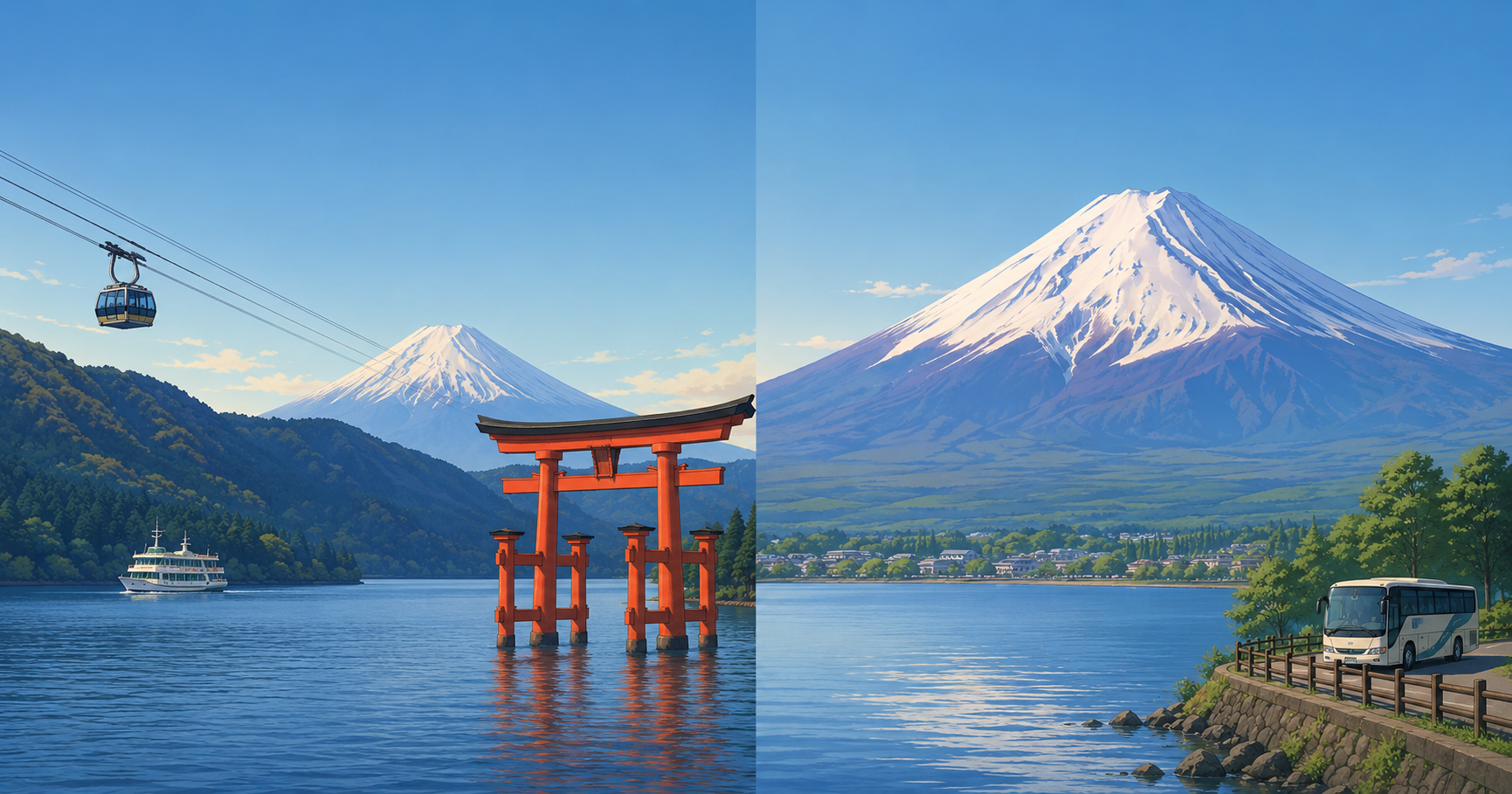
Lake Kawaguchiko is one of the easiest places to visit from Tokyo for a close view of Mount Fuji. You can reach the area in about two hours, travel around the lake by sightseeing bus, and return to Tokyo on the same day.
However, there is one important truth to understand before booking your trip: Mount Fuji is not always visible.
The mountain can disappear behind clouds even when you are standing right beside the lake. Your transport choice, arrival time, and expectations can therefore make a big difference.
This guide explains how to travel from Tokyo to Lake Kawaguchiko, whether to use the highway bus or train, what to see in one day, and how to improve your chances of seeing Mount Fuji.
Transport information and fares in this article were checked on August 25, 2026. Always confirm the latest timetable and fare before traveling.
- Quick Answer: Is Lake Kawaguchiko Worth a Day Trip?
- Where Is Lake Kawaguchiko?
- Tokyo to Kawaguchiko: Bus or Train?
- Option 1: Highway Bus from Shinjuku
- Option 2: Fuji Excursion Train from Shinjuku
- What About Regular Trains?
- How to Get Around Lake Kawaguchiko
- Where Can You Get the Best View of Mount Fuji?
- When Is Mount Fuji Most Likely to Be Visible?
- A Realistic Lake Kawaguchiko Day-Trip Itinerary
- Can You Visit Chureito Pagoda and Kawaguchiko on the Same Day?
- Day Trip or Overnight Stay?
- Common Kawaguchiko Mistakes
- Frequently Asked Questions
- Final Thoughts
- Official Sources
Quick Answer: Is Lake Kawaguchiko Worth a Day Trip?
Yes, Lake Kawaguchiko is a reasonable day trip from Tokyo if you:
- Leave Tokyo early in the morning
- Reserve your transportation in advance
- Limit yourself to two or three main attractions
- Understand that a clear view of Mount Fuji is not guaranteed
If seeing Mount Fuji is the main purpose of your visit, staying one night around the lake gives you a better chance. Morning visibility is generally better, and an overnight stay gives you a second opportunity if the mountain is hidden on your first afternoon.
Where Is Lake Kawaguchiko?
Lake Kawaguchiko is one of the Fuji Five Lakes in Yamanashi Prefecture. It is located north of Mount Fuji and is one of the most developed and accessible destinations in the area.
The lake is officially called Lake Kawaguchi, while the surrounding destination and station are commonly called Kawaguchiko.
From Tokyo, the two simplest options are:
- A direct highway bus from Shinjuku or Shibuya
- The direct Fuji Excursion limited express train from Shinjuku
Tokyo to Kawaguchiko: Bus or Train?
| Option | Approximate Time | One-Way Fare | Best For |
|---|---|---|---|
| Highway bus | About 2 hours, depending on traffic | From ¥2,200 | Lower cost and simple travel |
| Fuji Excursion train | About 1 hour 54 minutes | ¥4,200 | Predictable travel time and comfort |
My simple recommendation: Choose the highway bus if saving money is important. Choose the Fuji Excursion if you are worried about road traffic or prefer traveling by train.
Option 1: Highway Bus from Shinjuku
Direct highway buses run from Shinjuku Expressway Bus Terminal to Kawaguchiko Station. Some buses also stop at Fuji-Q Highland and Fujisan Station.
The current base fare between Shinjuku and Kawaguchiko is ¥2,200 one way. The journey usually takes around two hours, but traffic congestion can make it considerably longer.
Advantages of the highway bus
- Usually cheaper than the direct limited express train
- No transfer is required
- You arrive directly at Kawaguchiko Station
- Luggage can usually be stored in the bus compartment
Disadvantages of the highway bus
- Travel time is affected by road traffic
- Weekend and holiday services can sell out
- Your return to Tokyo may be delayed during busy periods
I strongly recommend reserving both your outbound and return buses before your trip. Do not arrive at Kawaguchiko and assume that any evening bus will have an available seat.
Check availability and make reservations through the official Highwaybus.com website.
Option 2: Fuji Excursion Train from Shinjuku
The Fuji Excursion is a direct limited express train connecting Shinjuku and Kawaguchiko. It does not require a transfer at Otsuki Station.
According to Fujikyu Railway, the journey takes at least 1 hour and 54 minutes. The current one-way fare from Shinjuku to Kawaguchiko is ¥4,200.
Advantages of the Fuji Excursion
- No transfer between Shinjuku and Kawaguchiko
- Less affected by highway traffic
- Comfortable for travelers carrying luggage
- Stops at Shimoyoshida, Fuji-Q Highland, and other useful stations
Disadvantages of the Fuji Excursion
- More expensive than the highway bus
- Popular departures can sell out
- There are fewer departures than regular local train combinations
Fujikyu Railway currently operates four regular round trips per day, with some additional seasonal services. Check the latest timetable and ticket information on the official Fuji Excursion page.
What About Regular Trains?
You can also take a JR train from Tokyo to Otsuki Station and transfer to the Fujikyu Railway Line for Kawaguchiko.
This option may be useful when the direct train and highway buses are sold out. However, it takes longer and requires at least one transfer.
Be careful at Otsuki Station. The JR line and Fujikyu Railway are operated by different companies, so make sure you follow signs for the Fujikyu Railway transfer.
How to Get Around Lake Kawaguchiko
Lake Kawaguchiko is larger than it may appear on a map. Walking from Kawaguchiko Station to every major attraction is not realistic for most day-trip visitors.
The easiest option is the sightseeing bus network departing from Kawaguchiko Station.
The Red Line serves many popular locations around Lake Kawaguchiko, including:
- Mt. Fuji Panoramic Ropeway
- Lake Kawaguchiko sightseeing boat area
- Kawaguchiko Museum of Art
- Oishi Park
- North-shore viewing areas
Day passes may be available, but whether one saves money depends on how many times you plan to ride. Check the current route, timetable, and pass conditions at Kawaguchiko Station.
Buses can become crowded during cherry blossom season, autumn foliage season, weekends, and Japanese public holidays. Leave additional time before your reserved return train or highway bus.
Where Can You Get the Best View of Mount Fuji?
Oishi Park
Oishi Park is located on the northern side of Lake Kawaguchiko and offers a wide view across the lake toward Mount Fuji.
It is particularly popular when seasonal flowers are in bloom. However, you do not need flowers to enjoy the view. On a clear morning, the combination of the lake and mountain is already impressive.
Lake Kawaguchiko North Shore
The north side of the lake generally provides some of the classic views of Mount Fuji rising behind the water.
If the sky is clear when you arrive, I recommend going to the north shore early instead of saving it until late afternoon.
Mt. Fuji Panoramic Ropeway
The ropeway is around a 15- to 20-minute walk from Kawaguchiko Station. You can also reach it using the Red Line sightseeing bus.
The observation area provides views of Lake Kawaguchiko and Mount Fuji when the weather is clear. Expect queues during busy periods.
Check current operating information before visiting, especially during strong winds or bad weather. More access information is available from the Japan National Tourism Organization.
When Is Mount Fuji Most Likely to Be Visible?
Generally, early morning provides a better chance of seeing Mount Fuji. Clouds and haze often build as the day continues.
Clear winter days usually provide the best visibility. Mount Fuji is more frequently hidden during the rainy season, which normally lasts from early June until around mid-July.
That does not mean the mountain is always visible in winter or always hidden in summer. Weather around Mount Fuji changes quickly, and no month offers a guarantee.
Check the weather forecast and live cameras on the morning of your trip, but remember that forecasts are not perfect.
If Mount Fuji is clearly visible when you arrive, take your photos first. Do not think, “I’ll do it later.” Fuji has a habit of disappearing while you are eating lunch.
A Realistic Lake Kawaguchiko Day-Trip Itinerary
This itinerary focuses on the lake and Mount Fuji views without trying to squeeze every attraction into one day.
7:00–8:00 a.m.: Leave Shinjuku
Take an early highway bus or Fuji Excursion train. The earlier you arrive, the better your chance of seeing Mount Fuji before clouds form.
9:00–10:00 a.m.: Arrive at Kawaguchiko Station
If Mount Fuji is visible, go directly to Oishi Park or another north-shore viewpoint.
If the mountain is already hidden, do not panic. Clouds may move, although there is no guarantee that they will.
10:00–11:30 a.m.: Oishi Park and the North Shore
Walk around the lakeside, take photographs, and enjoy the view without rushing straight back onto the bus.
12:00 p.m.: Lunch
Try a local dish such as hoto, a Yamanashi noodle dish served with vegetables in a thick miso-based soup.
Popular restaurants can have long lines, so consider eating slightly before or after the standard lunch period.
1:00–3:00 p.m.: Choose One Main Attraction
Select one of the following:
- Mt. Fuji Panoramic Ropeway
- Lake Kawaguchiko sightseeing boat
- A lakeside museum
- A day-use hot spring
- A relaxed walk and café visit
Trying to visit all five will turn the day into a transport exercise instead of a holiday.
4:00–5:00 p.m.: Return to Tokyo
Arrive at Kawaguchiko Station early enough to find your platform, collect stored luggage, buy refreshments, and board your reserved service.
Allow extra time when using local buses because congestion around the lake can cause delays.
Can You Visit Chureito Pagoda and Kawaguchiko on the Same Day?
Yes, but it makes the day considerably busier.
Chureito Pagoda is located near Shimoyoshida Station, not beside Lake Kawaguchiko. Some Fuji Excursion trains stop at Shimoyoshida, making it possible to visit the pagoda before continuing to Kawaguchiko.
However, the park involves uphill walking and many steps. During cherry blossom season, the area can also be extremely crowded.
If you want time to enjoy the lake, ropeway, lunch, and Chureito Pagoda without constantly checking the clock, staying overnight is the better choice.
Day Trip or Overnight Stay?
| Choose a Day Trip If… | Stay Overnight If… |
|---|---|
| You have limited time in Japan | Seeing Mount Fuji is a major priority |
| You only want two or three attractions | You want early-morning views |
| You prefer returning to your Tokyo hotel | You want to enjoy an onsen or ryokan |
| The forecast looks clear | You want to explore more than one Fuji Five Lake |
An overnight stay does not guarantee a clear mountain, but it gives you more than one viewing opportunity.
If you stay at a Japanese accommodation, our Japan hotel check-in guide explains what identification, payment, and arrival information you may need.
Common Kawaguchiko Mistakes
Booking only the trip from Tokyo
Reserve your return transportation as well. Evening buses and trains can sell out, especially on weekends and holidays.
Arriving around noon
A late arrival reduces both your sightseeing time and your chance of a clear morning view.
Planning too many attractions
Kawaguchiko Station, Oishi Park, Chureito Pagoda, Oshino Hakkai, and the Mount Fuji 5th Station are not all in one compact area.
Choose one geographic area rather than trying to collect every famous photograph in a single day.
Standing in the road for a photograph
Some Mount Fuji photo locations are located near residential streets and working businesses. Do not block traffic, enter private property, or stand in the road.
A beautiful photograph is not worth creating a dangerous situation for residents.
Assuming Mount Fuji will appear later
If the mountain is visible, photograph it first. Clouds can cover it surprisingly quickly.
Frequently Asked Questions
Can I use an IC card in the Kawaguchiko area?
IC cards can be used for some train and bus services, but acceptance depends on the operator and ticket type. Reserved highway buses and limited express trains still require the appropriate reservation or ticket.
Carry some Japanese yen as a backup, especially when using smaller local services.
Do I need to reserve the highway bus?
Advance reservations are strongly recommended. A reservation is particularly important for weekends, public holidays, cherry blossom season, autumn foliage season, and your return journey to Tokyo.
Is Kawaguchiko the same as Mount Fuji 5th Station?
No. Kawaguchiko is a lake and sightseeing area north of Mount Fuji. The Fuji Subaru Line 5th Station is partway up the mountain and requires a separate bus journey.
Can I climb Mount Fuji from Kawaguchiko?
Kawaguchiko is commonly used as a transport base, but climbing Mount Fuji is a separate activity requiring proper equipment, planning, and compliance with seasonal trail rules.
Do not treat a Mount Fuji climb as an extension of a casual lake day trip.
Is Lake Kawaguchiko worth visiting if Mount Fuji is hidden?
It can still be enjoyable, especially if you are interested in hot springs, museums, cafés, seasonal flowers, or simply spending time beside the lake.
However, if your only goal is photographing Mount Fuji, a completely cloudy day may be disappointing. It is better to be honest about that before you spend several hours traveling.
Final Thoughts
Lake Kawaguchiko is one of the most practical Mount Fuji destinations from Tokyo, but a successful day trip requires a little planning.
Leave early, reserve your return transportation, avoid overcrowding your itinerary, and take your Mount Fuji photographs as soon as the mountain appears.
Most importantly, remember that this is a real town where people live—not an outdoor photography studio. Respect local roads, private property, and other visitors while enjoying the view.